
Army chief urges unity, warns against extremism as Shia ulama back state efforts for peace, stability
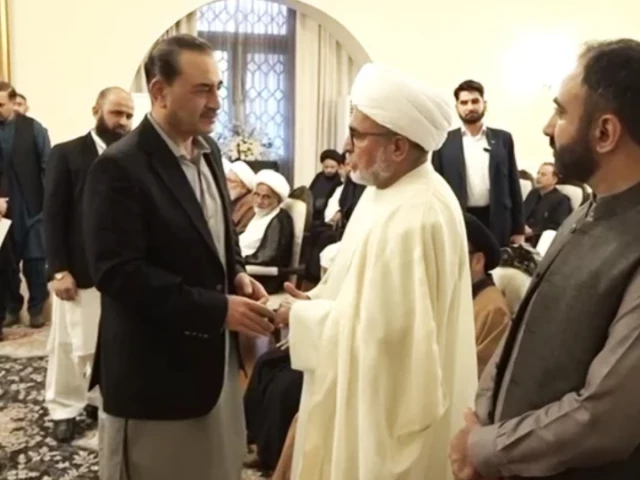
Chief of Defense Forces (CDF) Field Marshal Asim Munir interacts with a religious scholar during his meeting with the Ulema of Ahl-e-Tasheeh community in Rawalpindi PHOTO: ISPR
Chief of Defense Forces (CDF) and Chief of Army Staff (COAS) Field Marshal Asim Munir has said that violence in Pakistan caused by incidents in other countries will not be tolerated.
He made these remarks during a meeting with ulama and religious scholars of the Shia community in Rawalpindi, where national security, social harmony and the role of religious leaders were discussed, according to a statement issued by the army’s media wing, Inter-Services Public Relations (ISPR).
The army chief highlighted the important role of ulama in promoting unity, tolerance and national cohesion, particularly in combating misinformation, sectarian narratives and externally sponsored destabilization efforts.
Munir briefed the participants about Pakistan’s diplomatic efforts aimed at reducing tensions in the region and stressed that religious sentiments should not be exploited to incite violence. “Violence in Pakistan, based on incidents in another country, will not be tolerated,” he said.
The participating ulama expressed their desire for peace and stability and strongly condemned the violence carried out in the name of religion. They also reaffirmed full support to law enforcement agencies to maintain peace and stability across the country, the ISPR statement said.
Referring to Operation Ghazab lil-Haq, Munir emphasized that Pakistan would not tolerate the use of Afghan soil for terrorism against its people. He reiterated the determination to eliminate terrorists and their infrastructure through precise intelligence-based operations wherever they operate.
The army chief also stressed that the Afghan Taliban must prevent the use of Afghan territory for attacks against Pakistan.
Religious scholars issued messages reaffirming national unity and solidarity at the conclusion of the meeting. They paid tribute to the sacrifices of the martyrs and appreciated the role of Pakistan’s armed forces in reducing regional tensions.
Read: DG ISPR dismisses ‘ridiculous’ Afghan claim of attacking drug rehabilitation centre, says Pakistan attacked ammunition storage site
Maulana Zahid Abbas Kazmi said that as president of Wahdat Ulema-e-Islam, the organization stood “shoulder to shoulder” with the Pakistan Army on all fronts.
“The war against terrorism is not only the war of Pakistan’s armed forces but also ours and the entire nation,” he said, adding that love for one’s homeland was part of faith.
He also condemned the damage to military properties in Gilgit-Baltistan, saying such items had no connection with religious scholars.
Ulema of Ahl-e-Tasheeh community during their meeting with Chief of Defense Forces (CDF) Field Marshal Asim Munir in Rawalpindi PHOTO: ISPR
Allama Shabbir Hassan Maysami said that Pakistan was their country and they would continue to make sacrifices for it, adding that they strongly supported the State against all internal and external conspiracies.
Maulana Altaf Hussain said Pakistan’s army had given a strong and effective response to what he described as unprovoked aggression by Afghanistan, adding: “We are Pakistanis; our identity is Pakistan alone, and we are proud of it.”
He said a decision had been taken at his center that 20 people from each village would join Pakistan’s armed forces if necessary.
Allama Arif Wahidi described Pakistan as a source of pride for the Muslim world and a divine blessing achieved on the 27th of Ramazan. He said the entire nation stood with the armed forces against external aggression and emphasized that Pakistan’s sovereignty remains paramount.
Read more: CDF Munir says all necessary measures must be taken to neutralize the threat from the Afghan border
Allama Mirza Ali urged the youth not to take part in anti-state activities and to play a positive role in national stability.
Allama Nazir Abbas Taqvi said that groups he referred to as “Fitna al-Khawarij” and “Fitna al-Hindustan” were involved in terrorist incidents in Pakistan, while Allama Tauqeer Abbas reaffirmed his support for the armed forces to safeguard the integrity of the country.
Allama Muhammad Hussain Najafi said protecting Pakistan was essential to safeguard Muslims and Islam, and urged citizens to never allow the country to weaken.
Maulana Basharat Imami paid tribute to the martyrs who made lasting sacrifices in defense of the motherland, while the scholars offered collective prayers for national security, stability and elevation of the ranks of the martyrs.


