
Web3 has always been cyclical, but it has never stopped building. Markets recover and retreat, narratives rotate and evolve, but founders continue to launch products and seek their moment to be seen.
In an ecosystem where the launch of a protocol or token can happen quickly, standing out is more difficult than ever. That’s where CoinDesk PitchFest found its role within Consensus.
CoinDesk PitchFest does not replace due diligence or guarantee funding. What it offers is structured exposure to investors, operators and ecosystem leaders who are actively shaping the industry. In recent years, judges have included representatives from Dragonfly, Fabric Ventures, CoinFund, Borderless Capital, The Spartan Group and Outlier Ventures, firms that have backed some of Web3’s biggest companies.
For early-stage founders, that kind of space is important.
Progress beyond the stage
At Consensus Austin 2023, Rise presented a clear proposition: compliant global payroll and payment pathways for distributed teams operating in fiat and crypto currencies. The company addressed a practical challenge facing Web3-native companies navigating cross-border employment.
Since then, Rise has expanded support to over 90 local currencies and 100 cryptocurrencies, strengthened its compliance capabilities, and secured initial funding. Consensus was not an end point; It was an early platform in a longer growth trajectory.
That same cohort introduced Neuromesh, which then pivoted and re-emerged as AMMO AI, leaning even further into the AI x Web3 intersection. Semifinalist Nodepay has continued to develop its decentralized computing ambitions and expand within its ecosystem. Early exposure often speeds refinement.
At Consensus Hong Kong 2025, TransCrypts won PitchFest with its digital identity and fraud mitigation platform. As AI-driven phishing risks gained attention, the company surpassed that stage and reached a major milestone by closing a $15 million seed round led by Pantera Capital.
Consensus Toronto 2025 featured ChainPatrol, focused on AI-powered phishing detection and brand protection. While not defined by flashy ads, the company continues to operate across multiple ecosystems, addressing security challenges that become more complex as platforms scale.
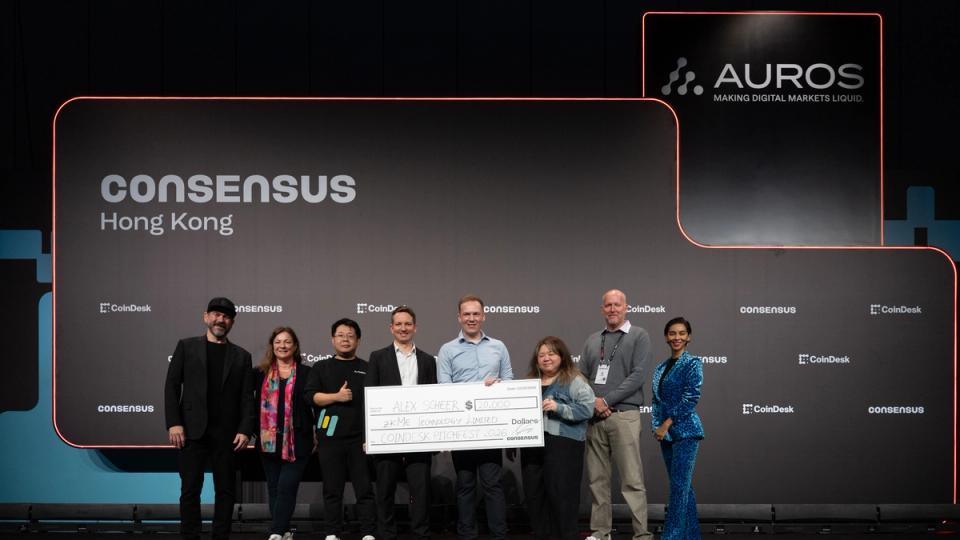
Most recently, zkMe Technology won PitchFest at Consensus Hong Kong 2026 with its zero-knowledge identity verification framework. zkMe had previously closed a $4 million funding round in 2024, reflecting early confidence in privacy-preserving compliance systems. Finalists including Coinbax, Onchain Labs and Hubble AI demonstrated the variety of ideas competing for attention in Hong Kong.
Among these groups, sectors differ (fintech rails, AI integration, identity systems, fraud mitigation, decentralized computing), but the opportunity remains constant: a curated environment where investors are listening.
Where exposure becomes momentum
Web3 is still crowded. The tools to get started are accessible; Credibility is harder to earn. Breaking through often requires more than a white paper or a strong online community. It requires direct access to decision makers who can evaluate the substance.
Consensus brings together early-stage founders, venture investors, exchanges, infrastructure providers, institutional participants and media in one place. Within that ecosystem, CoinDesk PitchFest provides a defined stage for early-stage teams to pitch clearly and competitively.
The scenario does not build the company; founders do it, but the right audience can accelerate progress.
A new layer: agent trading and sole proprietorship start-up
In addition to the main competition, Consensus Miami will feature a new CoinDesk PitchFest “side mission” that explores early signals on the edge of agent trading.
A different type of founder is starting to emerge: building with AI agents, emerging protocols like open clawand experimental payment standards such as x402. What once required equipment and capital can now, at least in the early stages, be launched, tested and in some cases monetized by a single operator.
These are not traditional startups. They’re fast, limited, and increasingly capable, from agent-powered tools to pay-per-call APIs designed to transact as easily with machines as they do with users. In some cases, products reach revenue in a matter of weeks, compressing the path from idea to market to a level that was previously unattainable.
It’s still early. The tools are evolving, standards have not yet been established, and most of these experiments will not scale. But the trajectory is clear and the pace is accelerating.
For CoinDesk PitchFest, this presents an opportunity to engage with the category as it forms, rather than after it matures. The “side mission” is designed to expose these builders before they resemble venture-backed companies, and to understand which of these early experiments remain niche and which are beginning to take on the characteristics of infrastructure.
If the last cycle was defined by protocols, the next one may be determined by what is built on top of them, smaller, faster and increasingly autonomous.
Consensus Miami is where that change begins to stand out.
Looking towards consensus in Miami
Consensus Miami 2026 will once again bring together the entire spectrum of the industry. For startups under five years old with less than $5 million in funding, PitchFest offers a convenient entry point into that broader market.
Provides exposure to active investors, commentary from experienced traders, and visibility through CoinDesk’s global platform. For some teams, it will validate years of work. For others, it will open conversations that will define their next chapter.
Web3 continues to move quickly. Founders who want to shape their future need rooms where serious business is done.
Consensus Miami is one of those rooms. CoinDesk PitchFest is where the next wave of builders advances.


