
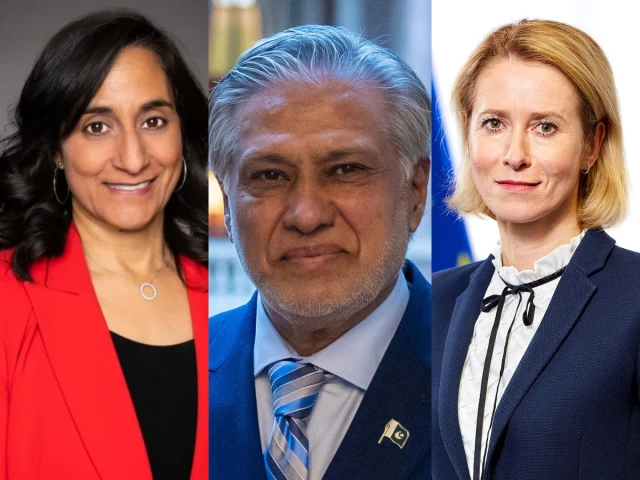
In separate phone calls, EU and Canada agree to maintain close contacts with Pakistan
Canadian Foreign Minister Anita Anand (L), Foreign Minister Ishaq Dar (M) and European Union Vice President Kaja Kallas (R).
European Union Foreign Policy Chief Kaja Kallas and Canadian Foreign Minister Anita Anand praised Pakistan’s role in facilitating peace efforts between the United States and Iran during separate phone calls with Deputy Prime Minister and Foreign Minister Ishaq Dar, according to the Ministry of Foreign Affairs.
During his call with the EU foreign policy chief, Dar “appreciated the regular and close contact between Pakistan and the EU during the current regional situation” and briefed him on the developments of the recently held talks in Islamabad.
Senator Mohammad Ishaq Dar of DPM/FM @MIshaqDar50 received a phone call from the EU vice-president for human rights @kajakallas.
DPM/FM appreciated the regular and close contact between Pakistan and the EU during the current regional situation. He shared the developments regarding the talks held recently in Islamabad… pic.twitter.com/rK5aj5fOqs
— Ministry of Foreign Affairs – Pakistan (@ForeignOfficePk) April 14, 2026
According to the statement, Kaja “praised Pakistan’s constructive role in facilitating direct negotiations between the United States and Iran in Pakistan.” Both sides “emphasized the need for continued dialogue and diplomacy for the resolution of the conflict.”
The two leaders also “positively assessed the growing cooperation between Pakistan and the EU and agreed to maintain close contact on all issues of mutual interest.”
In a separate call with the Canadian foreign minister, Dar “exchanged views on recent developments, including the negotiations between the United States and Iran held during the Islamabad talks.”
Anita “appreciated Pakistan’s role in facilitating dialogue,” the foreign ministry said. “Underlining the importance of all parties adhering to a ceasefire,” Dar reaffirmed Pakistan’s commitment to “continue its support for dialogue and diplomacy.”
Deputy Prime Minister/Minister of Foreign Affairs, Senator Mohammad Ishaq Dar @MIshaqDar50spoke last night with Canadian Foreign Minister Anita Anand. @AnitaAnandMPto exchange views on recent developments, including the negotiations between the United States and Iran held during the Islamabad talks.… pic.twitter.com/LPF8q2BZyZ
— Ministry of Foreign Affairs – Pakistan (@ForeignOfficePk) April 14, 2026
Both ministers agreed to remain in close contact on issues of mutual interest, the statement concluded.
The calls came two days after the United States and Iran were unable to reach a deal to end their war despite marathon negotiations that lasted about 21 hours.
The protracted talks, aimed at stopping hostilities that have killed thousands of people and sent global oil prices soaring over the past six weeks, ended with both sides blaming each other for the stalemate.
Also read: The United States and Iran could give diplomacy a second chance
The Iranian delegation was led by President Bagher Ghalibaf and assisted by Foreign Minister Abbas Araghchi, while the American delegation was led by Vice President JD Vance, along with Special Envoy Steve Witkoff and Jared Kushner.
The United States and Israel launched a joint offensive against Iran on February 28, killing thousands of people in Iran, including then-Supreme Leader Ayatollah Ali Khamenei, and leaving tens of thousands injured, including civilian areas, including residential buildings and religious sites.
The conflict also expanded geographically. Iran retaliated with drone and missile attacks against Israel, as well as Jordan, Iraq and Gulf countries hosting US military assets. It also restricted the movement of ships through the Strait of Hormuz.


