
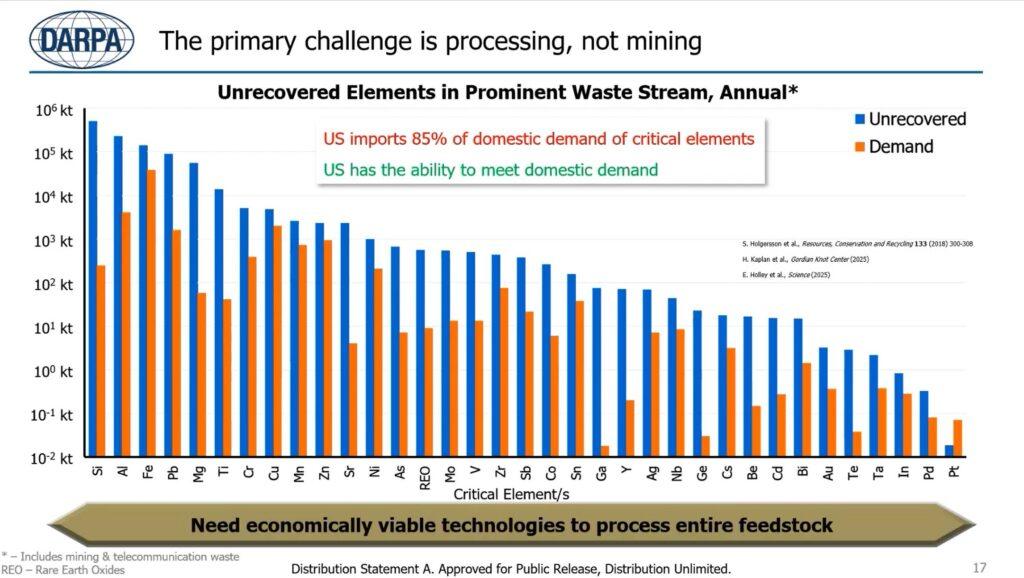
- US targets processing bottleneck rather than seeking new rare earth deposits
- The concept of parallel extraction seeks profitability despite higher labor and environmental costs at the national level
- Distributed processing model attempts to reduce dependence on single vulnerable mining sites
China is responsible for much of the world’s rare earth refining capacity, giving it control over supply chains during trade disputes. That advantage was built by managing the expensive and complicated processing stage at scale, often with lower costs and fewer environmental restrictions.
The United States has been trying to rebuild its rare earth supply chain for years, but mining alone has not solved the core problem. Processing remains the sticking point and, as Data center dynamics reports, that’s where the Defense Advanced Research Projects Agency is making a high-risk bet.
Rare earth elements are not, as the name suggests, truly rare, and the United States already has access to large volumes of the mineral. DARPA’s new Smash program moves away from searching for new repositories and toward solving the processing bottleneck.
Article continues below.
Look
Almost zero waste separation
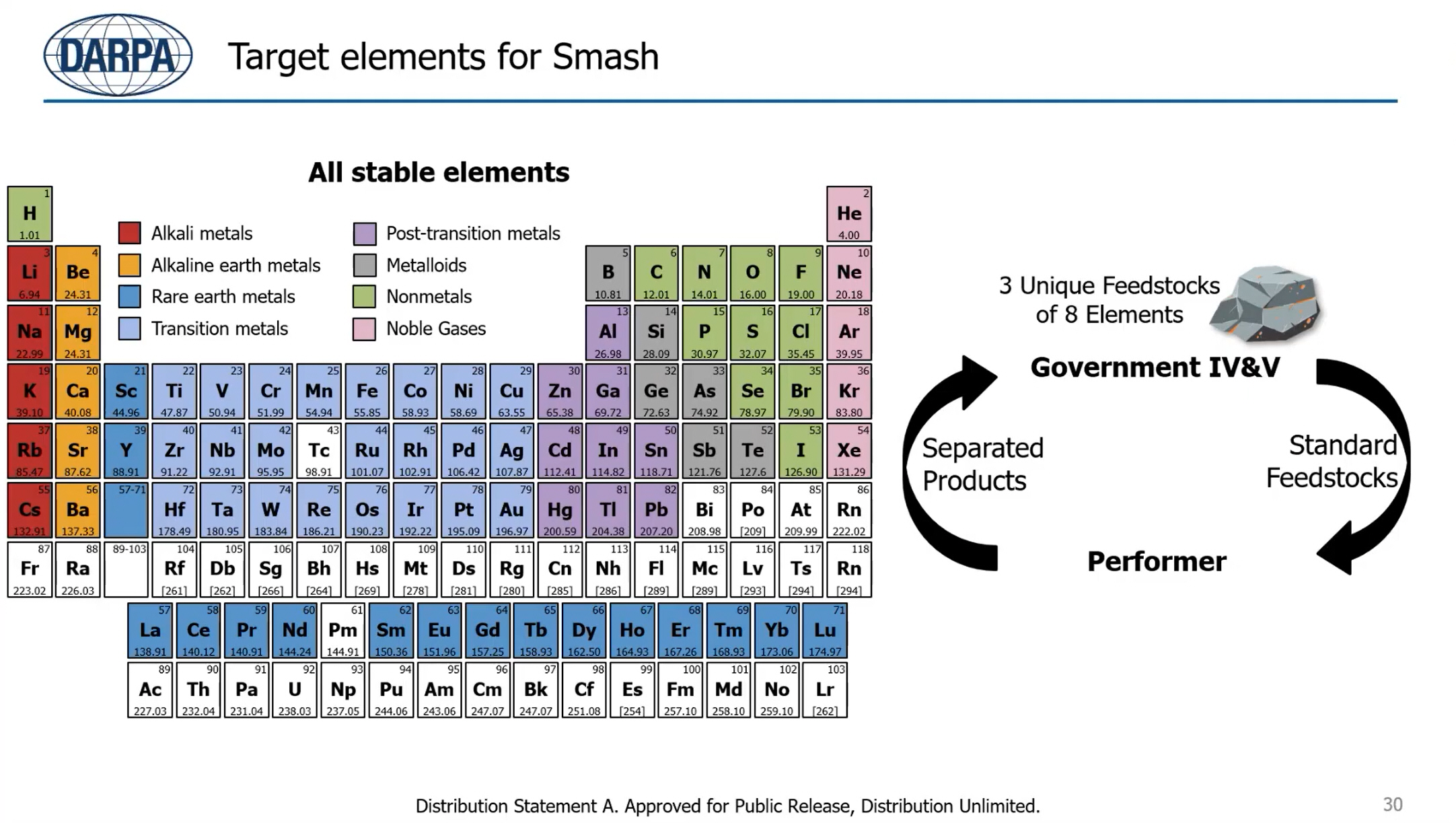
DARPA’s approach focuses on what it calls near-zero residue separation across the periodic table. The target is not just rare earth elements, but up to 80 stable elements that could be recovered from existing mineral and waste streams.
“So the challenge is processing, not mining,” said Julian McMorrow, Smash lead and program manager at DARPA’s Microsystems Technology Office. “We want to develop technologies so that the industry goes from wasting more than 99 percent of its raw materials to using all the raw materials.”
Traditional mining wastes huge amounts of material during refinement. More than two tons of ore and 13 tons of water can produce just one kilogram of copper, leaving most of the original material wasted.
Smash explores a parallel processing model that attempts to extract almost everything from a shovel of dirt at once. That concept borrows ideas from industries like oil refining, where multiple products are efficiently separated from a single input.
The program also reflects concerns about relying on a single major site, such as the Mountain Pass mine, which once dominated global rare earth production but ran into trouble when refining costs became uncompetitive.
DARPA notes that concentrating production in one location creates vulnerability if disruptions occur. A distributed model that uses varied raw materials, including mining waste and recycled materials, could reduce that exposure.
Smash will run as a 48-month effort divided into two phases. The first will focus on proof-of-concept experiments, while the second will progress towards functional prototypes suitable for industrial mining environments.
Even if the technology is successful in laboratory settings, scaling it up economically could be difficult. Achieving profitability while maintaining strict environmental and labor standards will be the true test.

Follow TechRadar on Google News and add us as a preferred source to receive news, reviews and opinions from our experts in your feeds.


