
It warns that any disruption to the ocean could significantly affect global supply chains and energy prices.
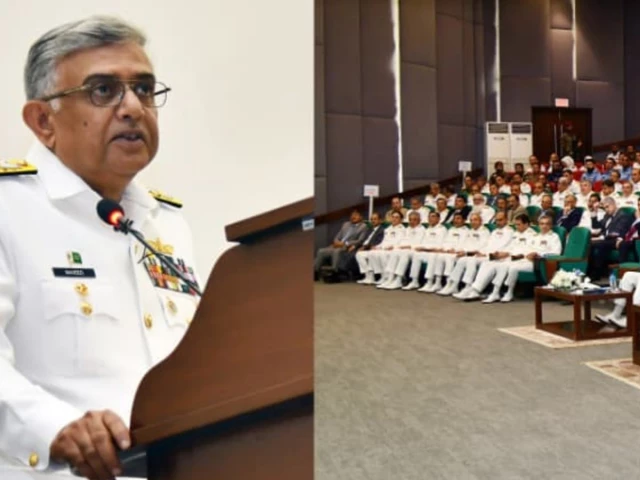
Chief of Naval Staff Admiral Naveed Ashraf, as chief guest, addresses an international conference emphasizing collaboration between industry, academia and end-users to promote innovation, indigenization and self-reliance. Photo:
Chief of the Naval Staff Admiral Naveed Ashraf said on Thursday that the future of warfare is being shaped in the Indian Ocean because of its enormous contribution to global trade, and warned that any disruption could significantly affect global supply chains and energy prices.
According to a statement issued by Inter-Services Public Relations (ISPR), the naval chief made these remarks at the conclusion of a two-day international conference titled ‘Emerging Technologies and Future Warfare’, organized by the Maritime Center of Excellence (MCE) in Karachi, where he attended as chief guest.
The conference aimed to bring together maritime experts, academics and defense industry representatives to discuss the evolution of geostrategic trends and the impact of technology on modern warfare.
A two-day international conference on emerging technologies and future warfare, organized by the Maritime Center of Excellence, culminated in Karachi, bringing together maritime experts, academicians and defense industry representatives on a single platform. 1/2 pic.twitter.com/NkU4A7kXm7
— DGPR (Navy) (@dgprPaknavy) April 23, 2026
Addressing the participants, Admiral Ashraf underlined the importance of close collaboration between industry, end users and academia to drive innovation, adaptability and operational relevance.
“Such collaboration would promote indigenization and self-reliance, helping to build a cost-effective and globally competitive defense ecosystem for Pakistan with export potential,” he said.
Read: Pakistan Navy Deterrence: Neutralizing Indian Signals
Highlighting the strategic importance of the Indian Ocean, he reiterated that the region was critical to global trade flows and warned that any disruption could have far-reaching consequences for economies linked to it.
The conference also highlighted the increasingly blurred lines between civil and military applications of advanced technologies, noting that this trend presented opportunities and challenges for Pakistan’s defense ecosystem. Participants discussed how rapid technological advances were transforming warfare by reshaping operational concepts, force structures, and outcomes.
The event was attended by senior military commanders, policy makers, diplomats, academics, industry experts and students from various universities.
He concluded with a reaffirmation of the need for sustained intellectual collaboration to effectively navigate technology-driven transformations and take advantage of future trends in warfare.
Earlier this year, the Pakistan Navy conducted a “Passage Exercise” with a Royal Omani Navy ship, KHASAB, involving a flotilla consisting of sailboats and a Pakistan Maritime Security Agency vessel.
A day later, the navy carried out a comprehensive exercise in the North Arabian Sea, testing surface-to-air missiles, loitering munitions and an unmanned surface ship, the ISPR said.
Last year, during hostilities between Pakistan and India in May, the Pakistan Navy said it had prevented the Indian Navy’s aircraft carrier INS Vikrant from undertaking any maritime action in the North Arabian Sea through a coordinated strategy.
“Pakistan Navy not only restricted Indian Navy to its own waters but also ensured security of maritime trade routes and coastal regions of Pakistan,” the officials had said. The express PAkGazette.
Prime Minister Shehbaz Sharif also praised the Pakistan Navy for its preparedness and professionalism, stating that the naval forces were fully prepared to launch an operation similar to the historic Operation Dwarka. However, he said the Indian Navy avoided confrontation after witnessing adequate response by Pakistan’s ground and air forces.


