Early detection and community mobilization remain critical to saving lives as potential treatments and vaccines are still being evaluated, the UN health agency said on Friday.
Since May 15, UN agencies have been supporting both the Democratic Republic of the Congo and neighboring Uganda to contain the outbreak caused by the rare Bundibugyo strain of the Ebola virus, which spreads through close contact.
“It is a disease that you contract when you take care of someone, your husband, your partner, your child or your mother,” Anaïs Legand, a WHO technical officer, told reporters in Geneva.
“You get it when you want to help someone who has symptoms, and this is terrible.”he said, explaining that Families and friends should be instructed not to touch loved ones who are getting sick..
30 to 50 percent chance of death
Ms. Legand highlighted the critical importance of prevention and early access to care, in the face of this particularly deadly disease. According to previous outbreaks, the fatality rate “ranges between 30 and 50 percent,” he said, “it’s huge.”
While “five in 10 people are likely to die,” more can be done to promote recovery, according to the WHO expert.
“We can expand optimized intensive care,” he said. “We can help communities recognize symptoms early to get an early diagnosis, so they can receive the level of care they need.”
Experience shows that Ebola outbreaks can only be controlled when communities are “fully involved” in the response, Ms Legrand insisted, highlighting a recent case in the Democratic Republic of the Congo where a patient made a full recovery and was discharged from hospital.
detective work
The WHO has brought together experts to review potential treatments and vaccines against the virus, and several products have now been identified for further evaluation.
For confirmed cases, Three candidate therapies have been prioritized for treatment in clinical trials.revealed Ms. Legand: the monoclonal antibodies MBP 134 and maftivimab, and the antiviral remdesivir.
A shipment of essential medical supplies for the Ebola response arrives at Bunia airport, in Ituri province, Democratic Republic of the Congo.
For prevention, the oral antiviral obeldesivir is being prioritized within a clinical study as a post-exposure measure for those who have been in contact with confirmed cases.
The WHO expert added that two vaccine candidates have been identified for evaluation once doses are available.
The agency is working closely with the governments of the Democratic Republic of the Congo and Uganda while “urgently increasing care capacities.”
Access problem
“This outbreak occurs in a very complex context,” he stressed, recalling that In the affected province of Ituri alone, 1.2 million people are in need of humanitarian assistance, while ongoing conflict and food insecurity are hampering the response..
“The problem we have on the ground is not necessarily a resource problem,” Ms. Legand insisted. “It’s a question of access.”
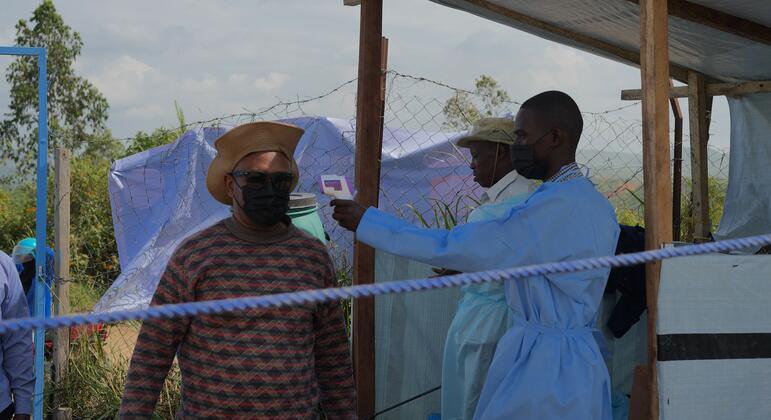
The airport in Bunia, the capital of Ituri province, has been closed and, although the government of the Democratic Republic of the Congo has allowed humanitarian flights to take place, operational limitations remain. “One day I received a call from my team telling me that there is no fuel.“said the WHO expert.
Tedros on the ground
WHO chief Tedros Adhanom Ghebreyesus arrived in the Democratic Republic of Congo on Friday and told reporters in the capital, Kinshasa, that he was there to show that the community “is not alone.”
He called on the multiple armed groups operating with impunity in the war-torn eastern region to declare a ceasefire so that health workers can reach people in need and stop the spread of the disease.
The Democratic Republic of the Congo notified WHO of an outbreak of Bundibugyo virus disease on May 15 and as of Thursday, 125 confirmed cases, including 17 deaths, had been reported in the provinces of Ituri, North Kivu and South Kivu.
Besides, There are 906 suspected cases under investigation, including more than 223 deaths. and are being reviewed as testing capacity improves.
In Uganda, there were seven confirmed cases as of Thursday, including one death. The WHO said there is no evidence of community transmission in the country at this time.
No travel restrictions for now
While it indicates that people from affected areas who may have been exposed to Ebola should not travel, The UN health agency does not recommend any restrictions on travel or trade with the Democratic Republic of the Congo or Uganda based on current information..
The Rwampara General Referral Hospital in Ituri Province, Democratic Republic of the Congo.