
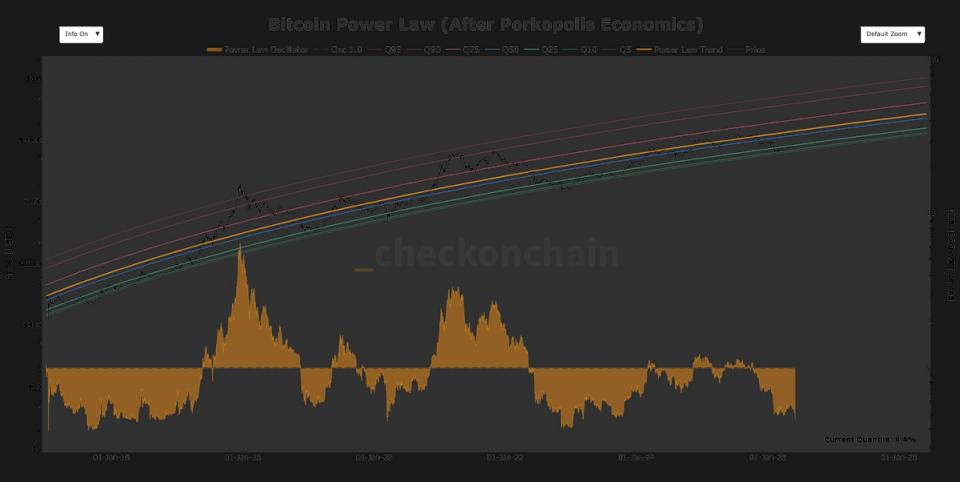
After briefly falling below $66,000 on Wednesday, bitcoin it trades near the bottom of the Energy Act corridor, a level it has historically reached shortly before rebounds in the price of the largest cryptocurrency.
The model, popularized by physicist Giovanni Santostasi and refined by Porkopolis Economics, plots the price of bitcoin as a function of time on a logarithmic scale and suggests that growth naturally slows as the network matures. It has tracked the price of bitcoin for more than a decade.
Unlike traditional cycle-based models that focus on the rate at which new bitcoins are created (decreasing by 50% approximately every four years), the Power Law maintains that bitcoin follows a long-term mathematical trend similar to patterns seen in nature, where growth slows over time.
According to checkonchain data, the power law oscillator shows that compared to the model, bitcoin has been more expensive than it is today for about 95.6% of its trading history.
Previous visits to these levels have coincided with periods of extreme market stress, including the March 2020 pandemic-induced sell-off and the collapse of cryptocurrency exchange FTX in November 2022. Both events pushed bitcoin toward the lower edge of the model before significant recoveries occurred.
While the Power Act offers no guarantee that the floor will hold again, long-term investors see the current reading as a sign that bitcoin is trading near one of its deepest historical discounts relative to the trend.


