
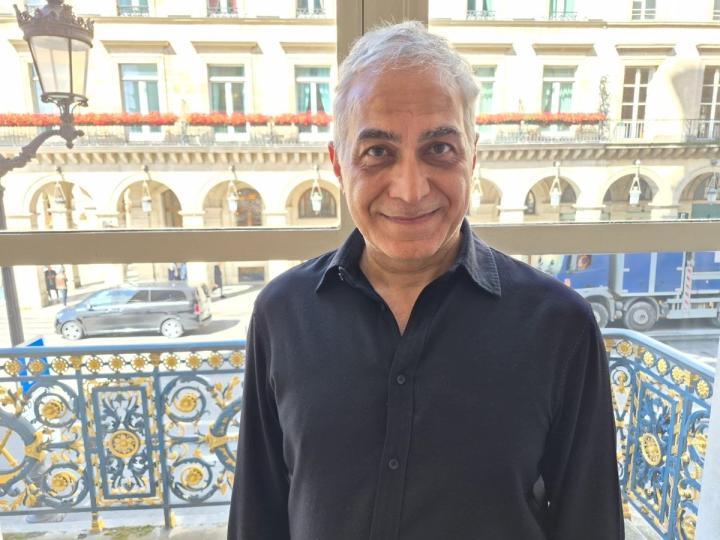
Reza Bundy, CEO of Atlas Capital and business partner of Nouriel Roubini, a long-time bitcoin critic, expects bitcoin to fall as much as 70% in the next six months before rising to $500,000 in the coming years.
Speaking to CoinDesk at the Proof of Talk conference in Paris, Reza Bundy, CEO of investment advisory firm Atlas Capital, issued his grim macroeconomic warning that flies in the face of typical industry optimism.
“We think there will be a massive decline in bitcoin over the next six months,” Bundy said, echoing Roubini’s long-standing thesis. “He [drawdown] It could reach up to 70%. We think between $26,000 and $30,000 was the figure we got. “If there is a decline in the stock market that is even half of what occurred in 2008, Bitcoin will double that debt loss.”
bitcoin was trading around $63,000, down nearly 28% this year, while stock markets have rebounded sharply thanks to AI hype and the search for momentum. The S&P 500 is up 10% and the Nasdaq is up about 19%, outperforming bitcoin over the same period.
‘Dr. Condemn’
Bundy said his bearish forecast is based directly on data and analysis developed alongside his chief economist and co-founder, Dr. Nouriel Roubini, known as “Dr. Doom” for accurately predicting the 2008 subprime mortgage crisis.
Roubini is also an anti-bitcoin advocate whose skepticism toward bitcoin dates back to the historic bull run of 2017. While bitcoin is up roughly 850% from its level when Roubini first called it a bubble, Dr. Doom has maintained his bearish stance on the digital asset.
In recent market assessments published on Bloomberg, Roubini reiterated his conviction that bitcoin is a “pseudo-asset class” and a pure “speculative asset” that lacks fundamental value or real-world utility, distinguishing it from real economic hedges like gold.
Bundy has somewhat echoed that pessimistic prediction for bitcoin, at least in the short term. He claimed that bitcoin has failed as a hedge against inflation, as many bulls have said, and is now just a highly volatile risk asset that moves at the same pace as tech stocks.
While bitcoin advocates are likely to dispute that characterization, pointing to the asset’s long-term returns and fixed supply, Bundy’s criticism echoes comments made by billionaire investor Mark Cuban, who recently said he sold most of his bitcoin after it had failed to perform as a hedge during periods of geopolitical tension and dollar weakness.
The original promise of Bitcoin
On the other hand, Bundy is not a permanent bear on bitcoin.
He still believes in bitcoin’s “store of value” thesis and is a long-term bull. Bundy’s long-term prediction is a price range between $150,000 and $500,000, which puts him at odds with his Atlas partner, Roubini.
Their optimism dates back to bitcoin’s original promise as an alternative currency to counter global political and monetary chaos. Bundy argued that bitcoin’s long-term growth will be driven by rising public debt, arbitrary money printing by central banks, and falling confidence in traditional currencies (as originally envisioned by Satoshi Nakamoto).
And Bundy has reason for his optimism. He plotted the long-term price of bitcoin using four economic paths:
- First, under “Controlled Expansion” (40% probability), the world sees steady growth and stable inflation. This keeps markets rising and pushes bitcoin into a range between $150,000 and $250,000.
- Second, if “fiscal dominance” prevails (25% probability), governments will print money to cover their huge debts, causing high inflation. This environment favors scarce assets, driving bitcoin between $250,000 and $500,000.
- Third, a “global conflict” path (20% probability) implies major security shocks in places like Taiwan or the Middle East. This would trigger rapid market panic and initial price drops, but would ultimately demonstrate bitcoin’s value as a safe and neutral asset.
- Fourth, a “deflationary recession” (15% probability) means a severe credit freeze that leaves bitcoin weak until central banks intervene to inject liquidity back into the system.
Change of ‘techno-dollar’
In the short term, however, Bundy still sees a global financial crisis on the horizon. He warns that the traditional stock market is a bubble ready to burst like it was in 1929, and this thesis also informs Atlas Capital’s investment strategy, called the “technodollar,” Bundy said.
Instead of tying digital tokens to a single depreciating government currency, he said the strategy uses AI-powered allocation models to shift exposure between assets, including gold, food, real estate and defense technology. Atlas currently executes this asset allocation strategy through a traditional ETF vehicle under the symbol “USAF” on the Nasdaq. The fund currently has around $18 million in net assets and has returned 8.7% since its inception, according to TradingView data. Bundy also plans to tokenize it on public blockchains later this month.
When asked why Bitcoin is not part of the bottom, even though he is bullish in the long term, Bundy said he is waiting for the short-term market crash that he predicted would happen first.
“We believe there will be a major correction in the stock market and we do not want to be part of the bitcoin crash. Once the correction occurs, we will make our final decision whether to include it or not.”


