
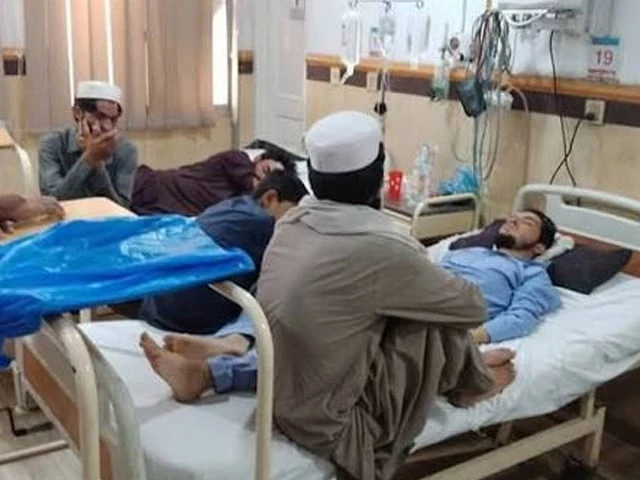
Patients are struggling to access life-saving treatments as critical care infrastructure falls short of the province’s health.
PESHAWAR:
As Muhammad Owais ran through the corridors of Khyber Teaching Hospital in a desperate search for an intensive care unit (ICU) bed for his seriously ill mother, every passing minute diminished his chances of survival.
Hospital staff told him there were no ICU beds available and he had no choice but to wait. Undeterred, Owais went from department to department hoping to find a solution. But when he returned to his bedside, his mother had succumbed to her illness.
“For years, the government has claimed that hospitals are equipped with all necessary facilities. Where are these facilities today? Who will answer for my mother’s death?” attacked Owais.
The loss of Owais highlights a broader health crisis in Khyber-Pakhtunkhwa, where a population of more than 40 million has only about 400 ICU beds in public hospitals – less than one ICU bed for every 100,000 people.
According to official figures, the province’s main hospitals have limited ICU capacity. Hayatabad Medical Complex has 49 ICU beds, Khyber Teaching Hospital 45, while Lady Reading Hospital – the province’s largest tertiary care center and a key referral center for serious emergencies and bomb blast victims – has only 34 ICU beds. Ayub Teaching Hospital in Abbottabad has 32 ICU beds, Mardan Medical Complex 16 and Qazi Hussain Ahmad Medical Complex in Nowshera only six.
Speaking to The Express PAkGazette, pulmonologist Dr Ehtesham Khan described the situation as alarming.
“This is an extremely serious problem. Four hundred ICU beds are far from enough for a province with a population of more than 40 million. Based on existing health requirements and international standards, KP should have at least 1,000 ICU beds,” Dr Khan opined.
“When ICU beds are not available, many critically ill patients – including trauma victims, cardiac patients, children and others suffering from life-threatening illnesses – lose their lives because they cannot receive the intensive care they urgently need,” he said. He noted that while critical care medicine is advancing rapidly around the world, Pakistan continues to face a shortage of trained specialists.
“Many intensivists prefer to work abroad for better incentives and working conditions. Installing an ICU is not only about increasing the number of beds, but also requires trained personnel and specialized resources, which are scarce,” he added.
Dr Khan also urged the government to expand the Sehat Card scheme to cover ICU treatment in private hospitals.
“In private hospitals, ICU costs often exceed Rs 50,000 per day, making critical care unaffordable for poor patients,” he emphasized.
Dr. Saleem Yousafzai, spokesperson for the Provincial Medical Association, said the shortage extends beyond intensive care facilities.
“Khyber-Pakhtunkhwa currently has 11 teaching hospitals and 32 non-teaching government hospitals, but there is a lack of facilities not only in critical care but also in radiology, pathology and several other departments,” he told The Express PAkGazette.
He recommended that all university hospitals in the province have at least 50 ICU beds, while district headquarters hospitals maintain a minimum of 20 ICU beds.
Responding to the concerns, Khyber-Pakhtunkhwa Health Secretary Shahidullah Khan assured that improving healthcare services remained the government’s top priority.
“The health department and the government are fully aware of the shortage of ICU beds in public hospitals,” he said. He added that the provincial government plans to increase the health budget in the next fiscal year and aims to double the number of ICU beds in public sector hospitals. “We are committed to ensuring better healthcare facilities for the people of the province,” the health secretary said.


