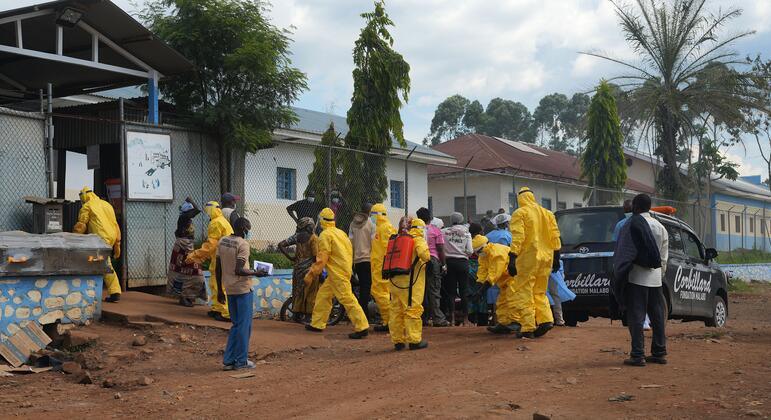
The rapid outbreak, which has also spread to neighboring Uganda, is caused by the rare and deadly Bundibugyo strain of the Ebola virus. WHO’s Director of Health Emergency Response and Alert Operations, Dr. Abdirahman Mahamud, told reporters in Geneva that as of June 8 in the Democratic Republic of the Congo there were 550 confirmed cases and 101 deaths.
“The good news [is]we have a cumulative 19 recovered patients, so early identification and treatment saves lives,” he said.
Speaking from Bunia, in Ituri province, which accounts for 94 percent of the country’s total cases, Dr. Mahamud explained that the increase in confirmed cases “is due to expanded testing.” More decentralized laboratories have been opened to speed up the analysis of suspected Ebola samples, including a fully functional facility in Mongbwalu, he said.
Uganda has reported 19 confirmed cases, including two deaths.as well as an individual likely to have died. The WHO said there is no evidence of community transmission in Uganda so far.
Remote opportunity
In the Democratic Republic of the Congo, as of June 6, 5,040 contacts had been identified and were under follow-up in the provinces of Ituri, North Kivu and South Kivu. Increased contact tracing has allowed health workers to reach 62 percent of contacts so far, with hopes of reaching the 90 to 95 percent goal “in the coming weeks,” Dr. Mahamud said. He described making “slow and steady progress” based on building trust and working with the community.
The WHO official highlighted that local health workers play an essential role in early identification and referral of cases to treatment centers. He described the current setup as “a well-functioning system that integrates everything from surveillance to contact tracing to treatment center and laboratory,” along with efficient data sharing.
Still, significant challenges remain, even in remote locations with limited connectivity, from where samples can take eight hours to reach the laboratory.
“Ituri is as big as France,” said Dr. Mahamud. “If you are in Bunia, you can get the result in one or two hours,” while in places further away from the testing facilities, the process can take 24 hours.
In a positive development, in remote Aru, near the border with Uganda, where samples have to travel 10 hours by road to be tested, a laboratory will be operational on Friday, he said.
The WHO has so far set up field laboratories in five affected areas to allow testing to be carried out closer to the epicenter of the outbreak. Working with partners in support of Government-led efforts, the UN health agency has deployed more than 100 people to the Democratic Republic of the Congo, delivered 40 tons of medical equipment and supplies, and helped establish Ebola treatment centers.