
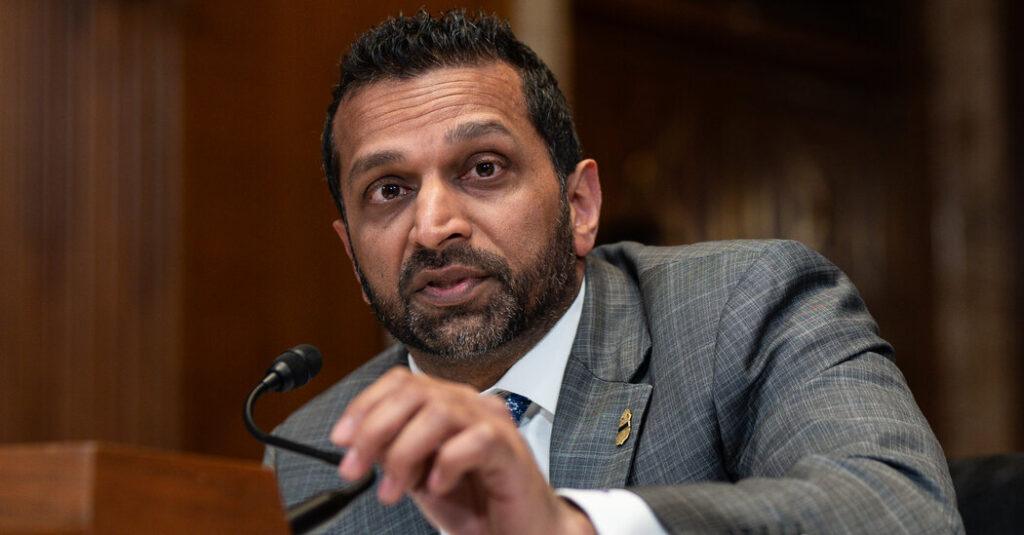
In 2019, Kash Patel, then a White House aide, objected to how the media portrayed her role in President Trump’s dealings with Ukraine. “It’s time for me to start fighting back,” Patel said at the time. He sued Politico, The New York Times and CNN.
In 2023, Patel, then a pro-Trump roving commentator, was offended by the work of a blogger who had criticized his record and called him a “chud,” a derogatory term progressives use to describe MAGA supporters. He sued blogger Jim Stewartson for $10 million in damages.
And in April, Patel, now director of the Federal Bureau of Investigation, was infuriated by an article in The Atlantic that reported alarm among some colleagues over his “erratic” behavior and alleged excessive alcohol consumption. He soon sued the publication, demanding $250 million in damages.
Patel has yet to reach a settlement or a favorable jury verdict in the cases. Each of the news organizations he sued defended their journalism and said it was protected by the First Amendment.
But the strategy is familiar. Trump, the man who appointed Patel to lead the FBI, has long turned to the courts when faced with unfavorable press coverage. And perhaps no one in his two administrations has followed suit as closely as Patel, who has filed at least six defamation lawsuits against media companies and commentators in nearly seven years.
In some of the cases, Patel filed strongly worded complaints only to allow them to languish in the ups and downs of civil litigation, a trajectory that some legal experts said raised questions about his goals.
“The goals here,” said Sonja R. West, a professor at the University of Georgia School of Law, “seem to be to muddy the narrative, increase opponents’ legal bills and send a message to journalists that if they cover us critically, it will cost them a lot of time and money.”
Jesse R. Binnall, a Virginia attorney representing Patel, said in an email: “Director Patel pursues these cases to win them, and anyone who thinks he would tolerate anything less than aggressive and expeditious accountability simply doesn’t know the man.” He added that the number of defamation lawsuits filed by Patel is a “direct reflection of the volume of lies published” about him.
The lawsuits are another front where news organizations have been forced to invest time and money to defend their work in the Trump era. Others include continued public criticism from top officials, including Trump; limitations on access to the White House and the Pentagon; leak investigations ensnaring national security reporters; and investigations by the Federal Communications Commission.
It’s difficult to get exact numbers on public officials who file defamation lawsuits, said Michael Norwick, an attorney with the Media Law Resource Center, a group that helps news organizations. Still, Mr. Norwick, who has worked at the center for 15 years, said: “I don’t remember this existing, and now it exists.”
RonNell Andersen Jones, a professor at the University of Utah SJ Quinney School of Law, said by email that there were examples of defamation lawsuits by officials who had completed their time in public service, but that she was not aware of pre-Trump cases in which officials had exercised “law enforcement or other executive powers that may combine with the pressure of the lawsuit.”
Andersen Jones said lawsuits against news media companies had forced her to remove a line she had used in conferences throughout her career, which said that top government officials, including the president, do not sue for defamation.
An FBI spokesman said even government officials should have recourse to address what they considered malicious lies in the media.
Patel and Binnall face an uphill battle in court. To recover damages in a defamation suit against a news organization, a public official like Patel would have to prove not only that the journalists had published a harmful falsehood, but also that they had done so knowingly or with reckless disregard for the truth, a legal standard known as actual malice.
When Patel sued the Times in 2019 over its coverage of Trump’s dealings with Ukraine, her complaint contained about 750 words of biography. He called himself a “brilliant lawyer, trusted advisor, strong defender and defender of the rule of law”; and demanded nearly $45 million in damages, along with “prejudgment interest” and “postjudgment interest” of 6 percent annually.
After all that preparation, Patel failed to hand over court documents to the Times and then dropped the case.
A similar situation developed after Patel sued Politico for what he claimed were “malicious efforts” to destroy his career through its coverage of Trump’s interactions with Ukraine. Politico decided to dismiss the case after Patel failed to provide court documents to the company for more than a year, leading to a “reasonable presumption that he had abandoned his claims,” according to a court filing.
Patel dropped that lawsuit but filed a new one, which is still active. (His lawsuits against The Times, Politico and CNN were filed by his previous lawyer, not Mr. Binnall’s firm.)
And Patel was reprimanded by a federal judge in Nevada for not pursuing his case against Stewartson, the blogger, for more than a year, a gap that Binnall, in an email to the Times, attributed to a careful and deliberate legal strategy. The litigation is ongoing.
In his public statements, Patel is prone to sweeping condemnation of news organizations. Traces of that language emerge in their lawsuits. His complaint against CNN, for example, included accusations of a “brutal attack on Kash’s reputation” and a “continuation of past smear campaigns to discredit Kash.”
He also said CNN had defamed Patel by reporting that he “worked to discredit” special counsel Robert Mueller’s investigation into Russian interference in the 2016 presidential election, a bizarre claim from a man who would later characterize that investigation in a book as the “work of a taxpayer-funded group of government gangsters.” He abandoned his claims related to the matter during an appeals court hearing.
In upholding the dismissal of Patel’s 2020 lawsuit against CNN, a Virginia appeals court determined that his claims were “conclusive and non-binding” and did not constitute actual malice. He also awarded CNN $150 in damages. The network declined to comment on whether Patel had paid.
The Supreme Court declared in 1964 that public debate can include “vehement, caustic and sometimes unpleasantly sharp attacks” on government officials, as Mr. Patel is now learning.
In April, a federal judge in Texas dismissed a lawsuit filed by Patel against Frank Figliuzzi, a retired FBI official and television commentator who had criticized Patel’s work habits last year on the MS NOW show “Morning Joe,” saying the FBI director was “much more” visible in nightclubs than at the agency’s headquarters. The judge dismissed the suit, saying Mr. Figliuzzi’s comment amounted to “rhetorical hyperbole that cannot constitute defamation.”
In an email, Binnall said: “While we agree that Mr. Figliuzzi is not a serious person, the notion that the more you exaggerate a lie, the more legally protected you are, is not a coherent reading of the law.” Patel is appealing the ruling.
Stewartson, the blogger, also defended the insults he had hurled at Patel on social media. “I thought it was hysterical that he put that there,” Stewartson said in an interview, referring to Patel’s references to being called a “chud.” “Because how do you prove he’s not a fool?”


