
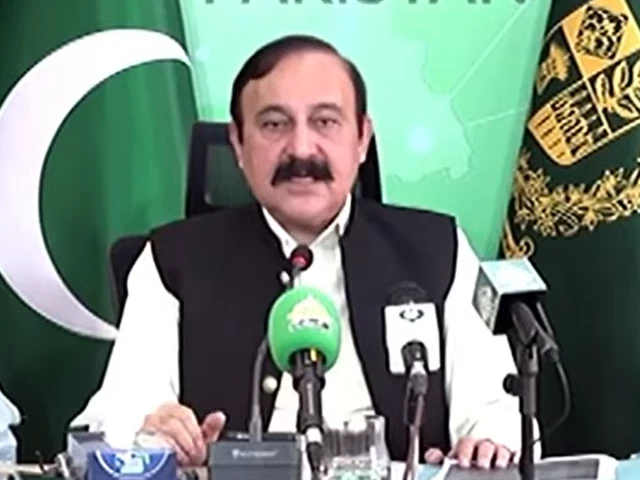
He says that “a path of peace and well-being will definitely be found” if violence is abandoned
Federal Minister for Parliamentary Affairs Tariq Fazal Chaudhry addresses a press conference in Islamabad on Sunday. SCREEN CAPTURE
Parliamentary Affairs Minister Dr Tariq Fazal Chaudhry on Monday asked the recently banned Joint Awami Action Committee (JAAC) to abandon its alleged violence and adopt constitutional means to achieve its demands, while asserting that there were no direct talks underway with the group, although the Azad Jammu and Kashmir chief minister could try.
Tensions have risen in AJK following recent deadly clashes that have led to competing narratives about victims, governance grievances and political legitimacy. Official sources have confirmed at least seven deaths.
Officials said that despite claims of peaceful intentions, certain elements have continued to engage in violent activities. The same elements, they added, have previously been involved in damage to public property and attacks that resulted in martyrdom and injuries to security personnel.
At a press conference outside Parliament, Chaudhry urged the JAAC to refrain from adopting a violent course of action and instead resolve issues through dialogue and negotiations, emphasizing that disputes should be resolved through peaceful compromise rather than confrontation.
“Now that the JAAC is banned, the government is not conducting direct negotiations with the committee.”
However, Chaudhry said the government would have “no reservations” if AJK Chief Minister Faisal Rathore, whom he said was a “dynamic young man” and very active amid the situation, tried to resolve the matter indirectly.
“There should be no violence. There should be no loss of life,” he stated, and once again called on the JAAC to abandon the path of resistance and confrontation. “A path will definitely be found that will be one of peace and well-being.”
Speaking about the sit-in, the minister asked protesters to give peace a chance, as the loss of life “around the 12-seat issue” was incomprehensible and irrational.
He said the government had taken important steps to address protesters’ concerns, stating that at least 35 of their 38 demands had been met.
The federal minister explained that the expiration of three lawsuits was based on the processing of the matter in court.
Outlining the measures taken to bring stability in the region, Chaudhry highlighted that the government canceled 170 first information reports (FIRs) against protesters and compensated the families of those who lost their lives on an equal basis with law enforcement officials.
He also said that the government offered jobs to the aggrieved relatives of the victims who died on the day of the protest.
“We have reduced the size of the AJK cabinet from 36 to 20 members as per the agreement reached between the warring parties, accepting demands that were quite non-negotiable,” the minister stressed, adding that the ministries were also reduced from 32 to 22.
On the issue of 12 migrant seats, Chaudhry urged the JAAC to seek political, legislative or judicial discourse, highlighting that the provision was protected by the AJK interim constitution.
He regretted that the JAAC did not postpone the call for the long march despite repeated requests from the government, which ultimately led to violence and riots in the valley.
“Four law enforcement personnel, including one from the Frontier Corps (FC), lost their lives in the riots,” he recalled.
Chaudhry further said that the scenes witnessed in AJK were deeply distressing for its residents as well as all Pakistanis.
A day ago, Pakistan People’s Party Chairman Bilawal Bhutto-Zardari, whose party is in power in AJK, made a direct appeal to the protesters and urged them to peacefully end their demonstrations and bring their protest activities to a “peaceful conclusion”.
He warned that the situation was creating an “unnecessary opportunity” for hostile actors and the “India-Israel nexus” to exploit the developments for their own purposes.
Background
Recent riots and deadly clashes broke out in areas including Rawalakot where the JAAC had been staging a sit-in in front of the Rawalakot Combined Military Hospital. AJK Police allege that armed JAAC members opened fire on law enforcement forces deployed in a planned attack, leaving four personnel dead and around 20 injured. JAAC, however, disputes this version, stating that security forces used tear gas and fired projectiles towards the hospital.
According to the AJK police, three people linked to the JAAC and four law enforcement officers died during the protests. JAAC, however, said in a statement on
The clash occurred when the AJK government and the JAAC witnessed a clash as the AJK election date was announced as July 27.
Read more: Certain elements seek to create instability in AJK despite repeated offers of dialogue: Rana Sanaullah
AJK’s 53-member legislative assembly includes 12 seats reserved for Kashmiri refugees, people who fled Indian-controlled Kashmir in 1947 and 1965 and are now scattered across Pakistan. Six seats represent refugees from the Jammu division (~434,000 people) and six from the Kashmir Valley (~30,000 people), an already imbalanced arrangement that many consider unfair.
The region witnessed one of its most turbulent periods in October last year, when protests led by the JAAC broke out over demands for constitutional and governance reforms. At least nine people, including three police officers, died during the riots.
The JAAC, which organized the protests and strike, had put forward a wide-ranging charter of demands, including an end to the privileges enjoyed by the ruling elite, the abolition of 12 assembly seats reserved for refugees, and the elimination of the quota system.
Two days after the violence, the government and the JAAC reached an agreement covering 12 basic and 13 additional points. Under the agreement, both sides agreed to constitute a high-level committee to examine the issue of refugee seats in the AJK Legislative Assembly.
Read more: Four police officers martyred, more than 20 injured in Rawalakot shooting: AJK police
The unrest also sparked political unrest in the region. The PPP subsequently moved a no-confidence resolution against then Prime Minister Chaudhry Anwarul Haq, and the Pakistan Muslim League-Nawaz joined the effort. Haq, who had been elected in April 2023 with 48 votes, preferred to face the vote rather than resign.
On 17 November, Rathore secured 36 votes in the elections and became the 16th chief minister of Azad Jammu and Kashmir.
With elections approaching and the issue of refugee seats still unresolved, the AJK government called an All Parties Conference (APC) in Muzaffarabad to build consensus. Almost all major parties attended, except the PTI and JAAC, which boycotted it.
The JAAC’s position is that the government had already rejected its written proposals submitted on May 30, so attending would be futile. He had proposed maintaining symbolic representation of refugees until the Kashmir dispute is permanently resolved, or replacing the 12 assembly seats with 4 seats in the AJK Council, a body chaired by the Prime Minister, which he claimed would better preserve the political dimension of the Kashmir cause.
The APC rejected any changes outside the constitutional and legislative framework, saying only the elected assembly could alter the seating arrangement for refugees. The JAAC called the resolution “a page and a half of absolutely trivial lines” and accused participants of coming together to serve their own interests and not those of the public.


