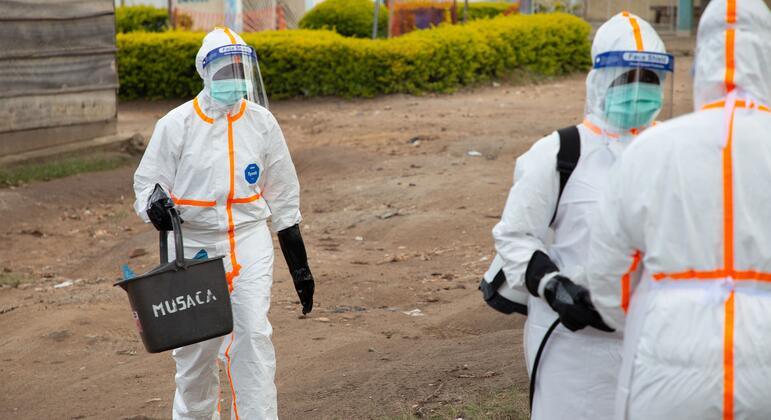
As of June 17, 896 confirmed cases and 232 deaths had been reported in 31 health zones. Domestically, Uganda confirmed 19 cases and two deaths, according to the latest updates released on Friday by the World Health Organization (WHO).
To safely deliver life-saving assistance, WHO chief Tedros called for a ceasefire last month amid decades-long clashes between Congolese authorities and the M23 armed group in eastern DRC, where more than two million forcibly displaced people live – including more than 320,000 refugees – and Ebola continues to spread.
Now, the risk is regional, said Dr. Allen Maina of the United Nations Refugee Agency (UNHCR), noting that eastern DRC flanks an area where trade, family ties and refugee movements link Uganda, Rwanda, Burundi, Tanzania and South Sudan.
Diseases and armed conflicts
As such, UNHCR is strengthening preparedness in these countries, working with governments, WHO and partners to strengthen WASH surveillance, screening, infection prevention, communication and support in refugee-hosting areas and border corridors.
“Our goal is to prevent further cross-border transmission without preventing people from seeking safety.“, said.
An example of this occurred on June 7, he said, when UNHCR monitored the arrival of some 2,250 people from Mbau, 20 kilometers from Beni, one of the epicenters of the outbreak, after the movements of armed groups caused panic and led them to flee to Oicha, in North Kivu, an Ebola-affected area that is already home to more than 14,300 displaced people.
Frontline emergency services
More than 115 UN health agency experts have been deployed to affected provinces, and more than 110 metric tons of emergency supplies have been delivered to support frontline operations, WHO acting regional emergencies director Dr. Marie Roseline Belizaire said from Bunia, Democratic Republic of the Congo.
Diagnostic and treatment capabilities continued to expand, but access restrictions continued to limit operations in some high-risk areas, he warned.
“A month after the outbreak was declared, the situation was still serious and continuing to evolve,” he said. “Cases continued to be reported in multiple areas, underscoring the need to maintain and accelerate response efforts.”
More than a million projections
The Ebola outbreak is spreading through one of the most active cross-border areas on the continent, where thousands of people move every day in search of safety, work, medical care and connection with their families, according to the International Organization for Migration (IOM).
“Understanding human mobility patterns was one of our most powerful tools in stopping the spread of disease.”said an IOM spokesperson, announcing that the UN agency has conducted more than one million tests to date and began expanding operations in the Democratic Republic of the Congo and neighboring Uganda on Friday.
Checks are being carried out at borders and along key travel routes and corridors in affected and at-risk countries, including support at more than 110 entry points, said Kit Leung, IOM’s senior migration health advisor.
90 percent mortality rates among pregnant women
Mortality rates among pregnant women infected with Ebola had reached 90 percent, and perinatal mortality (the period just before or after birth) had reached 100 percent in some settings, according to the United Nations agency for sexual and reproductive health, UNFPA.
“This outbreak was also a Health emergency and maternal protection for women and girls.”said UNFPA deputy country representative Noemi Dalmonte, speaking from Kinshasa, the capital of the Democratic Republic of the Congo.
As part of the broader Ebola response, the agency is focusing on pregnancy, childbirth, gender-based violence and building community trust, deploying 153 midwives to eastern DRC to help maintain safe childbirth, emergency obstetric care and postnatal care, with more deployments planned, she said.
Push for emergency funding
Some UN agencies are calling for urgent funding to help them continue tackling the Ebola outbreak on the ground:
- UNFPA urgent appeal for $17.1 million to sustain life-saving sexual and reproductive health services in the Democratic Republic of the Congo
- As part of an inter-agency effort, UNHCR is seeking $14 million for its Ebola preparedness and response from July to November to help forcibly displaced people and their host communities in the Democratic Republic of the Congo and Uganda, while strengthening preparedness in Burundi, Rwanda and South Sudan.
- The United Nations in Uganda, together with its humanitarian partners, has launched an emergency appeal for $15.8 million to support the country’s national response.