
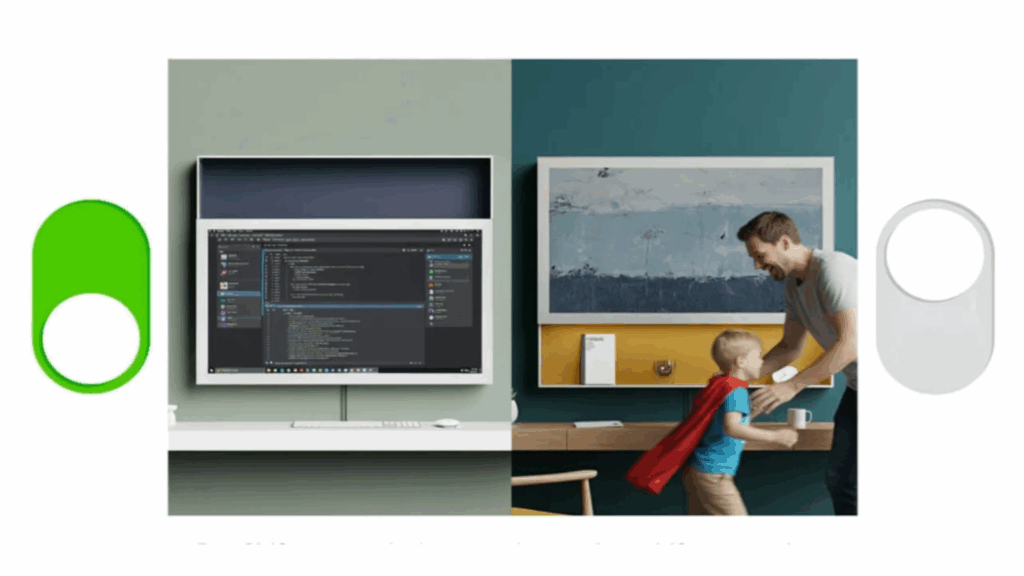
- A push up turns your monitor into wall art instantly.
- DuoShift replaces notifications with a deliberate, physical gesture at the end of the day
- Compact Apartments Finally Get a Desk Built for Two Lives
Compact living spaces have made it increasingly difficult for people to separate their professional and personal lives within the same four walls.
Seung Bin Bae, a Korean design student, has created a dual-purpose workstation called DuoShift aimed at solving one of the most persistent problems of remote work.
DuoShift addresses this problem through a single physical movement instead of relying on software, apps, or scheduled reminders.

A single motion replaces years of software fixes
The desktop works in two different modes, work mode and life mode, and to switch between them you only need to move the screen up.
In work mode, it works as a standard productivity monitor and maintains spreadsheets, browser tabs, and video calls throughout the day.
Pushing the screen up switches it to Life Mode, where it turns into a digital art frame.
This transformation simultaneously cleans the desk surface beneath it, returning the space to non-work use entirely.
Unlike calendar apps or notification systems that attempt to enforce discipline through software, DuoShift relies on a deliberate physical gesture to mark the end of the day.
Bae’s approach treats this transition as a ritual, similar to closing a laptop or changing out of work clothes after finishing a shift.
Visually, the design remains minimalist and slim, intended to blend into a living space rather than visually dominate it.
Why this matters beyond the desktop itself
Compact urban living continues to expand rather than retreat, and remote work remains common years after the pandemic reshaped daily routines.
Most monitor designs have not been adapted to address this overlap between life and work as a serious design issue.
DuoShift’s customizable frame finishes also allow it to blend into a room’s interior or stand out as a deliberately designed object.
Beyond its function, the product hints at commercial possibilities, including digital art subscriptions or collaborations with furniture and interior design brands.
Its modular structure also allows updates without complete replacement, a detail intended to reduce electronic waste and extend the useful life of the product over time.
As compelling as the concept is, it remains a student project without the manufacturing scale needed to reach a global audience.
Samsung, as one of South Korea’s most powerful electronics brands, could turn this idea into a mass-market product.
Without the backing of a company of that size, such a promising innovation risks being confined within South Korea’s borders.
The project was awarded in the Home and Living category at the Core77 Design Awards.
Whether the concept could scale to mass production through a partnership remains an open and unanswered question.
What DuoShift proves, regardless of its commercial future, is that a single deliberate gesture can offer something that software has always struggled to offer.
Follow TechRadar on Google News and add us as a preferred source to receive news, reviews and opinions from our experts in your feeds. Be sure to click the Follow button!
And of course you can also follow TechRadar on TikTok for news, reviews, unboxings in video form and receive regular updates from us on WhatsApp also.


