
Pakistan-China webinar explores trade, energy, education and regional connectivity opportunities to boost ties
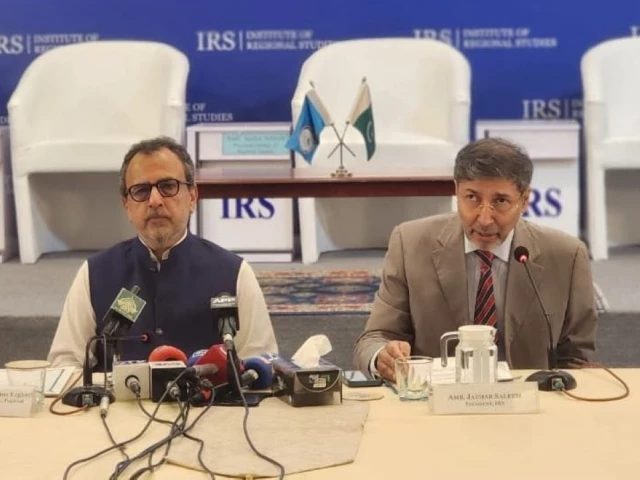
Federal Minister for Energy Sardar Awais Ahmed Khan Leghari highlighted Pakistan’s commitment to diversifying its international energy partnerships and identified Russia as an important partner in energy security, infrastructure development, technological cooperation and long-term investment. PHOTO: APP
The Institute of Regional Studies (IRS), Islamabad, in collaboration with the University of World Civilizations (UWCM), Moscow, on Thursday convened the second event of the Pakistan-Russia webinar series, titled “Pakistan-Russia: Strengthening trade, education and energy collaboration”.
The webinar brought together senior officials, diplomats, business leaders and academics from both countries to examine practical opportunities to expand bilateral engagement in trade, industrial development, energy, education and regional connectivity.
Building on the success of the first webinar in the series in June 2026, the second dialogue advanced the discussions from geopolitical perspectives towards concrete geoeconomic initiatives.
Participants emphasized that sustained interaction between governments, academic institutions, businesses and political communities was essential to unlock the considerable potential of Pakistan-Russia relations in an evolving Eurasian landscape.
Inaugurating the webinar, Ambassador Jauhar Saleem, President, Institute of Regional Studies, observed that Pakistan and Russia were entering a new phase of bilateral engagement in which economic cooperation, institutional partnerships and people-to-people exchanges can complement the ever-expanding diplomatic relations.
He stressed that political dialogue must be increasingly accompanied by practical initiatives capable of generating long-term economic and strategic benefits for both countries.
اسلام آباد، پاک۔روس تجارت، تعلenstein ویبینار
وزیرِ توانائی سردار اویس احمد خان لغاری کا خطاب
پاکستان اور روس کے درمیان تجارت، توانائی، تعلیم اور سرمایہ کاری مواقع موجود ہیں۔
پاکستان اور روس کے تعلقات باہمی احترام، مشترکہ مفادات… pic.twitter.com/A3eAgMHpU9– PTV News (@PTVNewsOfficial) July 9, 2026
Delivering the keynote address, Energy Minister Sardar Awais Ahmed Khan Leghari highlighted Pakistan’s commitment to diversifying its international energy partnerships and identified Russia as an important partner in energy security, infrastructure development, technological cooperation and long-term investment.
Deputy Minister of Industry and Trade of the Russian Federation Alexey V. Gruzdev reaffirmed Russia’s commitment to expanding industrial and trade engagement with Pakistan and highlighted new opportunities emerging across Eurasia.
Pakistan’s Ambassador to the Russian Federation, Faisal Niaz Tirmizi, highlighted the importance of translating the positive trajectory of bilateral political relations into greater trade, investment, connectivity and private sector cooperation.
Boris Burmistrov of the Russian Foreign Ministry reaffirmed Russia’s commitment to strengthening its partnership with Pakistan through intergovernmental collaboration, deepening multi-sector ties and working together in regional and international forums to promote shared interests.
Moderating the first session, Dr. Roxolana Zigon guided discussions on trade, transport connectivity and energy collaboration. Mohsin Sheikh, Chairman of Pakistan-Russia Business Council, gave a historical overview of trade dimensions between both countries and then outlined practical approaches to expand bilateral trade through better logistics, development of economic corridors and greater business-to-business engagement in Eurasia.
Ambassador Qazi M. Khalilullah, Executive Director of CISSS Karachi, emphasized the importance of long-term resilient energy partnerships and greater collaboration on energy infrastructure and strategic planning through measures such as advanced Eurasian cargo services and special representatives on Eurasian trade in the respective countries.
Read more: Pakistan and Russia agree to sign an economic cooperation program that will extend until 2030: Awais Leghari
Dr. Prokhor Tebin examined the changing dynamics of globalization and argued that emerging PAkGazette-economic realities provide Pakistan and Russia with new opportunities to deepen cooperation. Summarizing the session, Dr. Zigon emphasized the importance of sustained institutional dialogue focused on practical implementation.
The second session, moderated by Dr. Usman W. Chohan, examined industrial development, education, human capital and financial cooperation as key pillars of long-term bilateral engagement. Dr Asma Naveed of the National University of Modern Languages provided concrete recommendations on bilateral human capital development, including language training in specialized economic sectors, joint and long-term institutional commitment and the establishment of Russian language centers in the Pakistani education system.
Dr. Svetlana Minyurova of the Russian Academy of Education outlined prospects for closer collaboration between Pakistani and Russian universities through joint research, technology transfer, academic exchanges and institutional partnerships.
Dmitry Antonov of the Business Council for Cooperation with Pakistan (Russia) offered concrete recommendations on facilitating business-to-business (B2B) links between the two countries, including banking channels, development of inland routes and use of Eurasian multilateral forums.
In both sessions, participants agreed that the changing global political economy presents Pakistan and Russia with significant opportunities to diversify economic partnerships, strengthen regional connectivity and expand cooperation in trade, industry, energy, education, science and technology. Speakers highlighted the importance of building stronger links between governments, universities, businesses and research institutions to translate shared strategic interests into tangible results.
In his concluding remarks, Ambassador Jauhar Saleem noted that the discussions reflected a broad convergence of views on the need to move beyond dialogue to implementation. He noted that sustained commitment would be essential to developing lasting and multidimensional partnerships.
The participants agreed that the Pakistan-Russia webinar series has become an important platform to promote strategic dialogue and strengthen mutual understanding between the two countries. They welcomed plans to continue the series to examine and outline paths to strengthen the growing partnership between Pakistan and Russia in an increasingly interconnected Eurasian region.


