
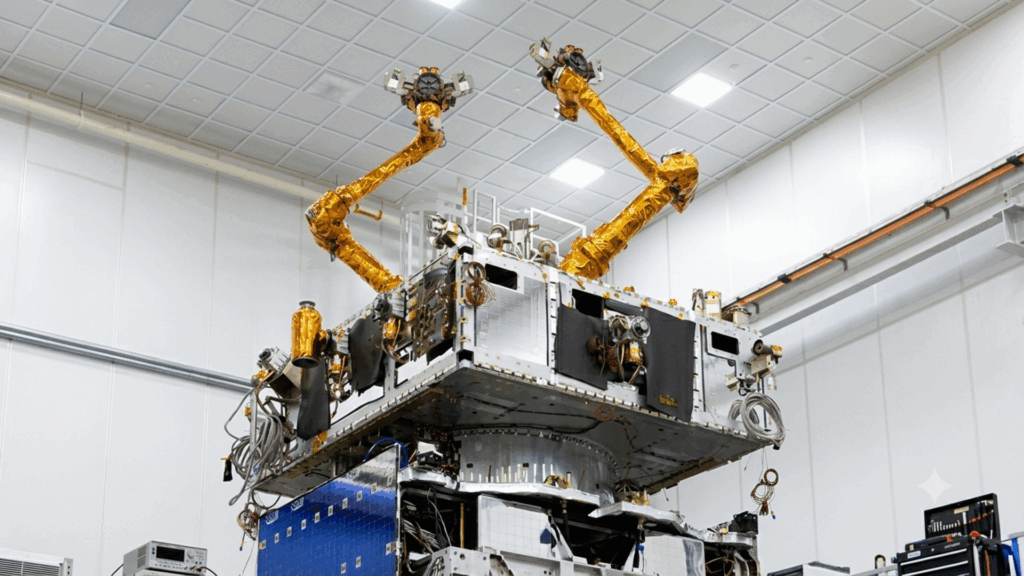
- Northrop Grumman MRV launches with two satellite servicing robotic arms
- Mission extension capsules can extend the life of a satellite by eight years
- The spacecraft can inspect, refuel, tow and relocate active orbital satellites or even destroy enemy satellites.
Northrop Grumman has launched its first robotic mission vehicle (MRV), equipped with two robotic arms to inspect, repair, refuel and relocate satellites already operating in orbit.
The spacecraft also carries three Mission Extension Pods (MEPs) that can extend the operational life of a satellite up to eight years after installation.
Although pitched as a commercial services platform, the spacecraft’s ability to operate alongside other satellites has already raised questions about potential military applications.
Latest videos ofTechnologyRadar
Satellite services technology also allows proximity operations
The MRV launched aboard a SpaceX Falcon 9 rocket from Cape Canaveral, carrying MEPs destined for commercial satellites operated by Optus of Australia and SES of Luxembourg.
Northrop Grumman says the spacecraft can inspect satellites, install life extension modules, tow spacecraft between orbital positions and help clean up debris already surrounding Earth.
Those missions rely on two robotic arms that allow the vehicle to maneuver extremely close to other satellites without relying on direct physical contact.
The robotic arm system was developed through the Geosynchronous Satellite Robotic Servicing program led by DARPA in conjunction with the United States Naval Research Laboratory.
Because those same capabilities allow precise movement around spacecraft, a future version could disable hostile satellites if governments requested such capabilities.
“I’ll let the U.S. government decide how that capability could meet the mission objectives that it has in that regard,” said Kathy Warden, CEO of Northrop Grumman.
“Our goal is to offer our customers options for technology implementation and for them to determine the policy for when and how they could implement that technology.”
Military officials say orbital threats are already evolving
U.S. Space Force officials have repeatedly argued that rival nations already possess satellites capable of approaching and interacting with other spacecraft operating in orbit today.
The service says those developments require greater attention because several countries continue to expand technologies capable of operating near valuable military and civilian satellites.
“We’re basically responding to a warfighting arena where our adversaries have already placed interceptors in space, and we want to make sure we rebalance that in terms of deterrence,” said Chief of Space Operations Gen. Chance Saltzman.
A Space Force spokesperson later cited the Chinese Shi Jian 21 satellite, equipped with a robotic grappling arm, while explaining examples of orbital interceptor capabilities already available.
Officials have also warned that nearby satellites could gather intelligence, electronically interfere, damage spacecraft components or deliberately move another satellite from its assigned orbit.
Those evolving capabilities have led the Space Force to expand its focus on orbital warfare alongside traditional space operations.
The service’s Space Delta 9 unit develops tactics for defensive and offensive missions in orbit as those threats continue to evolve.
The military is also planning larger space defense networks through the proposed Golden Dome missile defense architecture.
The Congressional Budget Office estimates that the concept could require about 7,800 space interceptors if the program moves forward.
For now, MRV remains a commercial tool, but it remains to be seen how governments will apply comparable space security technology with artificial intelligence tools and autonomous systems.
Follow TechRadar on Google News and add us as a preferred source to receive news, reviews and opinions from our experts in your feeds.


