
The new reward product from memecoin issuance platform Pump.fun has generated its first controversy.
A user posting as Arivu on X said he completed a Pump.fun GO bounty last week that asked someone to tattoo the “$boutywork” symbol on their forehead and provide video proof. The task appeared to reference a token called $Bountywork, but the description of the bounty itself used the misspelled version “$boutywork.”
Arivu said he followed the task exactly.
“Guys, I followed everything exactly what the name mentioned in the line,” he wrote on “Please give my life,” he wrote.
The typo then became the market.
A Solana token using the symbol BOUTYWORK began trading on PumpSwap, reaching a market cap of over $600,000 shortly after going live. It gained over $3.5 million in volume in 24 hours, 2,630 holders, and approximately $43,000 in liquidity.
Arivu later posted that he had received $20,000, but from the trading fee for a token someone had launched. He shared the token address and thanked the users, saying that they had changed his life.
‘Pay anyone to do anything’
Pump.fun GO, announced last week, will allow users to create and complete rewards for almost any task. The company pitched it as a way to “pay anyone to do anything,” a phrase that sounds like fun on the Internet (and most of the rewards are light-hearted challenges) until the task becomes more exploitative, like permanent body modifications.
The negative reaction to the new platform came quickly.
One X user claimed to have spoken to the tattoo shop and alleged that the person who got the tattoo may have been exploited by another person trying to profit from the token price rally. A phone call to the tattoo shop made by CoinDesk went unanswered twice.
Nikita Bier, X’s widely followed product manager, was more direct:
“It’s sad that all the rich people abandoned cryptocurrencies and now the entire industry is just teenagers in America forcing poor people to do shameful things.”
Tattooing wasn’t the only task that propelled Pump.fun GO beyond normal memecoin theater.
Other open bounties reviewed by CoinDesk showed how widespread the challenges are. Some were silly Internet challenges, like one that asked users to complete a watermelon-eating challenge in less than 60 seconds for a reward of around $93.
Another offered about $663 for people to go to Los Angeles’ Skid Row, a 50-block neighborhood that contains one of the largest homeless populations known for its drug markets and extreme poverty, and interview two homeless people on camera about who they voted for.
But some began to become dangerous.
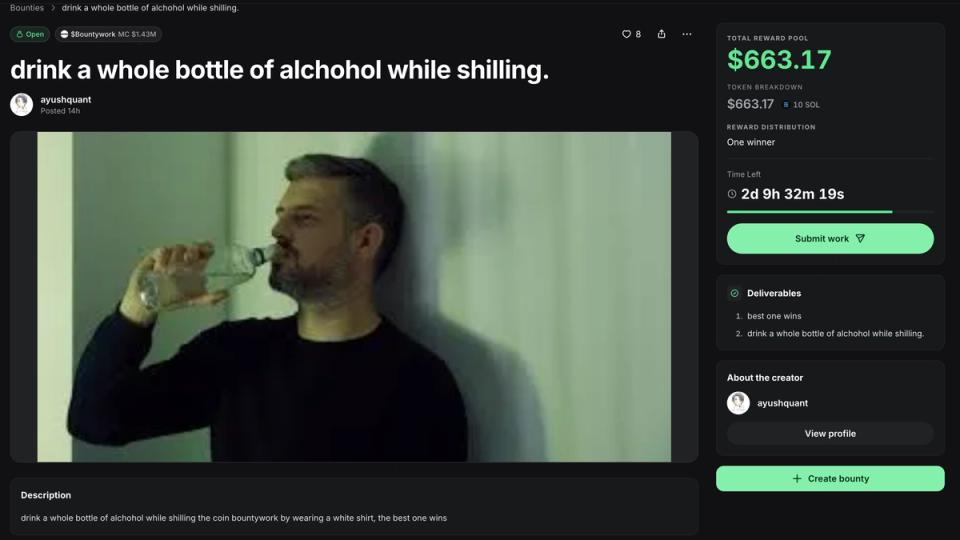
One bounty asked people to drink an entire bottle of alcohol while promoting a token, with videos showing multiple submissions of users appearing to drink bottles in about a minute.
Another offered around $266 for someone to shave their head while shouting “Jobcoin.”
That’s where the exploitative nature of the memecoin frenzy comes in.
Pump.fun GO turns attention into a reward, the reward into content, and the content into a token exchange. The person who performs the trick may receive a small payment. The creator can throw a coin around and capture many more if the market catches on.
The more attention something receives, the more profits it could generate.
To be clear, Pump.fun has no role in the types of streams users choose to create and has an active moderation team that removes dark or malicious content. Pump has been moderating the platform’s activity since its inception.
CoinDesk has contacted Pump.fun for comment.
However, this is not the first time Pump.fun has been involved in controversial social experiments.
Previously, the platform streamed live videos ranging from extreme dark humor to dark behavior, all in an effort to boost its tokens to a few million dollars in market capitalization.
At the time some of these streams aired, several videos that emerged, including suicidal streams, death threats, and a man continually locked in his bathroom, were disturbing, to say the least.
And that is the uncomfortable part of this story.
On the one hand, this is the wild, wacky side of the crypto Internet: a typo, a bounty, a Solana token, a viral photo, and a graph that goes vertical before most people understand what happened.
On the other hand, when cryptocurrencies are reeling from a bear market and trying to be taken seriously by the masses, such stunts show how quickly memecoin incentives can curb cryptocurrencies’ reputation as a serious contender for everyday financial rails.


