According to the latest figures, more than 1,400 confirmed cases of Ebola Bundibugyo virus disease, including 350 deaths, have been reported in the two countries. More than 90 percent of infections are concentrated in Ituri province in the Democratic Republic of the Congo, a major cross-border trade hub with Uganda, devastated by years of armed conflict.
Calling Kampala
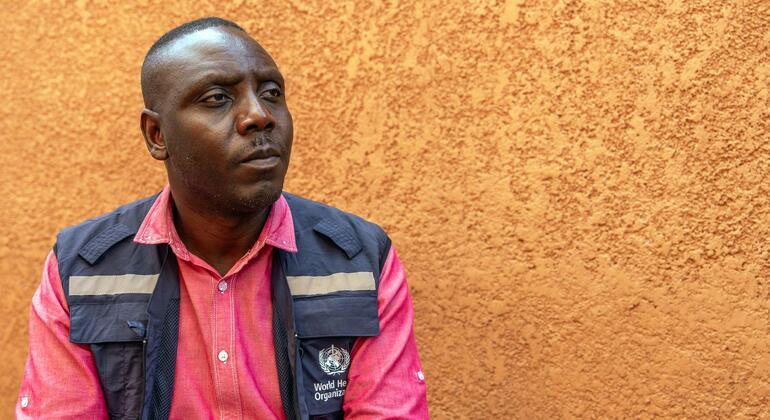
On a Sunday morning in Kampala, Dr. Chris Opesen, an anthropologist with the World Health Organization (WHO), receives a call from local authorities shortly after 5:30 in the morning.
A woman suspected of having Ebola is preparing to return home and has been asked to help ensure her reintegration into the community is safe.
Three days earlier, Lilian* had presented symptoms consistent with Ebola and was transferred to the Ebola isolation unit at Mulago Hospital for diagnosis and care.
Although the move was planned, it was a harrowing experience for her, her family and her neighbors. Since then, everyone has been anxiously awaiting the final confirmation test that will determine whether she can return home safely.
Over the past 36 hours, Dr. Opesen has been in regular contact with Lilian and her family, offering them reassurance and guidance as anxiety in the community has increased.
“The anthropologist is the midfielder of the outbreak response,” he says, drawing on a football analogy. “I connect response teams with communities and provide feedback, from the community to the response teams, citing concerns, fears and complaints.”
Manage fear and misinformation
Together with colleagues from the Kampala Capital City Authority, Dr Opesen calls a community meeting with Lilian’s family and friends to address concerns before her return.
What begins as a tense and emotional exchange gradually changes as Dr. Opesen proposes a more structured dialogue. The group agrees and elects a president, a neighbor and a secretary: Ángela*, Lilian’s sister.
Students attend an Ebola awareness session at a primary school in Kasese district, Uganda.
As each person is given space to speak, the atmosphere slowly calms down. “We appreciate you, because without you there would still be fear,” Angela says later.
Later, Dr Opesen and his colleague Henry Bwire, surveillance focal point for the Kampala Capital City Authority, accompany a neighbor to a local store.
Lilian had asked them to talk to the shopkeeper, who had allegedly stigmatized her mother the day before.
“Ebola is a disease that everyone fears,” explains Bwire. “Sigma can arise through miscommunication and fear, both of which were present in this case. Our role was to bring Lilian back and clear up that miscommunication and reduce that fear in the community.”
After the discussion, the merchant thanks the team and assures them that Lilian will be treated with respect upon her return.
Hoping everything is clear
All that remains is confirmation from the laboratory.
They both decide to wait on neutral ground rather than return home, positioning themselves between the hospital and Lilian’s neighborhood. They remain in contact with the laboratory and the family throughout the afternoon.
Around 6:30 p.m. the call comes: the result is negative for Ebola. Lilian had been treated for a bacterial infection and is well enough to return home.
Emergency relief supplies for the Ebola outbreak are unloaded from a plane in Entebbe, Uganda.
A worthy return
Back at the house, family and neighbors gather in anticipation. Dr. Opesen arrives with a cake and bottles of water.
When Lilian finally arrives, escorted by a member of Uganda’s national emergency medical team, she looks tired but relieved. The group listens as she tells of her experience and what recovery will mean to her.
“As a family, we appreciate you coming out to the field and into the community to talk to us, because the stigma can be too much,” she says. “Thank you for listening and addressing our concerns. I hope this is a learning experience.”
Lilian then cuts the cake and shares it with everyone gathered.
“For me, reintegration should be a celebration, especially when the evacuation didn’t go as planned,” says Chris. “I wanted to do something special for Lilian, and for her to serve the portions to the people and for them to eat what she had given them, to show their acceptance in the community.”
A long day, a shared result
At 9 p.m., more than 15 hours after his day began, Dr. Opesen is finally on his way home. Despite the long hours, he describes the day as rewarding.
“My role in the response gives me satisfaction,” he says. “If I do my job well, I can make a difference and support WHO leadership on the front lines of a safe and dignified response.”
*Names have been changed to protect patient privacy.