
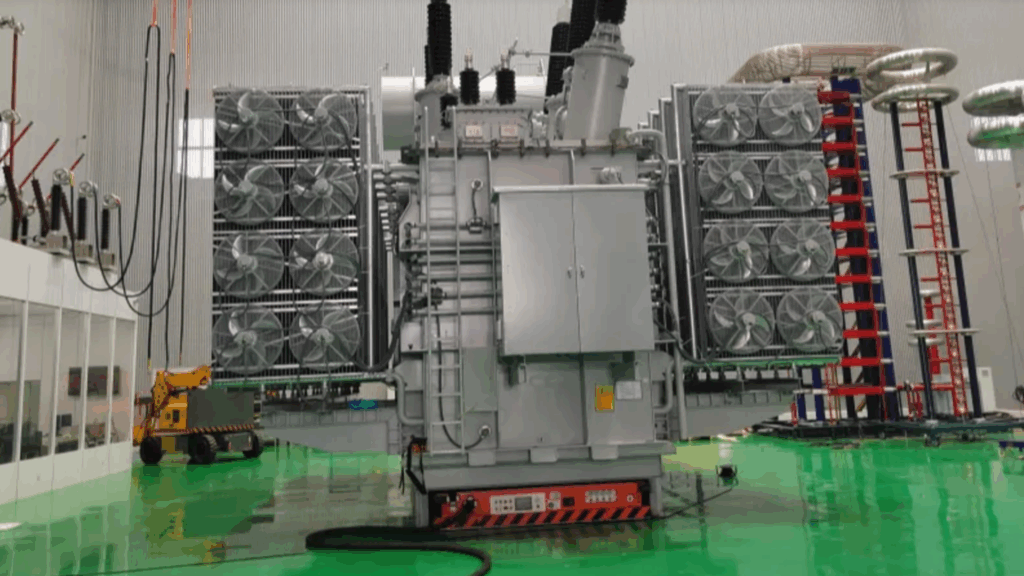
- AI Expansion Is Overwhelming Transformer Factories in Today’s Global Electricity Markets
- Delivery times for power transformers have extended from months to several years.
- Aging power grids are driving an urgent wave of transformer replacement
Power grids in Europe and North America are facing serious equipment shortages that could delay new power connections for years, experts have warned.
Power transformers, the large devices that regulate voltage before electricity reaches homes and factories, now take much longer to manufacture.
Orders that took 6-12 months before 2020 can now take 24-48 months to complete.

What is driving the increase in demand?
The rise of electric vehicles and the shift towards industrial electrification are placing significant new demands on local power grids.
Utilities increasingly compete directly with private developers for the same limited factory capacity, extending wait times for almost everyone.
Much of the substation infrastructure built 30 to 50 years ago in the United States and Western Europe now requires urgent replacement.
Wind farms and solar installations also require specialized step-up transformers to convert the power they generate before long-distance transmission occurs.
Battery storage projects add further complexity, as each installation requires its own dedicated transformer connected directly to the broader electrical grid.
The biggest new demand comes from data centers built to support artificial intelligence and AI tools, which consume electricity at an extraordinary rate.
A single installation of this type can consume several hundred megawatts, comparable to the electricity consumption of a medium-sized city.
Big tech companies can pay up front to reserve years of factory production, making smaller buyers have to wait even longer.
The situation is so critical that larger transformers, with powers above 100 MVA and 230 kV, once shipped within 12 to 18 months, can now take more than 36 months to be delivered.
Why factories can’t just build faster
The main limitation lies at the material level, since the transformer cores depend on grain-oriented electrical steel, which remains scarce.
Alternative steel grades cannot meet the strict efficiency standards set by the European Union and the United States Department of Energy.
Copper prices for internal winding materials have remained high, adding considerable cost pressure to already limited manufacturing budgets across the industry.
The shortage of skilled labor further complicates matters across the industry, as transformer assembly still relies heavily on precise and hands-on manual labor.
Factory testing facilities, where each unit undergoes short-circuit and impulse voltage evaluation, can only process a limited volume on a weekly basis, further limiting overall production.
As a result, equipment prices have risen 50% to 80% above pre-2020 levels, driven largely by rising material and labor costs.
While industrial transformers take longer, smaller units used in residential and commercial settings ship faster, typically within 12 to 20 months.
Industry analysts consider these pressures to be structural rather than temporary, suggesting that sustained investment in capacity will be required before conditions improve.
Buyers who plan ahead, secure factory spaces early, and standardize technical specifications appear to be better equipped to handle long delays.
Diversifying supplier relationships beyond congested manufacturers can offer flexibility as global demand continues to outpace available production capacity around the world.
Via Evernew Electrical (originally in Swedish)
Follow TechRadar on Google News and add us as a preferred source to receive news, reviews and opinions from our experts in your feeds. Be sure to click the Follow button!
And of course you can also follow TechRadar on TikTok for news, reviews, unboxings in video form and receive regular updates from us on WhatsApp also.


