
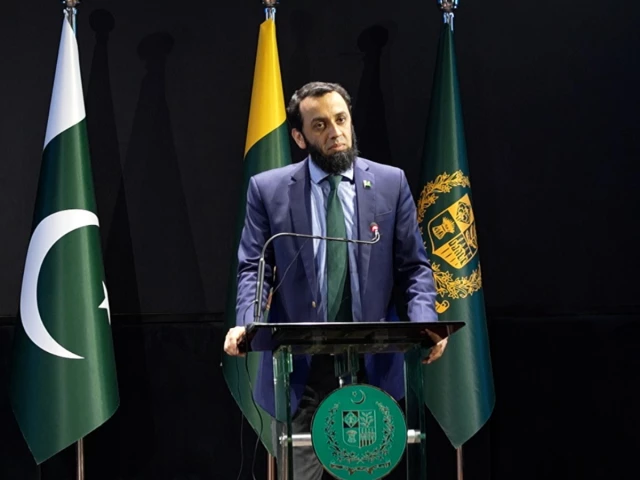
Tarar further states that “false flag operations have been part of Indian history”
Information Minister Attaullah Tarar holds a press conference on Wednesday, December 17, 2025.
ISLAMABAD:
Information Minister Attaullah Tarar on Wednesday marked one year since what he described as the “Pahalgam false flag operation”, claiming that India had failed to provide evidence for its allegations against Pakistan over the Pahalgam attack.
In a special address, Tarar said the Pahalgam incident “reflects hollow thinking, illogical reasoning, false ego, arrogance and greed”, adding that India has not provided satisfactory answers to the questions raised about the attack.
He said India “has continued to present its internal affairs as external affairs and external affairs as internal affairs”, stating that terrorism is “India’s internal problem which it presents as an external problem”. Instead, he described the Jammu and Kashmir dispute as “a recognized international issue that India presents as an internal matter.”
Tarar further stated that “false flag operations have been part of India’s history” and described the handling of the Pahalgam incident as “crude”. He said India did not respond positively when Prime Minister Shehbaz Sharif offered an “independent and impartial investigation”, adding that “India’s refusal to conduct an investigation is proof that the Pahalgam incident was a false flag operation”.
Highlighting procedural concerns, he said the registration of a First Information Report (FIR) within 10 minutes of the incident indicated that “its text had already been prepared”, calling the timing “unusual and surprising” given the distance between the site of the attack and the police station.
He added that “international media, Indian civil society, politicians and think tanks have also raised serious questions about the Pahalgam incident,” arguing that “it is extremely difficult to make baseless propaganda globally acceptable.”
According to Tarar, India has failed to construct an effective narrative on the issue and has not presented “credible or solid evidence.” He accused the Indian media of acting as a “propaganda tool,” saying they “created an atmosphere of war” and spread “false and baseless news.”
Read: Trump heeds the truce call of the CDF Munir and the prime minister
The minister also alleged that minorities in India face discrimination under what he described as a Hindutva ideology, claiming that Muslims are being subjected to violence. He further stated that India “uses terrorism as a state policy” and has been involved in such incidents around the world.
Tarar cited the arrest of Kulbhushan Jadhav as an expose of India’s involvement in terrorism and asserted that Pakistan possesses “irrefutable evidence” of India’s role in terrorist activities inside Pakistan, including incidents such as the Jaffar Express train attack and the Khuzdar incident.
He said Pakistan continues to confront terrorism resolutely and is taking practical steps, adding that “the entire nation is united in its determination to eliminate terrorism completely.”
Tarar warned that any “misadventure” by India would receive an “immediate, effective and decisive response” and said Pakistan would not compromise its sovereignty, dignity or security.
He concluded by stating that Pakistan has emerged globally as “a symbol of peace” and that the country’s political and military leaders, including Prime Minister Shehbaz Sharif and Field Marshal Asim Munir, remain united in efforts to safeguard national security.
Pakistan-India conflict
The latest escalation between Pakistan and India began on April 22, when an attack in Pahalgam killed 26 people. India immediately blamed Pakistan for the incident. However, Pakistan categorically rejected India’s blame.
In response, India took a series of hostile actions the next day, April 23, including suspending the 65-year-old Indus Waters Treaty (IWT), canceling visas for Pakistani citizens, closing the Wagah-Attari border crossing, ordering the closure of the Pakistan High Commission in New Delhi, and reducing diplomatic staff in each country’s embassies.
Tensions escalated further in the early hours of May 7, when missile strikes hit six towns in Punjab and Azad Jammu and Kashmir (AJK), destroying a mosque and killing dozens of civilians, including women, children and the elderly.
Read more: French intelligence official confirms Pakistan’s downing of Rafale
In a swift military response, Pakistan’s armed forces shot down Indian fighter jets, including three Rafale jets. The confrontation escalated again in the early hours of May 10, when India attacked several Pakistani air bases with missile strikes. In retaliation, Pakistan launched Operation Bunyanum Marsoos, which damaged Indian military installations, including missile storage sites, air bases and other strategic targets.
On May 10, US President Donald Trump announced that a ceasefire had been reached after intense diplomatic efforts overnight. Minutes later, the agreement was confirmed separately by Pakistan’s Foreign Minister Ishaq Dar and India’s Foreign Minister.


