
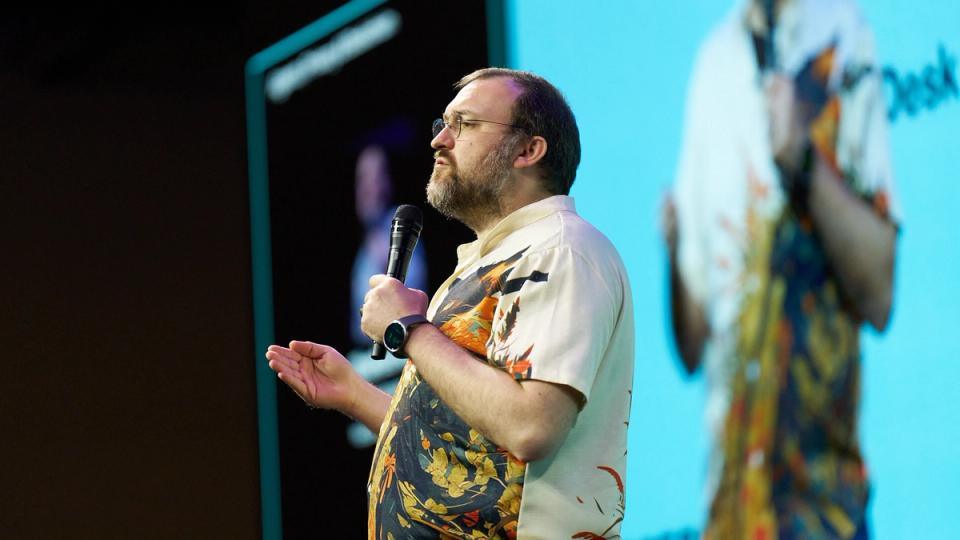
AI agents will be more relevant than humans on the Internet in the next decade, a change that is already forcing Google, Facebook and Amazon to react, Charles Hoskinson said.
In his keynote speech at Consensus Miami 2026 on Wednesday, Hoskinson also said that “by 2035, the majority of search, commerce and activity on the Internet will be artificial intelligence agents rather than people.”
He said the change threatens existing business models. “Amazon, Google, Facebook are terrified of the agent revolution,” Hoskinson said, adding that companies are investing heavily because “their entire business models will be disrupted.”
AI agents don’t click on ads or have brand preferences, Hoskinson explained, saying this “threatens the advertising-driven models of platforms like Google, Amazon and Facebook.”
“Why do you think Google is interested in x402?” asked his audience about the Coinbase-backed protocol that allows AI agents and applications to make direct programmatic payments over the internet using stablecoins and crypto lanes.
Hoskinson noted that this change will change the way cryptocurrencies are used, adding that artificial intelligence (AI) will increasingly take care of tasks such as due diligence, transaction execution, and interaction with decentralized finance.
Hoskinson’s AI agent forecast echoes that of Coinbase CEO Brian Armstrong, who said “very soon there will be more AI agents than humans transacting” and Binance founder Changpeng Zhao, who predicted they will “make a million times more payments than humans.”
On the other hand, Hoskinson said that AI agents are “the best thing that has happened to cryptocurrencies” because they simplify the user experience.
The Cardano founder warned cryptocurrency users not to rely on intermediaries instead of maintaining direct control of their assets, which is the principle, he said, on which cryptocurrencies were built.
“You have to own your data. You have to own your identity. You have to own your money,” he said, adding that users are “outsourcing that to custodial wallets,” “permissioned networks” and “third parties that they regret trusting when their account is closed.”
He also pointed to the fragmentation of blockchain ecosystems as a barrier to progress, saying it has slowed development. “11 million tokens have been issued over the years. We have enough,” Hoskinson said. “What I want is cooperation. What I want is for the mission to be accomplished.”
User experience remains a key issue limiting user adoption, said Hoskinson, who described current cryptocurrency onboarding processes as complex and error-prone. “That’s the user experience in 2026,” he said. “Is this a product you want to use?”
He said technologies such as account abstraction and chain abstraction could simplify how users interact with cryptographic systems, while maintaining control over assets and identity.
Hoskinson highlighted the change in attitude among financial institutions, noting that JPMorgan has moved from restricting cryptocurrency-related activity to developing blockchain-based products. “When we started, JPMorgan was closing people’s bank accounts and now they have a blockchain product,” he said.


