
In South Korea and Taiwan, the global hunger for artificial intelligence has unleashed a boom unlike anything seen in years. The two economies are home to a small group of companies that produce the coveted chips that AI cannot function without.
As exports reach record levels and stock markets soar, the rush to profit has reached a fever pitch. Seniors are opening brokerage accounts to funnel their savings into semiconductor stocks. On social media, young people question the meaning of their jobs and say they could earn as much (or more) trading stocks.
However, the windfall is masking a much bleaker outlook for much of the rest of the economy. Industries outside of chip manufacturing are struggling to navigate a turbulent landscape upended by energy and tariff shocks. Household debt and real estate prices continue to rise. Both currencies remain weak despite repeated government interventions to shore them up.
In both places, rapid growth arises from a narrow, highly specialized sector that employs only a small part of the population. Everyone else is left scrambling to find a way in.
As investors pour money into chip stocks, seeking a piece of the AI bonanza, they are amplifying wild swings in the market. Korean stocks plunged 10 percent on Tuesday, triggering a global tech sell-off, before rising more than 3 percent a day later.
Economists describe the phenomenon as a K-shaped split, in which some industries and socioeconomic groups prosper while others stagnate or fall behind. Around the world, including the United States, that divide has widened since the Covid-19 pandemic. Now, the rise of AI threatens to make it even more expansive.
The huge demand for AI, Taiwan’s central bank warned in a statement this month, risks creating an economy in which “different groups or industries experience drastically different economic outcomes.”
“The rich prosper,” the bank said. “Low-income group struggles.”
Few places illustrate that divide more clearly than the home countries of the world’s semiconductor giants, where companies like Samsung, SK Hynix and Taiwan Semiconductor Manufacturing Company are reaping record profits while much of the rest struggles.
South Korea’s benchmark KOSPI is the world’s best-performing major stock index since the beginning of the year. Samsung and SK Hynix have each surpassed $1 trillion in market valuation. Samsung shares have more than doubled this year, while SK Hynix has tripled. The Bank of Korea raised its economic growth forecast after rising exports. In May, South Korea’s exports rose 53 percent year on year to hit a record monthly high.
Samsung and SK Hynix dominate the production of memory chips that help artificial intelligence systems store information. These systems require enormous amounts of high-bandwidth memory, making the two conglomerates indispensable to the global development of AI and virtually guaranteeing demand for their products.
“Because semiconductors now account for such a huge proportion of Korea’s export value, the headline numbers look strong,” said Sang-Ha Yoon, executive director of the Korea Institute for International Economic Policy, a government-funded think tank.
But these figures hide a growing divergence. Exports of non-semiconductor products (petrochemicals, steel, batteries and auto parts) are struggling against weak demand and intense competition from China.
“The same headline that says ‘Korea is doing well’ also says: ‘Korea is doing well in a very limited sense,’” Mr. Yoon said.
For workers outside the AI sector, Yoon continued, “the lived experience may be one of higher costs and stagnant real wages.”
As the benefits of the boom become increasingly concentrated, many South Koreans have begun turning to the stock market to share in the gains.
Last month, stockbrokers reported that seniors in South Korea were cashing out life insurance policies and retirement savings to buy chip stocks. Nearly 83 percent of net stock purchases by retail investors on the KOSPI this year have been from Samsung or SK Hynix, according to Young Gon Lee, an analyst at Toss Securities.
“We are seeing capital that had been held in safer assets moving into riskier assets in search of higher expected returns,” Lee said.
The enthusiasm extends to Taiwan, which last month overtook India to become the world’s fifth-largest stock market. TSMC, which makes the world’s most advanced AI chips, accounts for more than 40 percent of the value of Taiwan’s benchmark index and has a market capitalization close to $2 trillion.
The chip frenzy has helped propel Taiwan to some of the fastest growth rates in the world. The economy expanded nearly 13 percent in the fourth quarter of 2025 and nearly 15 percent in the first three months of this year.
But that has not translated into broader wage increases, said Dachrahn Wu, executive director of an economic research center at National Central University in Taoyuan. Most Taiwanese workers are employed outside the technology sector and earn less than $1,500 a month, Wu said. The small group of people with high income can save and invest. Most can’t.
Taiwan’s economic growth falls mainly on the wealthy, such as TSMC shareholders, Mr. Wu said. “But the wages of ordinary people have not increased much.”
Semiconductors and other technology products account for the vast majority of Taiwan’s exports, said Ma Tieying, senior economist at DBS Bank in Singapore. Meanwhile, other export-dependent industries have been hit hard by tariffs and weakening demand.
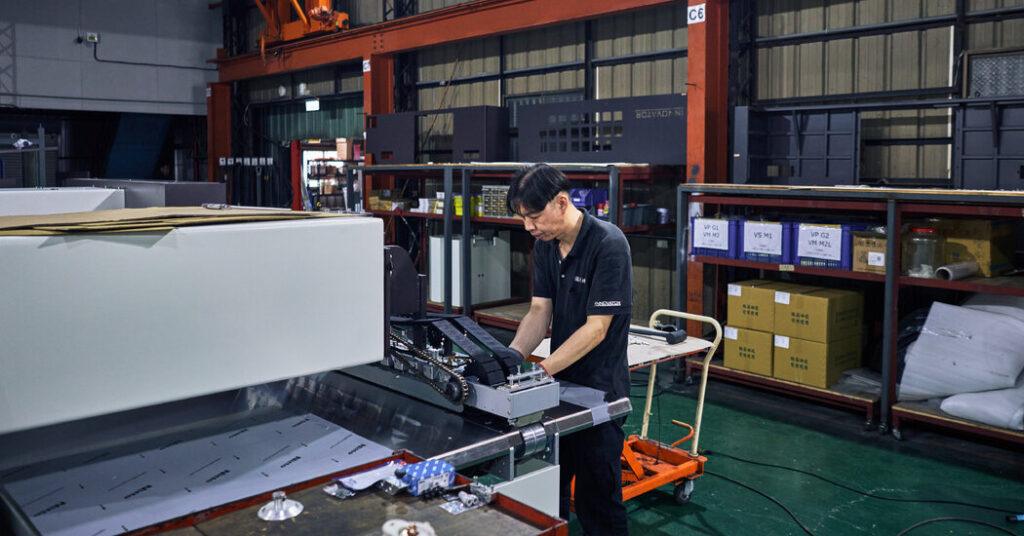
Taichung, a central city in Taiwan, was once a center of machine tools and home to hundreds of thriving small businesses. But tariffs have transformed the industry, said Ian Chang, second-generation general manager of Innovator Machinery Company, which makes woodworking machinery.
Many companies have gone bankrupt and others have put their workers on unpaid leave, widening the gap between traditional manufacturing workers and those with stable jobs in the technology sector.
Mark Ke has run his family’s textile manufacturing business, Ecomax Textile Company, in nearby Changhua, for nearly five decades. The company pioneered the use of plastic bottles and other recycled items to make fabrics, supplying international brands including British retailer Marks & Spencer, and producing material used in the 2014 FIFA World Cup balls.
However, since then, textile manufacturers have faced increasing competition from rivals in China and Southeast Asia. Instead of propping up the sector, the government provided incentives such as tax breaks and infrastructure for the island’s prized chipmakers, Ke said.
“The direction of government support is totally misplaced. It is primarily focused on the AI industry,” he said. Textile products fell by the wayside.
Questions over who benefits from technology windfalls have become a source of political and labor tension in South Korea.
Last month, Samsung workers threatened a strike that would have disrupted the national economy and global technology supply chain, demanding that the company commit 15 percent of its operating profits to employee bonuses. Samsung agreed to 10.5 percent.
If Samsung were to hit the roughly $200 billion in operating profit this year projected by some financial analysts, workers in its semiconductor division could receive bonuses of up to $430,000, a Samsung spokesman said. The average monthly salary in South Korea last year was about $2,800, according to government data.
Asked at the company’s annual shareholder meeting this month whether TSMC might adopt a similar arrangement, its president, CC Wei, said the company had increased employee bonuses over the past three years.
The dispute at Samsung may be an early sign of a broader debate about how the benefits of artificial intelligence should be shared.
Before workers reached a deal with the company, Kim Yong-beom, chief of staff to Lee Jae Myung, South Korea’s president, floated the idea of using tax revenue from companies benefiting from AI demand to finance what he called a “national dividend.”
“The critical concern is the possibility that the excess profits generated in the AI era will structurally exacerbate the K-shaped economic divide within society,” Kim wrote in a now-deleted Facebook post.
Allocating a portion of these profits to workers should not be seen simply as an act of redistribution, Kim said, but as a “necessary cost to maintain the stability of the entire system.”
Amy Chang-Chien, Xinyun Wu and Jin Yu Young contributed with reports.


