
Center asked to send 14,000 additional police personnel to maintain order
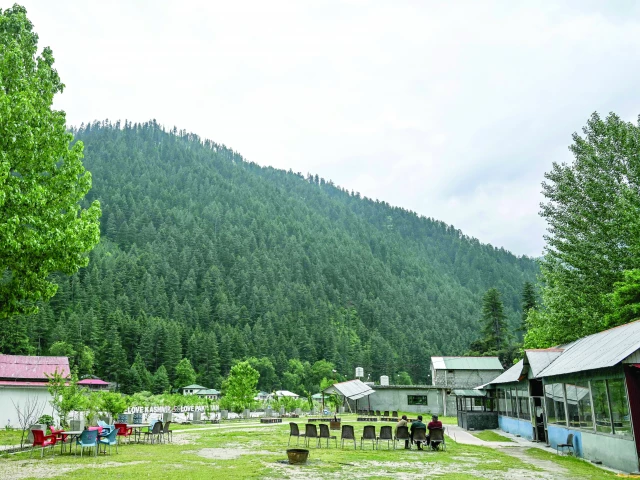
Guest house staff sit inside an empty tourist spot at Keran village on the LoC in Neelum Valley, AJK. Photo: AFP
ISLAMABAD/RAWALPINDI:
The Azad Jammu and Kashmir (AJK) government on Friday banned the Jammu Kashmir Awami Joint Action Committee (JK-JAAC) under anti-terror laws, as the state administration took steps to beef up security ahead of a planned protest call on June 9.
The AJK Home Department has issued a formal notification placing the JK-JAAC under the First Schedule of the Azad Jammu and Kashmir Anti-Terrorism Act, 2014, effectively banning its operations along with all associated nomenclatures, following presidential approval.
“The Government of AJ&K has reasonable grounds to believe that the Jammu and Kashmir Awami Joint Action Committee (JK-JAAC), also known by the names Joint Awami Action Committee (JAAC) and Awami Action Committee (AAC), is involved in terrorism,” the notification states.
He further alleged that the organization had acted “in a manner detrimental to the peace and security of the State” and had been “engaged in creating anarchy in the State by intimidating the public, promoting hatred and creating a sense of insecurity in the society and the public at large.”
Authorities said the decision was made following an evaluation of material deemed sufficient to indicate activities prejudicial to law and order. Citing Section 12 of the Anti-Terrorism Act 2014, the notification confirmed the group’s formal inclusion in the First Schedule, with all alternative names covered by the ban.
The Home Department said legal action would be taken in accordance with the law, while copies of the notification were distributed to all relevant authorities in Islamabad, Muzaffarabad as well as Poonch and Mirpur divisions of the state.
Authorities reiterated that maintaining public order remained a priority and stated that no organization would be allowed to “endanger the public peace, security or administrative order of the state” while coercive measures are implemented throughout the region.
In this context, the AJK government has also requested reinforcements of 14,000 additional police officers from federal and provincial agencies ahead of the June 9 protest call, while issuing a travel advisory for visitors.
In a letter to the Chief Secretary and Home Secretary, AJK Inspector General of Police Captain (retd) Liaquat Malik said the JK-JAAC had announced protests and a long march, which required manpower beyond the existing deployment at the district level.
The request includes 6,000 personnel from the Border Police, 5,000 from the Pakistan Rangers, 2,000 from the Islamabad Police and 1,000 from the Sindh Police. The letter states that 60% of deployed personnel should be equipped with riot gear, including tear gas guns and projectiles, while 40% would remain armed, with deployment planned for 15 days, from June 7 to 21.
Subsequently, more than 650 Islamabad police officers were summoned to the police lines headquarters under emergency provisions in an initial phase of deployment, and officials ordered them to report in plain clothes.
The AJK government also advised tourists and outsiders to avoid traveling to the region and urged visitors already present to leave immediately before the protest period. The notice will remain in effect from June 5 to 20 and authorities say it aims to “save visitors from any unexpected situation or inconvenience.”
Meanwhile, political and administrative authorities in AJK have expressed reservations about the protest call, stating that most of the committee’s demands have already been addressed through institutional mechanisms.
Officials said 35 of the 38 demands raised by the committee had been accepted or implemented, while progress continued on the remaining issues through established forums, including a Monitoring and Implementation Committee and an independent Committee of Experts constituted to deliberate on sensitive constitutional issues.
The government said it had carried out negotiations and relief measures, including compensation payments to affected families, wheat subsidies, property tax reduction, open merit in education and recruitment, and adjustments to administrative structure and financial reforms.
He further stated that certain demands related to taxes, revenue systems, refugee seats and official privileges required constitutional and legal processes rather than street agitation, adding that these matters were already under structured consultation.
Authorities accused the committee of rigidity and warned that any attempt to disrupt the electoral process on June 9 would be treated as an attack on democratic norms, particularly as the date coincides with the start of nominations for the July 27 general election.
Defense Minister Khawaja Asif also rejected the demand attributed to the action committee on abolition of 12 seats reserved for Kashmiris residing in Pakistan in the AJK Legislative Assembly, calling it an attempt to undermine the electoral process before the elections. In a post on X, he said that raising such a demand before the elections was tantamount to sabotaging the democratic framework.
Observers and officials further argued that the committee’s continued boycott of institutional dialogue and implementation forums had escalated tensions, and noted that its refusal to engage with designated committees had hampered resolution efforts.
They said the Monitoring and Implementation Committee had remained active in reviewing the agreed terms, while an expert panel on refugee seating had been constituted for legal deliberations, but the action committee’s involvement had been inconsistent.
Authorities argued that moving away from formal mechanisms and calling a strike to jam the wheels on the opening day of the nomination process risked obstructing candidates and disrupting administrative functions during a critical electoral phase.
With coercive measures now being implemented along with enhanced security measures, the AJK administration has reiterated that maintaining law and order, protecting public movement and ensuring the continuation of electoral activity remain its core priorities in the days leading up to June 9.
(WITH INPUT FROM THE APP)


