
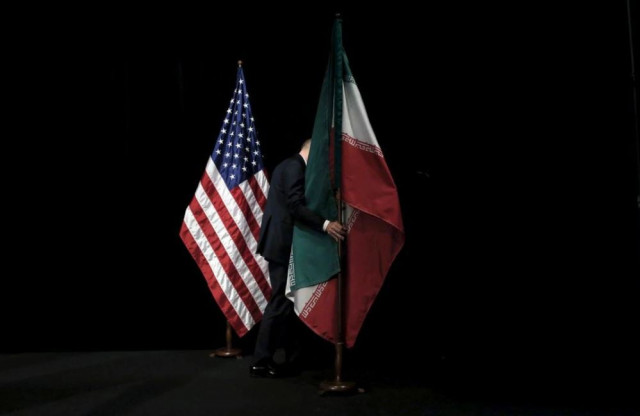
A staff member removes the Iranian flag from the stage after a group photo with foreign ministers and representatives from the United States, Iran, China, Russia, Britain, Germany, France and the European Union during the Iran nuclear talks at the International Center in Vienna, Austria, July 14, 2015. PHOTO: REUTERS/FILE
ISLAMABAD:
Pakistan will host what could be the decisive round of talks between Iran and the United States, as a series of critical confidence-building measures taken by both sides on Friday revived hopes of a landmark deal, diplomatic sources said.
They said the delegations from Tehran and Washington had agreed in principle to travel to Islamabad for the next round, very soon.
The move follows an intense phase of behind-the-scenes diplomacy led by Pakistan after the initial round of talks failed to produce a breakthrough.
Sources described the upcoming engagement as “crucial”, with momentum regained after what they called “unprecedented diplomatic efforts” by Islamabad to prevent the process from collapsing.
Pakistan’s role as mediator was initially met with skepticism, even within domestic political circles.
Questions arose over whether Islamabad possessed the influence and credibility to overcome the deep mistrust between Iran and the United States and, more importantly, to avoid a potential military escalation.
However, instead of publicly boasting, Pakistan quietly pursued a calibrated strategy of engagement with both sides.
Against all odds, Islamabad managed for the first time to secure a two-week ceasefire, creating the necessary space for diplomacy to take root.
This was followed by a rare face-to-face meeting between Iranian and American officials in Islamabad, an important milestone, although it failed to resolve key differences.
Diplomatic experts say the real breakthrough came later.
With the peace process at stake and Tehran deeply distrustful of Washington’s intentions, Pakistan intensified its efforts. In a high-risk move, Chief of Army Staff Field Marshal Syed Asim Munir traveled to Tehran for direct talks with Iranian leaders.
The visit, described by officials as “momentous”, proved instrumental in removing key obstacles that had stalled progress.
The result was quick. A ceasefire was announced in Lebanon, while Iran took the reciprocal step of reopening the Strait of Hormuz, developments widely seen as essential confidence-building measures to sustain dialogue.
Analysts believe that Pakistan’s effectiveness as a mediator is due to a combination of strategic factors.
While Islamabad maintains close ties with Tehran and has also cultivated a working relationship with the Trump administration, observers maintain that its influence goes beyond traditional diplomacy.
Pakistan’s status as a nuclear power, coupled with its strong military and deep understanding of regional security dynamics, gave it unique influence.
Unlike conventional mediators like Oman or Qatar, Pakistan was able to take into account the broader geostrategic environment, including nuclear considerations, proxy conflicts, and its defense ties with key regional players like Saudi Arabia.
Using these levers, Islamabad conveyed a clear message to Tehran that the current window for a deal represented a strategic opportunity, one that may not remain open indefinitely.
At the same time, Pakistan engaged in dialogue with Washington at the highest level, urging restraint and emphasizing the need to prevent potential spoilers from derailing the process.
Despite the progress, officials warn against premature optimism.
Since US President Donald Trump expressed his willingness to travel to Islamabad to sign a possible agreement, a wave of optimism has taken over sectors of the media. However, diplomats stress that negotiations remain complex and are far from over.
“A deal is only done when it is done,” one source said.
While there is broad agreement on several issues, negotiations are still ongoing on more contentious points. The process involves detailed, step-by-step engagement that requires patience, precision and sustained trust-building between parties with decades of hostility.
Officials also warn of lingering risks, including domestic political pressures in both countries and the possibility that external spoilers may try to undermine progress.


