
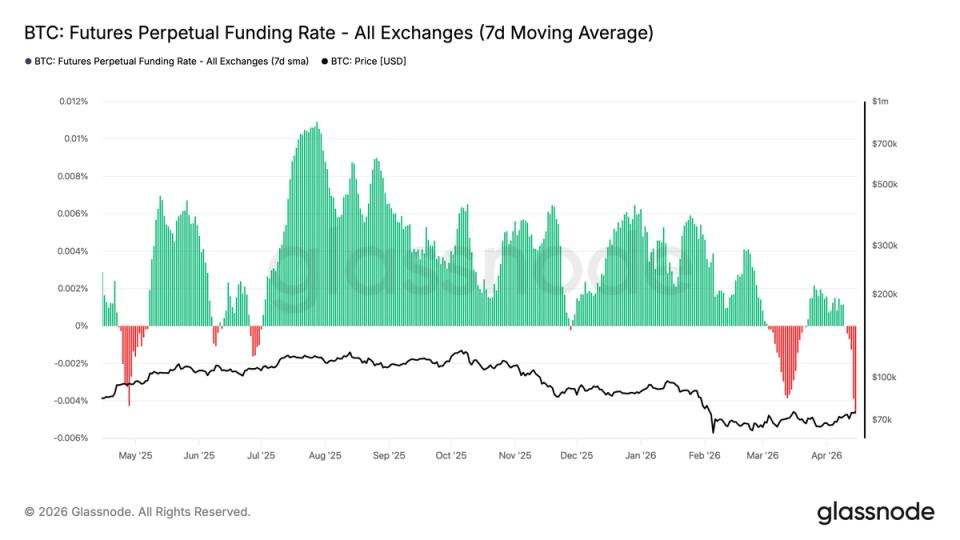
bitcoin Funding rates have hit their most negative levels since 2023, a sign that has historically coincided with market lows, as BTC continues to rise to $75,000.
On a seven-day moving average, funding rates have fallen to around -0.005%, according to data from Glassnode.
Funding rates are periodic payments exchanged between long- and short-term traders in perpetual futures contracts, designed to keep prices aligned with the underlying spot market. When the rate is positive, long traders pay short traders, reflecting bullish positioning. When the rate turns negative, the shorts pay the longs, indicating a market biased towards bearish bets.
Despite the current sustained streak of negative funding throughout March and April, bitcoin has continued to rise, rising from a low to mid-$60,000 level to around $75,000.
Historically, deeply negative funding rates have often coincided with local lows in the price of bitcoin. This dynamic typically reflects overcrowded short positioning, which can create the conditions for a squeeze to the upside as bearish bets unwind.
This pattern has developed over multiple market cycles. In March 2020, during the COVID-19-induced market crash, bitcoin fell to around $3,000 as funding rates turned sharply negative.
A similar setup emerged in mid-2021 amid China’s mining ban, when prices fell to $30,000. Funding rates also reached their most extreme during the FTX crash in November 2022, when bitcoin bottomed near $15,000.
The trend continued into 2023, when funding rates turned negative during the Silicon Valley Bank crisis, coinciding with bitcoin’s brief dip below $20,000 before recovering. More recently, episodes such as the yen carry trade crash in August 2024 and the April 2025 “Liberation Day” sell-off also caused negative financing to align with local lows.
The persistence of negative funding rates suggests that bearish positioning remains elevated even as price action trends higher. This divergence may indicate that the market is climbing a wall of worry, and that short positions could act as fuel for further gains.


