
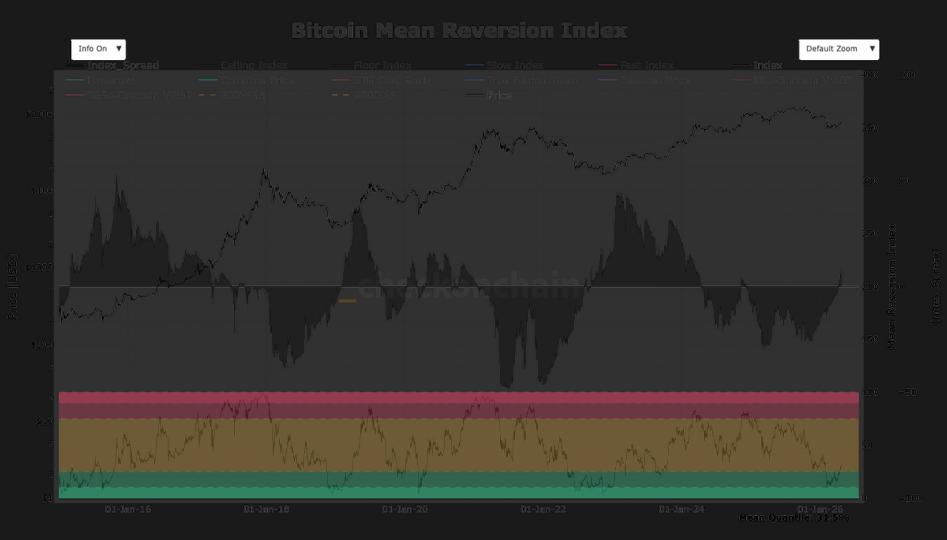
Bitcoin Recent gains (it’s up nearly 15% this month) aren’t enough to convince some industry observers that the largest cryptocurrency has escaped the bear market it entered in October. After all, it is still 40% below its record.
Deeper declines are possible in the future, with some unnamed forecasters predicting a drop to as low as $40,000, a 70% drop from its all-time high. The figure comes from bitcoin analyst James Check, who says such a move is unlikely. While it’s not impossible, he said in a post about X, it would be statistically extraordinary.
“Just to give you an idea, for the bears who want to see $40,000.
You may end up being right. However, consider that based on mean reversion, averaging against nine anchors (a combination of technical, chain, trend, fast, slow, etc.), it is a Q 0.4 event.
Less than $2 Bitcoin in 2011.”
After rising over $126,000 in October, bitcoin fell more than 50% to around $60,000 in February before stabilizing. On Friday it was trading around $78,000.
Speaking to the bears, Check said their predictions deserve closer scrutiny.
The checkpoints target Bitcoin’s mean reversion index, a composite model that averages multiple key valuation metrics, including the 200-week moving average, realized price, power-law trend, and a series of volume-weighted average price measures. The index ranks the price of bitcoin based on a historical percentile.
When modeled at $40,000, bitcoin registers as a “0.4 event,” meaning it would fall in the 0.4 percentile of all daily closes.
“That’s below any significant deviation in all major anchors,” Check said.
To put it in context, Check says that would be equivalent to trading bitcoin below $2 in 2011 in relative terms. On the contrary, today’s price is around the 31.5th percentile, historically weak but within normal correction ranges.
“There is no zero probability in the markets,” Check added, “but this would be an almost unprecedented outcome.”


