
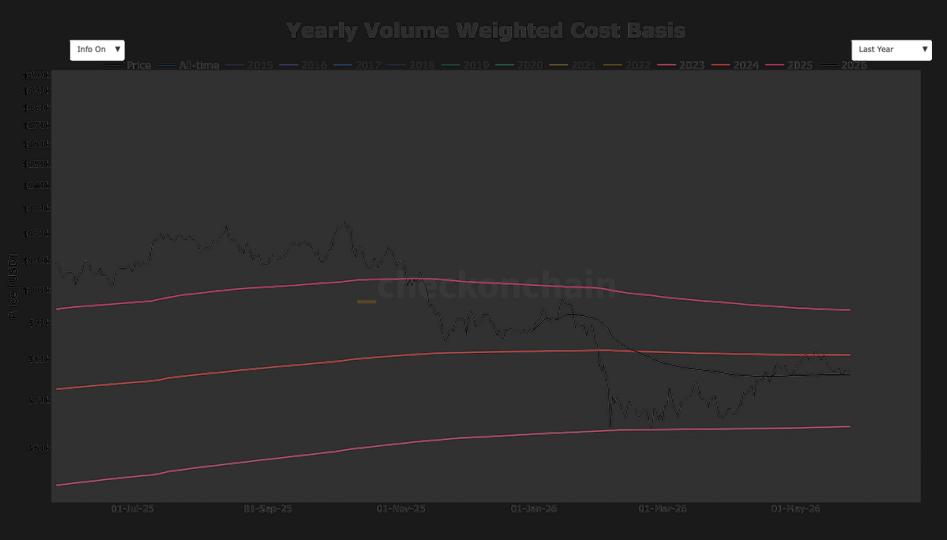
The price of bitcoin has been closely tracking the 2026 realized price, currently around $76,200, according to Checkonchain, since early April.
The realized price is the average on-chain acquisition cost of all bitcoins that were last moved within a specific year. In other words, it reflects the aggregate cost basis of market participants as of 2026, and is seen by some market participants as a more meaningful indicator than traditional psychological support or resistance price levels.
In February, when bitcoin plunged to nearly $60,000, the market found support near the 2023 realized price, reinforcing the growing importance of these cohort cost base levels in shaping market structure.
This weekend, the largest cryptocurrency briefly fell to $74,500 before recovering from its 128-day moving average, another closely watched technical level.
At its current price, bitcoin is trading below two major on-chain metrics clustered around $77,000: the true market average and the cost basis for the short-term holder. Both levels are widely monitored as indicators of broader market sentiment and short-term positioning.
Attention is also focusing on Deribit’s options expiry on May 29, where approximately $6.6 billion in open interest will expire.
The largest concentration of call options, around $600 million, is at the strike price of $80,000. The highest sell position is concentrated at $75,000, with around $377 million in open interest. Market makers and traders are incentivized to keep price action locked between these levels as expiration approaches, contributing to the current period of compressed volatility.
Data from Glassnode shows that over 15% of the circulating supply of bitcoin has been purchased between $74,000 and $83,000, highlighting how compressed the current trading range has become and how much supply is concentrated around these levels.



