
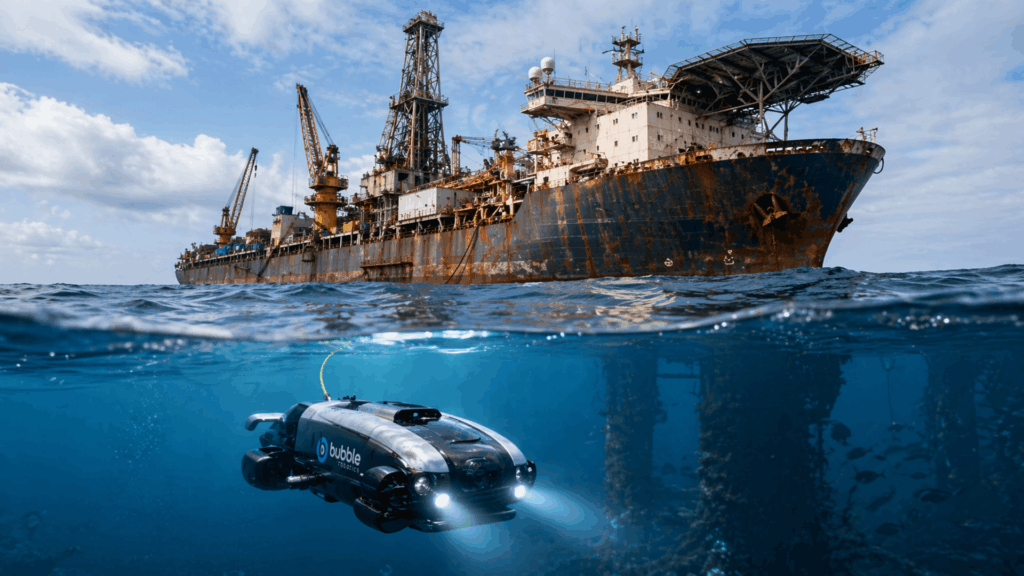
- Offshore inspections remain costly due to heavy reliance on vessels
- Autonomous robots aim to completely eliminate humans from offshore operations
- Persistent deployment replaces short missions with continuous data collection
Offshore operations have long relied on vessels and crews costing up to $100,000 a day, which is not only expensive but also dangerous and difficult to scale.
Bubble Robotics, a startup founded by former NASA and ETH Zürich robotics engineers, now claims to have a better solution.
The company emerged from stealth in April 2026 with $5 million in seed funding and a plan to replace those expensive ships with autonomous robots.
Article continues below.
Persistent robots instead of episodic vessels.
Bubble Robotics’ central argument is simple: offshore operations should not require humans at sea, and instead of sending ships out for short missions, it deploys robotic systems that remain on site for months at a time.
These AI-enabled machines continuously inspect, monitor and collect data without human intervention.
“Today, 80 to 90 percent of offshore inspection costs come from vessels and crews,” said Jean Crosetti, CEO and co-founder of Bubble Robotics.
“By removing that dependency, we unlock a step change in cost, security and operational frequency. What used to be episodic becomes continuous.”
The timing of this approach aligns with a serious industry problem. The energy sector alone needs 600,000 additional professionals by 2030, but the existing workforce is already stretched.
Bubble’s robots operate under a robotics-as-a-service model, meaning industrial customers pay for capacity with no upfront capital expenditure or overseas mobilization.
This model reduces costs, addresses labor shortages, and increases the frequency of inspections.
Beyond industrial applications, maritime security remains a persistent concern, as undersea cables, ports and energy assets are largely unmonitored in real time despite increasing exposure to threats.
Persistent autonomous systems offer a way to detect anomalies and protect infrastructure without deploying human teams.
This technology is based on advances in cutting-edge artificial intelligence and satellite connectivity that have supposedly reached a tipping point.
It remains an open question whether these systems can actually operate for months in the harsh ocean conditions without failing.
Despite this concern, there are signed letters of intent worth more than $4 million, which implies market interest.
However, actual deployments will reveal whether the robots perform as advertised.
The ocean is at the center of the energy transition, global trade and climate resilience; However, history is littered with ambitious marine technologies that battled salt water, storms, and biological pollution.
Bubble Robotics may have a compelling thesis, but persistent autonomy at sea is a claim that requires proof, not just press releases.
Follow TechRadar on Google News and add us as a preferred source to receive news, reviews and opinions from our experts in your feeds.


