
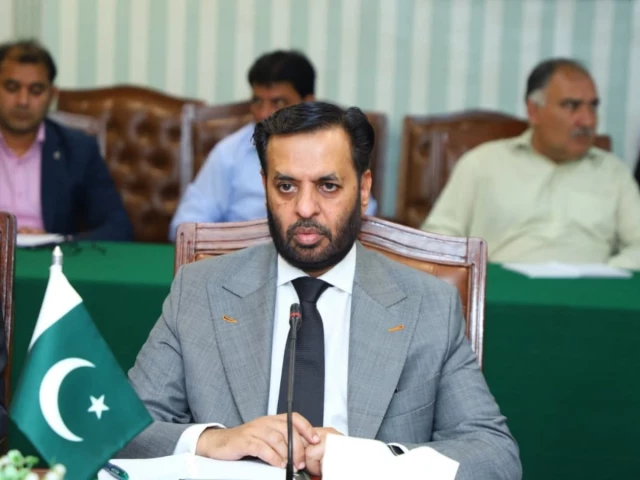
Minister Kamal calls the approval an important milestone in strengthening Pakistan’s healthcare system.
Minister of Health, Mustafa Kamal. Photo:
Federal Minister for National Health Syed Mustafa Kamal on Wednesday announced that the federal cabinet approved Pakistan’s first National Vaccine Policy, paving the way for local production of vaccines in the country.
The approval was granted during a federal cabinet meeting held in Islamabad, chaired by Prime Minister Muhammad Shehbaz Sharif.
On the occasion, the minister termed the development as an important milestone in strengthening Pakistan’s healthcare system. He noted that the country had until now lacked a comprehensive national vaccine policy, adding that the newly approved framework was developed through extensive consultations with key stakeholders to ensure a robust and sustainable approach.
Kamal highlighted the role of Special Assistant to Prime Minister on Industries and Production Haroon Akhtar Khan, Minister of State for Health Dr Malik Mukhtar Ahmed Bharath and Drug Regulatory Authority of Pakistan (DRAP) in shaping the policy.
He stressed that establishing local vaccine production capacity had become essential for the country and described the initiative as an important step towards achieving self-reliance in the health sector.
The federal cabinet also approved the formation of a special committee under the supervision of DRAP to determine vaccine prices and ensure quality standards.
The policy aims to reduce dependence on imported vaccines, conserve foreign exchange and make Pakistan self-sufficient in vaccine production.
Pakistan, in collaboration with the World Health Organization, has, over the last five decades, provided life-saving vaccines to 160 million children and 130 million mothers.
Earlier this year, World Health Organization vaccine chief Kate O’Brien said vaccines have saved 154 million lives worldwide over the past 50 years, noting that more than 30 diseases can be prevented through immunization.


