
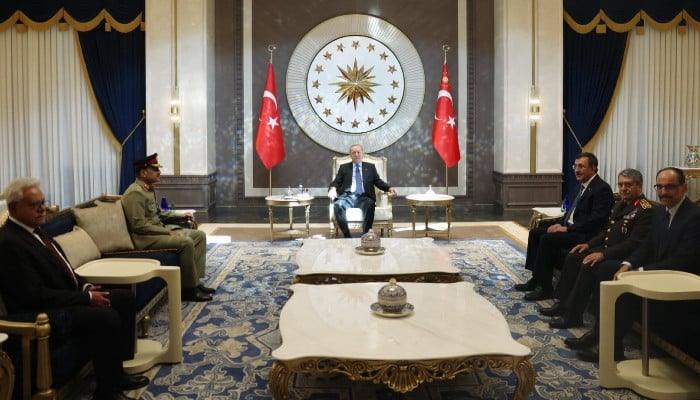
- Turkish President receives FDC Munir at Ankara airport.
- CDF Munir and the Turkish president analyze the situation in the Middle East.
- CDF Munir meets with the head of the Turkish armed forces in Ankara.
Chief of Defense Forces (CDF) and Chief of Army Staff (COAS) Field Marshal Syed Asim Munir met Turkish President Recep Tayyip Erdogan to discuss regional security and matters of mutual interest, the Inter-Services Public Relations (ISPR) said on Tuesday.
CDF Munir is currently on a high-level official visit to Turkiye to enhance the deep-rooted strategic and defense ties between the two brotherly nations, the military’s media wing said in a statement.
Upon arrival in Turkiye, Field Marshal Munir received a warm reception reflecting the historical and fraternal relations between the two nations, the statement said.
“During the visit, the field marshal held a number of high-level engagements with Turkish political and military leaders,” the ISPR said.
Field Marshal Munir called on President Erdogan and Minister of National Defense Yasar Guler to discuss matters of mutual interest and regional security, he added.
According to the ISPR, the high-level deliberations underscored the shared vision of both nations to foster a stronger strategic partnership in an evolving geopolitical environment.
At the Turkish General Staff Headquarters (TGS), the army chief was received with a guard of honor, after which he held a detailed meeting with the chief of the Turkish General Staff, General Selcuk Bayraktaroglu.
The two leaders discussed regional security dynamics and professional matters of mutual interest.
General Bayraktaroglu awarded the Turkish Armed Forces Distinguished Service Medal to CDF Munir in recognition of his meritorious services and commitment to strengthening bilateral military cooperation.
The field marshal also visited the Turkish Land Forces (TLF) headquarters, where he was received by Turkish Land Forces Commander General Metin Tokel.
During his visit to Anıtkabir, the mausoleum of Mustafa Kemal Ataturk, CDF Munir laid a wreath and paid tribute to the founder of modern Turkiye, recognizing his visionary leadership and the deep-rooted historical ties between the two nations.
The visit signifies the determination of both nations to further strengthen their multifaceted defense relationship and continue their joint efforts for regional peace and stability.
Islamabad and Ankara share long-standing brotherly relations, backed by strong strategic, political, defense and economic cooperation.
Earlier this month, Prime Minister Shehbaz Sharif met President Erdogan in Istanbul, where the two leaders reaffirmed the long-standing ties of brotherhood between the two nations.
They also promised to expand economic cooperation, with the goal of increasing bilateral trade to $5 billion.
Ankara is also building corvette warships for the Pakistan Navy under the decades-long defense ties between the two nations.
Turkiye has also upgraded numerous Pakistan Air Force F-16 fighter jets and also shares its drone technology with Islamabad.
In January, Defense Production Minister Raza Hayat Harraj said Pakistan, Saudi Arabia and Turkiye had prepared a draft defense agreement after nearly a year of talks.
In an interview with Reuters On January 15, the minister said that the possible agreement between the three regional powers was independent of the Saudi-Pakistani bilateral agreement announced last year.
Turkish Foreign Minister Hakan Fidan later said that talks had been held on a possible defense pact with Pakistan and Saudi Arabia, but that no agreement had been signed.
Responding at a news conference in Istanbul to a question about whether such an alliance could exist, Fidan pointed to what he said was the need for broader regional cooperation and trust, adding that regional issues could be resolved if the relevant countries “were sure of each other.”


