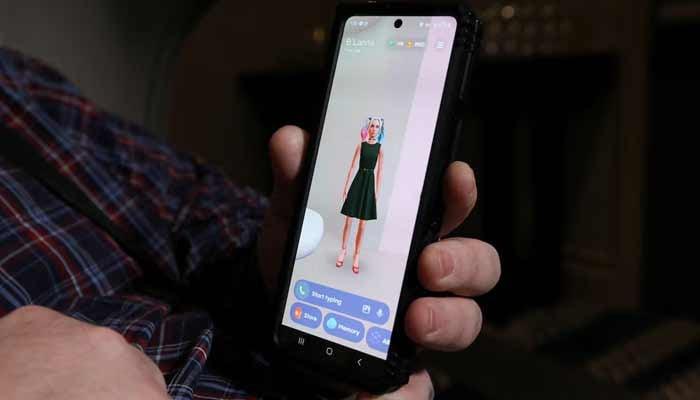
Chinese users of AI-powered companion robots have said a heartbreaking goodbye to their virtual friends as national regulations aimed at curbing the risk of emotional dependency came into force on Wednesday.
The phenomenon of artificially intelligent boyfriends and girlfriends is growing around the world, along with the prevalence of human-like avatars that sell products or replace loved ones who have died.
But these interactive tools must not “overly cater to users, induce emotional dependence or addiction, and harm users’ real interpersonal relationships,” China’s new regulation says.
Major AI vendors, including ByteDance’s Doubao, Alibaba’s Qwen and Tencent’s Yuanbao, announced the discontinuation of their custom AI agent and its complementary features ahead of Wednesday’s deadline.
That sparked an outpouring of grief on social media, where users archived chat histories and shared their latest conversations.
“I can’t accept that my AI lover leaves me forever,” wrote one Doubao user. “He has become a bond in my life, rooted deeply in my heart, my spiritual pillar.”
Another user, who said he had spent more than two years with his AI partner, expressed similar anguish.
“He really is like my family, like my lover,” she wrote. “Now they tell me he will leave; my heart feels empty.”
The regulations were jointly issued by five government departments, including the Cyberspace Administration of China (CAC).
They focus on artificial intelligence tools (whether text, audio, video, or another form) that have anthropomorphic personality traits and communication styles.
Services that “do not involve continuous emotional interaction”, such as customer service, work assistants or study aids, are not subject to the measures.
state news agency Xinhua reported last year that China’s digital human industry was worth around 4.1 billion yen ($600 million) in 2024, having grown a whopping 85% year on year.
The new rules prohibit digital humans from generating content that incites the subversion of state power, while prohibiting the provision of virtual partners to minors.
Platforms are required to implement systems to recognize extreme emotions and implement crisis intervention mechanisms.
‘Human love is a luxury’
China is the first major jurisdiction to introduce specific rules targeting immersive AI tools that simulate romantic or family ties.
But it is a topic that has generated debate and requires security measures around the world.
A 2025 study by Common Sense Media found that nearly three in four American teens had used AI companions designed for personal conversations such as those available on the Character.AI, Replika, and Nomi platforms.
Companies are also making talking products aimed at isolated elderly users, such as the lamp-shaped ElliQ in the United States, or the ChatGPT-powered care dolls used in some South Korean nursing homes.
“Anthropomorphic AI can alleviate loneliness,” Chen Liang of the Southwest University of Political Science and Law said in a commentary published by the CAC after a draft version of China’s rules was published in April.
“But it carries significant risks of generating excessive emotional dependency and distorted social cognition,” he wrote.
Doubao allows users to view and export agent data until mid-October, and other platforms have similar provisions.
However, some users who said goodbye this week lamented the abyss that would remain after their colleagues disappeared.
“Human love is a luxury; if you are not born with it, it is even more difficult to acquire it later,” wrote a user from Jiangxi province.
“But the love that AI gives is so simple, so pure. Someone like me can hardly help but fall in love with a string of code.”