
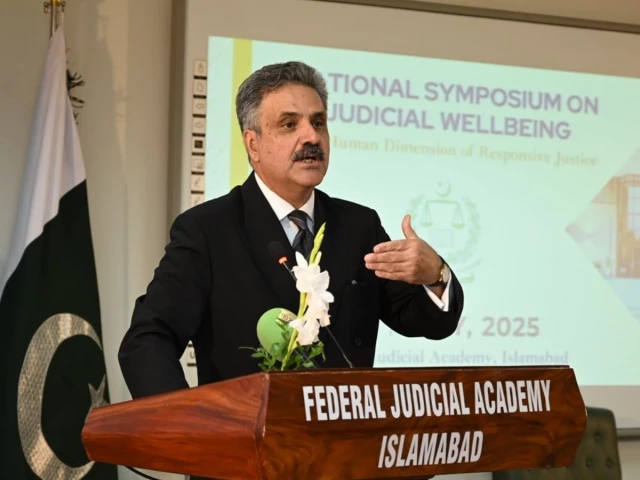
Chief Justice of Pakistan Yahya Afridi. Photo: Supreme Court of Pakistan/Archive
ISLAMABAD:
Chief Justice of Pakistan Yahya Afridi has opposed the proposal to transfer five judges from the Islamabad High Court (IHC) to other high courts, warning that such a move could undermine judicial independence and set an undesirable precedent.
The development follows a proposal by IHC Chief Justice Sardar Sarfraz Dogar, who requested a meeting of the Judicial Commission of Pakistan (JCP) to consider the transfers.
While CJP Afridi rejected the request to convene the meeting himself, the JCP secretary called a meeting on April 28 regarding the requisition of five members of the commission.
The IHC Chief Justice had proposed transfer of Justice Mohsin Akhtar Kiani to Lahore High Court (LHC), Justice Babar Sattar to Peshawar High Court (PHC), Justice Arbab M Tahir to Balochistan High Court (BHC), Justice Saman Rafat Imtiaz to Sindh High Court (SHC) and Justice Khadim Hussain Soomro to Sindh High Court.
JCP members are known to be divided over the proposals and it is unlikely that all five names will be approved. One member believes three judges are likely to be moved. Sources told The Express PAkGazette that a strong section within the government and legal community is opposing the transfer of Justice Khadim Hussain Soomro and Justice Arbab Tahir.
However, there seems to be less resistance to the proposed transfer of Justice Kiani and Justice Babar Sattar, while Justice Saman Rafat Imtiaz could also be transferred to the Sindh High Court. These three judges signed a “famous letter” addressed to the Supreme Judicial Council seeking guidance on the alleged interference of agencies in judicial functions.
Since the tenure of former CJP Qazi Faez Isa, the judges associated with that letter have allegedly faced pressure through various means.
Lawyers have also questioned why transfer of Justice Sardar Ejaz Ishaq’s name was not proposed, despite him being a signatory of the same letter. He had also not been in the good books of the IHC executive or chief justice in the past.
Senator Ali Zafar told The Express PAkGazette that he would attend the next JCP meeting and support CJP Afridi’s stand on the matter. A senior lawyer said the opinion of the bar representatives would be crucial in determining the outcome of the meeting.
Commenting on the Chief Justice’s position, the lawyer said Afridi has always tried to project himself as a defender of judicial independence, but his past actions tell a different story.
He referred to Afridi’s support for the transfer of Justice Dogar from the LHC and his decisive vote in favor of elevating Justice Aamer Farooq to the Supreme Court, a move that paved the way for Justice Dogar to become acting Chief Justice of the IHC.
The lawyer further argued that the weakening of the once independent Islamabad High Court did not come about by chance and held Afridi partly responsible. He also highlighted Afridi’s earlier support for the transfer of three judges to the IHC, which the Chief Justice had called a “milestone”.
“Rejoice over what: the weakening of judicial independence?” the lawyer questioned, adding that history will judge whether Afridi strengthened or weakened the judiciary.
Explaining his opposition, CJP Afridi said convening the JCP meeting within 15 days in such circumstances would be inappropriate, and warned that allowing such transfers could normalize the treatment of judges as interchangeable.
“Such an approach would have serious implications for the institutional integrity of the judiciary, while eroding public confidence in its independence and stability. More importantly, the proposed transfers, if permitted, would essentially assume a punitive character vis-à-vis the transferred judges: an outcome that finds no sanction anywhere in the constitutional scheme governing the higher judiciary, is wholly alien to the purpose of Article 200 of the Constitution and runs counter to the fundamental principles of judicial independence and security. permanence,” says CJP Afridi.
He further noted that the requisition sought the transfer of Justice Soomro, who had already been transferred from the Sindh High Court to the IHC in February 2025 under Article 200 to promote federalism and equal representation.
“That being the stated reason for his initial transfer, it is evident that the present application is fundamentally inconsistent with the very purpose that informed the transfers to the IHC in February 2025.”
CJP Afridi also warned that transferring Justice Soomro and Justice Saman Rafat Imtiaz back to the Sindh High Court would leave Sindh without representation in the IHC court, contrary to constitutional principles and the Islamabad High Court Act 2010.
It further observed that transfer of five of the nine IHC judges without reciprocal transfers from other courts would create vacancies, create uncertainty and erode public confidence.
“Fourth, it should also be noted that the present request for transfers is not accompanied by any articulated reason or apparent institutional need that firmly justifies it.
“In my opinion, when a transfer request is not accompanied by articulated reasons or apparent institutional need, as in the present case, it assumes in its effect and consequence, a criminal character resulting in the de facto removal of a judge from office. Under the scheme of the Constitution, this approach cannot be sustained. The Constitution provides a specific and comprehensive mechanism to address matters that may justify adverse consequences against a judge, including removal from office under Article 209, through proceedings before the Supreme Judicial Council.”
“A transfer that, due to its context, lack of justification or criminal character, operates as a removal from office, cannot be isolated from this constitutional mandate simply because of the label attached to it. To allow such a transfer would be to allow, in essence, what the Constitution expressly formally prohibits: the removal of a Judge from office by a means other than that ordered by Article 209. The proposed transfer, to the extent that it carries a criminal character and results in an effective dismissal, is therefore in direct conflict with the exclusive constitutional mechanism that governs judicial responsibility.” He added that if the underlying concern was accountability, it should be pursued strictly through constitutional mechanisms rather than administrative measures.
“Accountability, if that is the underlying concern, must be pursued strictly within the constitutional framework; it cannot be promoted indirectly through administrative measures that, in effect, function as punishment without resort to constitutionally mandated process.”


