
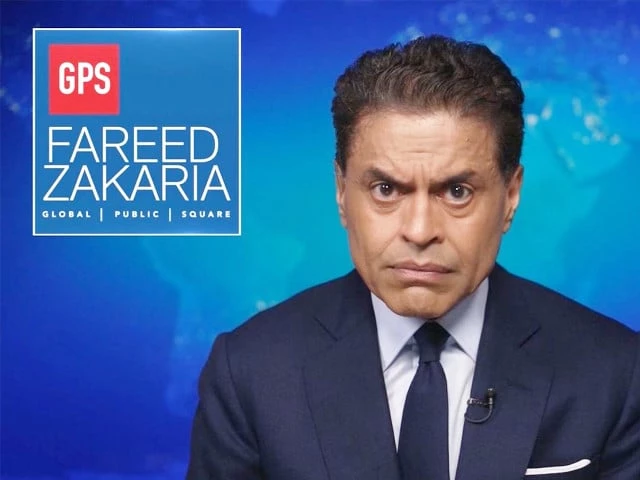
Zakaria said that ultimately the US president would have to accept that he too must “give something up.”
KARACHI:
American journalist and renowned author Fareed Zakaria has said that US President Donald Trump would have to “give something up” to secure a deal with Iran to end the conflict.
In an interview in Express 24/7 On the show ‘Full Frame’ with host Fahd Husain, Zakaria said President Trump would want a deal that would put him in a stronger position than former US President Barack Obama.
“You can’t accept that you went through all this big drama, withdrawing from the nuclear deal, bombing the nuclear program, bombing Iran, essentially going to war with Iran and all you end up with is what Obama was able to achieve through negotiations,” he said, adding that Trump would try to frame any outcome as an improvement over the Iran nuclear deal.
“It’s now clear that Donald Trump has gotten himself into something that is more complicated than he imagined… but he can’t get to the result he wants, which is an Iranian surrender.”
He noted that the US president would have to make concessions, such as easing sanctions or restoring some level of diplomatic engagement. Zakaria added that Trump’s approach to negotiations, including his dealings with China, showed a degree of pragmatism.
Zakaria said that ultimately the American president would have to accept that he must also “give up something,” such as sanctions relief on Iran or some level of new diplomatic engagement. He said Trump might be able to do so, citing his negotiations with China as an example where he acted more hands-on.
He described recent events and the announcement of talks as a hopeful sign, saying it seemed like both sides wanted a deal.
“So in a sense, both sides need a deal, but it’s very hard for them to figure it out,” he said, adding that there was deep distrust between American and Iranian negotiators, and both sides had legitimate reasons to be distrustful.
Describing the recent US and Israeli attacks as the “most devastating blow” to Iran’s military, nuclear program and basic command and control system since 1979, he said the country’s economy was also in very poor condition, with growing public discontent.
Zakaria, who also hosts CNN’s ‘Fareed Zakaria GPS’, praised Pakistan’s mediation efforts. “Frankly, Pakistan’s mediation has been very positive and very useful because you need some facilitator when you have so much accumulated mistrust.”
He also warned that miscalculations could derail the process and return the situation to violence.
Calling the confrontation with Iran a turning point, he said the United States was not basing its military action in any sense of defending an international order or a rules-based system. He added that the approach reflected feelings among parts of the American public that the country had borne the burden of maintaining global order for too long and should instead act in a more selfish, short-term and transactional manner.
“One thing to remember with Trump is that right now he is the most unpopular president in American history, more unpopular than Richard Nixon when he resigned after Watergate,” he said, adding that Trump still retains substantial support from about 35% of the population who firmly believe in his approach.
Regarding Pakistan’s role, Zakaria again praised its mediation efforts, while highlighting the importance of internal development. He said Pakistan needed to improve the lives of its people to ensure a sustainable path to growth, calling it the most important source of strength.
“The true path to maintaining power and influence on the world stage is economic growth and technological progress. You have to have weight on the world stage to have a voice,” he concluded.


