
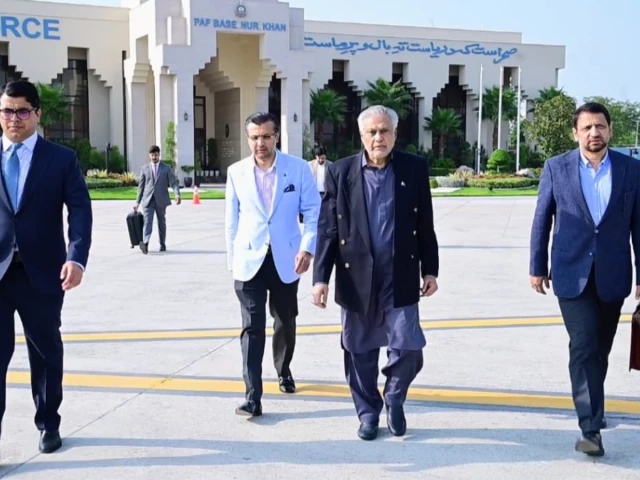
FO says Dar will engage with leaders to advance international cooperation in AI and promote equitable governance of AI.
Deputy Prime Minister and Foreign Minister Ishaq Dar leaves for Shanghai on a two-day visit to attend the 2026 World Conference on Artificial Intelligence. PHOTO: FO
Deputy Prime Minister and Foreign Minister Ishaq Dar left for Shanghai on Thursday on a two-day visit to attend the World Artificial Intelligence Conference 2026 and formalize the country’s participation in a new international artificial intelligence organization, according to a statement issued by the Ministry of Foreign Affairs (FO).
According to the FO, Pakistan will join the World Artificial Intelligence Cooperation Organization (WAICO) as a founding member during the visit. He said the deputy prime minister will “sign the agreement” for Pakistan’s accession to WAICO as a founding member.
Deputy Prime Minister and Foreign Minister Senator Mohammad Ishaq Dar @MIshaqDar50 left Islamabad for Shanghai, China on a two-day visit.
As Pakistan joins the World Artificial Intelligence Cooperation Organization (WAICO) as a founding member, the DPM/FM will sign the… pic.twitter.com/bUs8pTNW5j
– Ministry of Foreign Affairs – Pakistan (@ForeignOfficePk) July 16, 2026
During the visit, Dar also plans to “participate in the 2026 World Conference on Artificial Intelligence” and “engage with leaders to advance international cooperation in AI and promote inclusive and equitable governance of AI,” the ministry said.
An earlier Foreign Ministry statement said Dar would also hold a bilateral meeting with Chinese Foreign Minister Wang Yi on the sidelines of the conference, in addition to meetings with other counterparts to discuss matters of mutual interest.
He said he would present Pakistan’s perspective on strengthening international cooperation on artificial intelligence, with a focus on “inclusive and equitable” governance of AI, capacity development and the priorities of developing countries, particularly those in the Global South.
During Prime Minister Shehbaz Sharif’s visit to China in May, the prime minister expressed support for China’s initiative to establish the World Artificial Intelligence Cooperation Organization, saying it “represents a concrete step towards promoting the development of artificial intelligence for good and for all,” and said he will work with China to “promote global governance and international cooperation in artificial intelligence.”
WAICO
Chinese President Xi Jinping is expected to outline an ambitious vision for China’s role in global AI governance at a forum on Friday, as Huawei shows off its most advanced AI computing cluster yet, in a sign of Beijing’s push to build a domestic alternative to American technology.
Xi’s attendance at the annual World Artificial Intelligence Conference (WAIC) for the first time underscores Beijing’s vision of AI as an engine of economic growth and a strategic technology in global competition.
Huawei’s Atlas 950 SuperPoD large-scale artificial intelligence computing system will make its public debut during the July 17-20 forum in Shanghai. The launch is one of the clearest demonstrations yet of China’s efforts to assemble these types of systems without the most advanced chips from American giant Nvidia.
Designed for large-scale AI training and inference, the system links thousands of Huawei Ascend AI processors through high-speed interconnects to function as a single computing cluster.
DeepSeek’s latest V4 model has been adapted to run entirely on clusters built with Huawei’s Ascend chips, highlighting Chinese companies’ progress in building AI ecosystems independent of US technology. Domestic media reported that Chinese chipmakers including Biren and MetaX would also launch new “supernode” computing clusters.
The meeting comes as Washington and Beijing prepare for their first government-level talks on artificial intelligence under US President Donald Trump’s administration, turning WAIC from a technology showcase into an early test of how China intends to compete for influence over the rules governing artificial intelligence around the world.
The two rivals laid out competing visions for AI governance at a UN dialogue on AI last week, with Washington arguing that sweeping regulation would stifle technological advances and Beijing framing its low-cost, open-source AI models as a public good that would bridge global inequality in AI.
“In this context, WAIC has become more than a technology showcase; it is now a geopolitical arena where Beijing seeks to articulate its vision of AIas a national priority and a diplomatic instrument,” wrote George Chen, president of Asia Group’s digital practice.
In a January speech, Xi likened AI to a “great, epoch-making technological transformation after the steam engine,” and Beijing has explicitly staked future growth on spreading AI throughout its economy and achieving self-sufficiency in cutting-edge technologies.
China proposed the creation of a World AI Cooperation Organization (WAICO) at last year’s conference, but no country has formally announced its membership.
The conference coincides with a High-Level Meeting on Global AI Governance in Shanghai, where progress on WAICO and the implementation of the Global AI Governance Initiative is expected to be announced.
Beijing is also expected to promote China’s open source AI models as a low-cost alternative to Western offerings, arguing they can expand access to the technology.
“AI development should never move towards a self-enclosed technological monopoly, but should always be anchored to the fundamental goal of serving humanity,” reads a statement. town newspaper comment this week.
In addition to Chinese tech industry heavyweights, WAIC will be attended by international leaders including UN Secretary-General Antonio Guterres, Kazakh President Kassym-Jomart Tokayev and Thai Prime Minister Anutin Charnvirakul.
Nine Turing laureates and Nobel laureates will also attend, including deep learning pioneers Yoshua Bengio and Richard Sutton, but there is little representation from major American tech companies.
“China has been moving ahead with Southeast Asian countries in terms of AI capability development, and presents itself as a spokesperson for developing countries that are falling behind in the AI race,” said an Asian diplomat. Reuters on condition of anonymity.
Other product launches expected at the forum include smartphones with AI agents from ZTE-owned Nubia and AI startup StepFun, according to Chinese media.
Additional contributions from Reuters


