
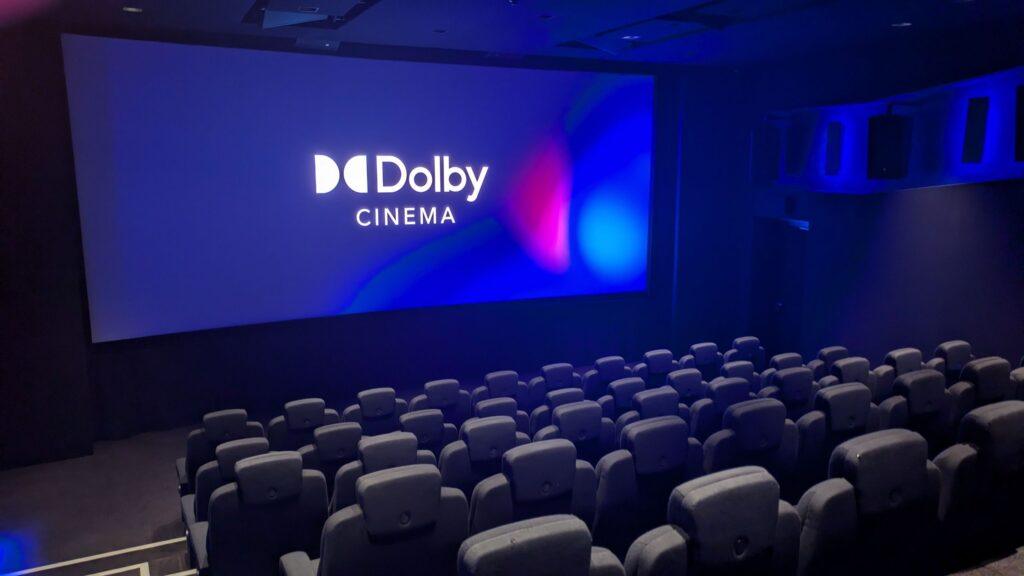
- Dolby AC-4 was the preferred codec of many audio professionals
- Better than existing Atmos audio without high bandwidth requirements
- Peacock is updating but other streamers have not announced any plans
One of the biggest differences between streamed movies and 4K Blu-ray is sound quality: Even the most expensive streaming levels offer compressed audio with a clear reduction in dynamic range and clarity compared to disc-based playback.
But that could change thanks to a new version of Dolby sound technology that audio experts apparently can’t distinguish from uncompressed PCM, but which works at broadcast bit rates.
The new technology is called Dolby AC-4 and it is a codec: an encoder/decoder for compressing audio. It is designed to deliver much higher audio quality than current broadcast soundtracks and can do so without requiring much bandwidth.

With a little help from the New York chapter of the Audio Engineering Society and Engine Room Audio, the audio professionals at Immersive Machines in the US set up a double-blind listening test in which audio experts listened to mixes in multiple formats, including the current broadcast standard, DD+JOC (using the Dolby Digital+ codec).
Time and time again, experts chose AC-4 as having the best sound quality among compressed audio formats.
How Dolby AC-4 Could Make Your Streams Sound Sweeter
Most streaming apps use DD+JOC for immersive audio. It’s a version of the proven Dolby Digital standard, with the JOC bit standing for “Joint Object Coding.” Allows Dolby Atmos to deliver positional audio without breaking support for 5.1 channel setups.
Dolby AC-4 is what Dolby calls a next-generation audio codec and is designed to more efficiently deliver audio for listening with headphones and speakers, including 3D object information.
As Dolby explains: “The AC-4 encoding system uses new aspects of object audio beyond what is already available with Dolby Atmos in other Dolby codecs for features such as dialogue enhancement or commentator replacement.” And significantly, “it can deliver channel-based audio quality equivalent to approximately half the bitrate of Dolby Digital Plus.”
That’s impressive, but does it deliver?
Immersive Machines’ listening test used three formats: DD+JOC at 768 kbps, uncompressed PCM audio at 13.824 kbps, and AC-4 L4 at 448 kbps. Listeners heard them on a full 7.1.4 channel system, on the same system with specific speakers muted and individual speakers soloed. Each format was assigned the letter A, B or C and their identities were not revealed until the test was performed.
The test was not based only on vibrations. Listeners were asked to identify compression artifacts such as gating, “hiss,” loss of spatial precision, and loss of frequency range. And with all the speakers turned on—that is, the way you’d listen at home—AC-4 was in a tie with the reference uncompressed PCM audio.
Compression was most noticeable on AC4 when the individual speakers were soloed, but for a full home theater setup, AC-4 delivered seemingly lossless sound, but while transmitting only 3% of the data.
There are some caveats here, particularly the sample size: a test with 16 listeners is not hard science. But at the same time, 16 audio professionals who are told to listen critically are going to be much more demanding than you or me, so it’s still a great endorsement.
The first TV/movie streaming service to offer AC-4 will be Peacock, although Amazon Music and TIDAL are also using the technology (but specifically for spatial audio based on binaural headphones). Other streamers may migrate, but so far there have been no further announcements since Peacock’s news at CES 2026.
You can read more about Immersive Machines’ testing here, but while it suggests that streamers could offer 4K Blu-ray-like sound quality in the very near future, it’s worth noting that Dolby AC-4 doesn’t address one of the other reasons people buy Blu-Ray discs: unlike streaming, purchased Blu-Rays don’t disappear from your library when streaming rights expire or the streamer decides to reduce its catalog.
Better quality has certainly been a big factor in why people buy 4K Blu-ray, especially if you have a great home theater setup, but collecting and ownership is growing as a reason why people are investing in Blu-ray again, and AC4 won’t change that.
Are you thinking of buying a new television?
Try our TV size and model finder! You tell you how far you sit from your TV, we’ll tell you what size to buy based on viewing angle advice from picture quality experts, and we’ll recommend our three best TVs in that size at different prices.

Follow TechRadar on Google News and add us as a preferred source to receive news, reviews and opinions from our experts in your feeds.


