
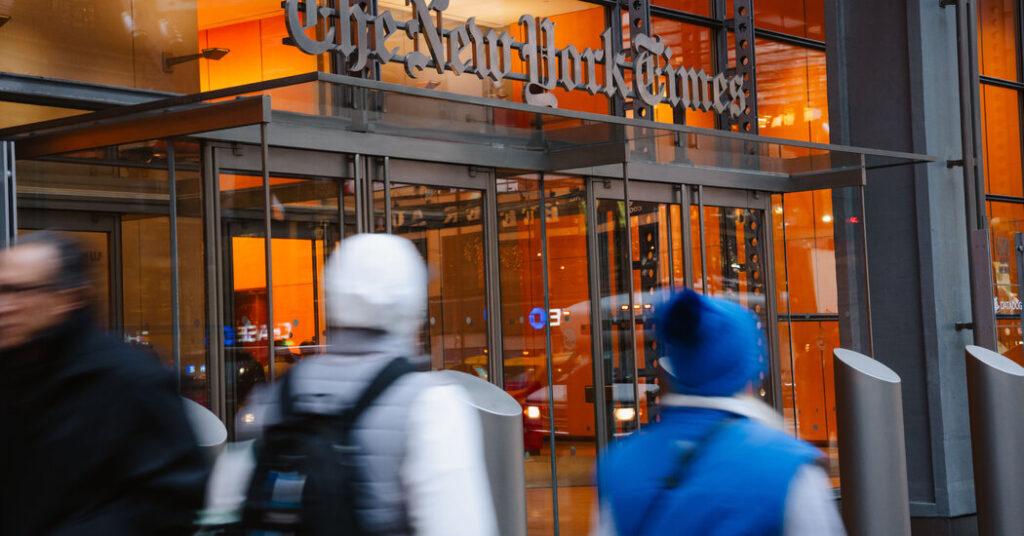
The Equal Employment Opportunity Commission is poised to file a civil rights lawsuit against The New York Times, centered on allegations that a white employee did not get the promotion he sought and argued it was because of his race and gender, two people familiar with the matter said.
The lawsuit, which could be filed this week, would mark a rapid escalation of an investigation that has been underway for months, said one of the people, who had been briefed on the investigation but could not discuss it publicly.
The EEOC is subject to strict laws against disclosing details of civil rights complaints and investigations. Danielle Rhoades Ha, a spokeswoman for the Times, called the allegations “politically motivated.”
It was unclear whether the lawsuit would be filed on behalf of the original plaintiff or if the EEOC would bring the case as a broader civil rights claim, arguing that the Times’ employment practices, including diversity initiatives, amounted to unlawful discrimination against white men.
A reverse discrimination lawsuit would be the latest example of the agency’s new approach under its Republican chairwoman, Andrea Lucas, who has directed EEOC staff to pursue cases aligned with the Trump administration’s policy priorities, including diversity programs. That includes a broad attack on companies and institutions for what they describe as discrimination against white men.
President Trump has publicly criticized diversity, equity and inclusion efforts as “radical” and “wasteful.” He issued a series of executive orders aimed at eliminating DEI efforts across the federal government shortly after taking office, including ordering that government employees who oversee diversity, equity and inclusion efforts be placed on leave.
Ms. Lucas has said her priorities include pursuing discrimination based on religion and national origin and rooting out DEI initiatives.
The commission, the centerpiece of the Civil Rights Act of 1964, is responsible for enforcing federal civil rights laws in the workplace. Ms. Lucas has publicly argued that DEI initiatives violate those laws. In 2024, it opened an investigation into Nike for its diversity efforts, a matter that became public earlier this year after the EEOC filed a motion in federal court to enforce a subpoena.
EEOC employees have said they feel pressured to bring cases favored by the Trump administration, even when the legal basis appears shaky, The Times reported last week.
An EEOC spokesperson did not respond to a detailed request for comment.
“The New York Times categorically rejects the baseless and politically motivated allegations that the Trump administration’s EEOC is bringing against us,” said Ms. Rhoades Ha. “Our employment practices are, and always have been, lawful, merit-based, and focused on recruiting and promoting the best talent in the world.”
Unlike the Nike investigation, which had no original whistleblower (Ms. Lucas conducted it herself, court documents show), the case against The Times has its roots in a complaint from an employee. The complaint came months before Lucas published a social media post encouraging white men to come forward with discrimination complaints.
The Times employee originally filed the complaint in July 2025 with the EEOC office in New York, the person familiar with the case said. In September, The Times learned that the case had been transferred to an investigator in Alabama, the person said.
For months, the EEOC and The Times exchanged requests for information as the agency conducted its investigation. The agency and The Times recently briefly engaged in what is known as “conciliation,” a voluntary, negotiated mediation process that generally follows a determination by the agency that there is “reasonable cause” to believe discrimination occurred.
If conciliation fails, the agency decides whether to sue the employer in federal court.
The Times employee had unsuccessfully sought a deputy editor position.
The EEOC’s initial investigation was a broad look at the newspaper’s hiring and promotion practices. But in recent weeks, the newspaper was told that the investigation had narrowed down to a central question: whether the employee didn’t get the deputy editor job because he was a white man.
The talks were underway when suddenly on April 21, the EEOC told The Times that the case had been referred to the agency’s legal unit for review, to determine whether it would file a civil action in court, the person said.
“Throughout this process, the EEOC deviated from standard practices in highly unusual ways, blatantly weaponizing a traditionally independent government agency to serve a predetermined narrative,” said Ms. Rhoades Ha. “If this lawsuit moves forward, we will defend ourselves and our values vigorously, as there is not a single piece of evidence to support any claim of discrimination.”
Trump has long attacked the media as biased and corrupt. But in his second term, he has repeatedly leveraged the federal government’s regulatory tools to harass and, in some cases, extract millions of dollars in payments from his perceived enemies in the press.
Hollywood studio Paramount paid $16 million and promised to reform its diversity hiring practices last year, several weeks before management approved its megamerger with Skydance. Last week, federal regulators took the extraordinary step of ordering a review of the licenses of ABC-owned stations, saying their action was prompted by an investigation into the network’s diversity and inclusion policies.
Michael Grynbaum contributed reports.


