
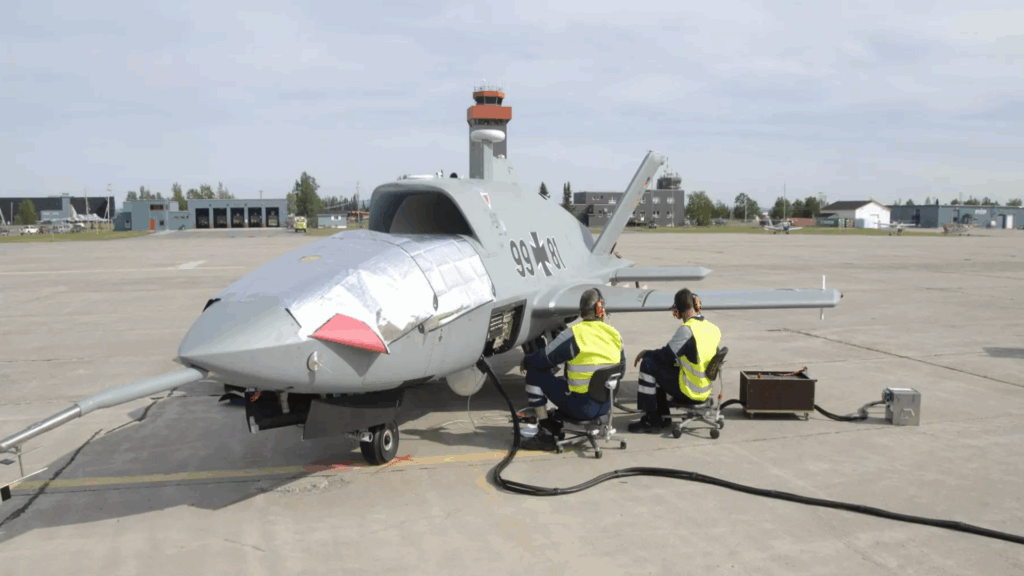
- Barracuda technologies now power Europe’s largest military aviation projects
- Europe’s largest drone emerged from a secret program
- Barracuda pioneered concepts of cooperation with manned and unmanned aircraft
On April 2, 2006, at the San Javier airport in Spain, a drone released the brakes, accelerated to maximum and took off after less than 1,000 meters of runway.
The first full flight lasted only 15 minutes, but what those minutes represented required 40 months of intensive and secret development.
The Barracuda project was launched in early 2003 at Airbus in Manching, Germany, initially operating as a classified program deliberately removed from bureaucratic oversight.

A secret program built inside a bubble
The team studied the development of both civilian and military aircraft before eliminating anything unnecessary.
“It was an incredible feeling, we had achieved what seemed impossible,” said Peter Hunkel, who ran the program with a core team of just 35 people.
Thomas Gottmann, then the plane’s chief engineer, recalled the conditions that made it work.
“We were few people, we were in the same building, we had short distances, almost no administrators and all the support of management,” he said.
“We were working in a bubble and we only had to worry about one thing: developing in the shortest possible time the largest unmanned aircraft in Europe at that time.”
Financing came from Airbus’ own resources together with support from the German Federal Ministry of Defense and associated technical and procurement agencies.
The result was a jet-powered drone built almost entirely of carbon fiber composites, with a length of more than 8 m, a wingspan of more than 7 m and a maximum take-off mass of more than three tonnes.
Designer Mario Kalanja explained that the commission was deliberately ambitious from the beginning.
“I was tasked with designing a drone that looked like a ‘fighter jet,'” he said, adding that stealth requirements and low radar signature demands directly influenced every aerodynamic decision made during development.
Unlike entry-level drones built for accessibility, the Barracuda was designed from the start for operational complexity, flying autonomously and communicating with ground stations over multiple data links.
Six campaigns, one failure and a lasting legacy
The program suffered a major setback in September 2006, when the Barracuda was lost at sea during its second test flight.
After extensive research carried out together with the German Air Force, the platform was rebuilt and relaunched in 2009.
Five more flight campaigns followed, covering reconnaissance functions, cooperative anti-collision systems and automatic flight path adjustment under controlled test conditions.
They also tested ground target recognition and coordination of drones operating alongside manned platforms using sensor data fused from multiple sources.
Those technologies are now migrating directly to two of Europe’s most important defense programs: the Eurodrone and the Future Combat Air System (FCAS), which is expected to be operational in 2040.
“The Barracuda is the father of them all,” Hunkel stated clearly. Gottmann added that without the Barracuda, none of the manned and unmanned teaming concepts fundamental to FCAS would be possible.
via Airbus

Follow TechRadar on Google News and add us as a preferred source to receive news, reviews and opinions from our experts in your feeds.


