

- OmniCalculator Tests Suggest Claude and ChatGPT Aren’t the Smartest
- Report finds Grok 4.2 performs better in logic and problem solving
- Claude continues to lead in writing quality and tone.
ChatGPT remains the most popular AI chatbot, even with the ongoing exodus to Claude, but is it the smartest? A new report from OmniCalculator suggests that ChatGPT might not be the smartest AI out there.
When it comes to the quantifiable mathematical ability of these AI chatbots, the smartest free AI model is, surprisingly, Grok. Specifically the Grok 4.2 model from xAI. That doesn’t mean anything about your writing style and ability, or anything else chatbots can do, but it does suggest that you might have an advantage in math prowess.
Claude’s winning style
Claude’s recent rise in popularity has been driven by people wanting to abandon ChatGPT over unpopular military AI deals, but also the way he composes and writes responses.
Article continues below.
Quality is difficult to quantify compared to mathematical skills, but it is easy to recognize. The OmniCalculator report highlighted Claude 4.6 as the best in its sector, capable of processing and responding to long documents without losing coherence and maintaining a consistent voice at all times. For the average person, this is much more important than whether AI can solve complicated logic and math problems.
It even appears in the personality facsimiles offered by AI models. Claude is more willing to acknowledge uncertainty, which can make his responses seem measured rather than overconfident. That tone can create the impression of deeper thought, regardless of any underlying reasoning.
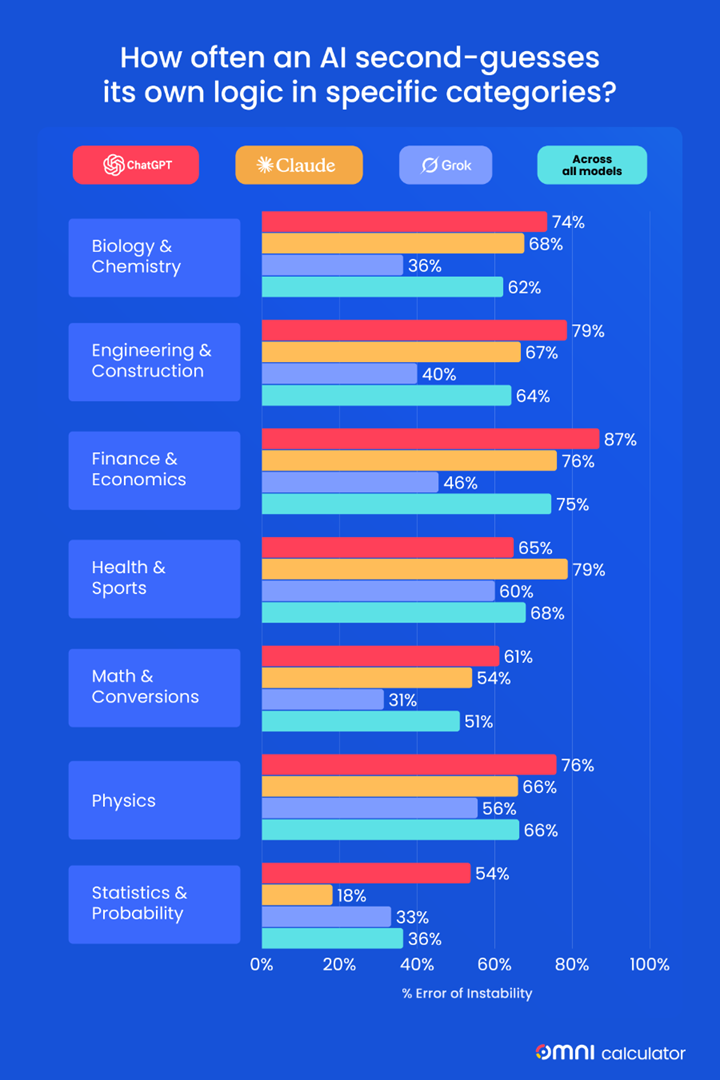
Legacy models, including older versions of ChatGPT and Claude, were found to be checking or guessing their own answers about 60% of the time in complex problem-solving scenarios. That kind of instability doesn’t always appear in casual use, but it becomes apparent when pushing these systems through multi-step reasoning tasks where consistency is important.
But Grok 4.2 reduces that instability rate to 33.1%, meaning you’re much less likely to backtrack or alter your conclusions mid-process. That’s great for reasoning and logic, but it doesn’t help much when it comes to imitating the soft tones that make other models feel more polished.
Specialized subjects
The capacity distinction is not trivial. Good writing and strong reasoning skills (or AI facsimiles of the same) are related skills, but they are not identical. A model can produce elegant prose and make subtle errors of logic. Another may arrive at the correct answer but converse in clumsy ways that seem very outdated.
However, the margins are tight and no model works perfectly. Even the best performers make mistakes, sometimes on relatively simple problems. The idea of a single most intelligent AI is a bit absurd in that sense. The clear winner in one context may retreat in another.
And there is no permanent winner. Each of the leading models occupies a slightly different space. Similarly, the underlying complexity of what people understand by intelligence is complex and constantly evolving. Which AI chatbot to trust is situational. The best model for writing an email may not be the best for solving a technical problem. The most reliable coding assistant may not produce the most natural-sounding text.
As competition intensifies, companies are likely to lean more on their strengths, refining specific capabilities rather than pursuing an all-purpose solution. The result could be a landscape in which specialization matters as much as scale. So the question of which AI is smarter will probably always have the answer “it depends.”

Follow TechRadar on Google News and add us as a preferred source to receive news, reviews and opinions from our experts in your feeds. Be sure to click the Follow button!
And of course you can also follow TechRadar on TikTok for news, reviews, unboxings in video form and receive regular updates from us on WhatsApp also.

The best business laptops for every budget


