
Pakistan is ’embarking on right path of reform and resilience’, post-IMF reform eases pressures: Aurangzeb
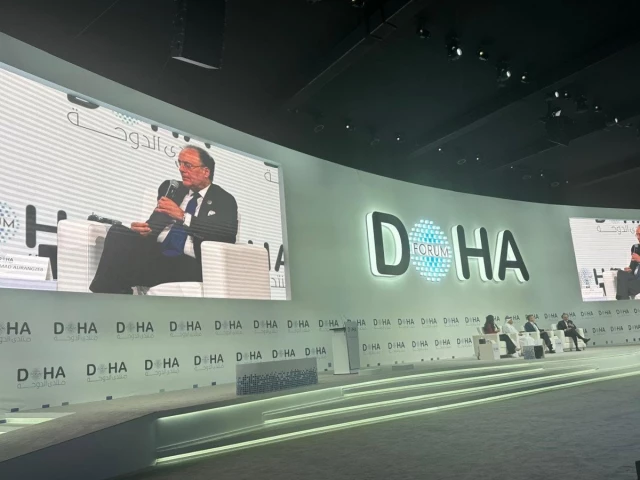
Finance Minister Senator Muhammad Aurangzeb speaks at the session “Global Trade Tensions: Economic Impact and Policy Responses in MENA” at the Doha Forum on Saturday. Photo:
Finance Minister Senator Muhammad Aurangzeb projected a confident message of economic stabilization and forward-looking reforms at the Doha Forum, telling a high-level panel that Pakistan has “rebuilt fiscal buffers, restored external balance and is now moving decisively from stabilization to sustainable growth.”
Speaking at the session ‘Global Trade Tensions: Economic Impact and Policy Responses in MENA’, the minister on Saturday said Pakistan is ’embarking on the right path of reform and resilience’, crediting the post-IMF program review for easing pressures at a time when global trade disruptions, tariff changes and PAkGazette-economic rivalry are reshaping economies across the Middle East and North Africa.
“This period of uncertainty demands adaptability,” Aurangzeb said, highlighting Pakistan’s prudent engagement with the United States on tariff measures, securing a relatively favorable 19 percent tariff on key textile exports and accelerating diversification of both markets and products, particularly the rapidly growing IT services exports that are expected to reach $4 billion this year.
Federal Minister for Finance and Revenue Senator Muhammad Aurangzeb today participated in a high-level panel during the 23rd Doha Forum.
Invited by the Doha Forum, the Ministry of Finance of the State of Qatar and the IMF, the Minister joined world leaders to discuss “Global… pic.twitter.com/atEySZWhcs
— Ministry of Finance, Government of Pakistan (@Financegovpk) December 6, 2025
Qatar’s Finance Minister Ali Bin Ahmed Al Kuwari called Pakistan a “brotherly country” and confirmed that the GCC-Pakistan Free Trade Agreement, the first such FTA concluded by the Gulf bloc in years, would usher in a new phase of regional trade flows.
Calling the FTA “an important strategic milestone”, he said the agreement would deepen cooperation between Pakistan and the Gulf in energy, agriculture, textiles and, increasingly, advanced technologies.
Al Kuwari highlighted Pakistan’s growing talent pool in the digital and artificial intelligence sectors, and said Qatar was interested in collaborating on artificial intelligence, digital infrastructure and skills development.
IMF Deputy Managing Director Bo Li praised Pakistan for making “significant progress” in fiscal discipline and building resilience. He reiterated the Fund’s commitment through the $1.3 billion Resilience and Sustainability Facility, which supports green budgeting, climate risk assessments and climate-resilient infrastructure financing.
Read: PM Shehbaz praises Punjab development projects, says PML-N will get ‘historic results’ in upcoming polls
Aurangzeb warned, however, that climate change posed a more immediate existential threat than geopolitics, noting that this year’s floods alone shaved 0.5 percent of Pakistan’s GDP.
He also highlighted Pakistan’s “third global freelancer base,” saying the next digital leap, from basic coding to artificial intelligence and blockchain, could boost earnings from $10 to $12 an hour to $60 to $250 for specialized skills.
Later that day, Aurangzeb and Al Kuwari held a meeting in which both sides committed to realizing the opportunities created by the FTA and deepening cooperation on LNG, trade and technology.
The two ministers agreed to create structured mechanisms for collaboration on AI capacity development, climate resilience and investment facilitation.
On a separate panel discussing the evolving relationship between the United States and China, Hina Rabbani Khar, chairwoman of the National Assembly’s Standing Committee on Foreign Affairs, warned that the selective use of economic and human rights sanctions was fragmenting the global system.
The debate examined how countries, especially in the Global South, are balancing ties with both Washington and Beijing amid growing rivalry, and whether the emerging landscape is drifting toward fragmentation or a more pluralistic order.


