

- Report commissioned by Mozilla accuses Microsoft of using ‘harmful design’ to undermine browser choice in Windows 11
- This allegedly includes misleading wording, hassles, pre-screening, and generally dubious tactics to push Edge ahead of other browsers.
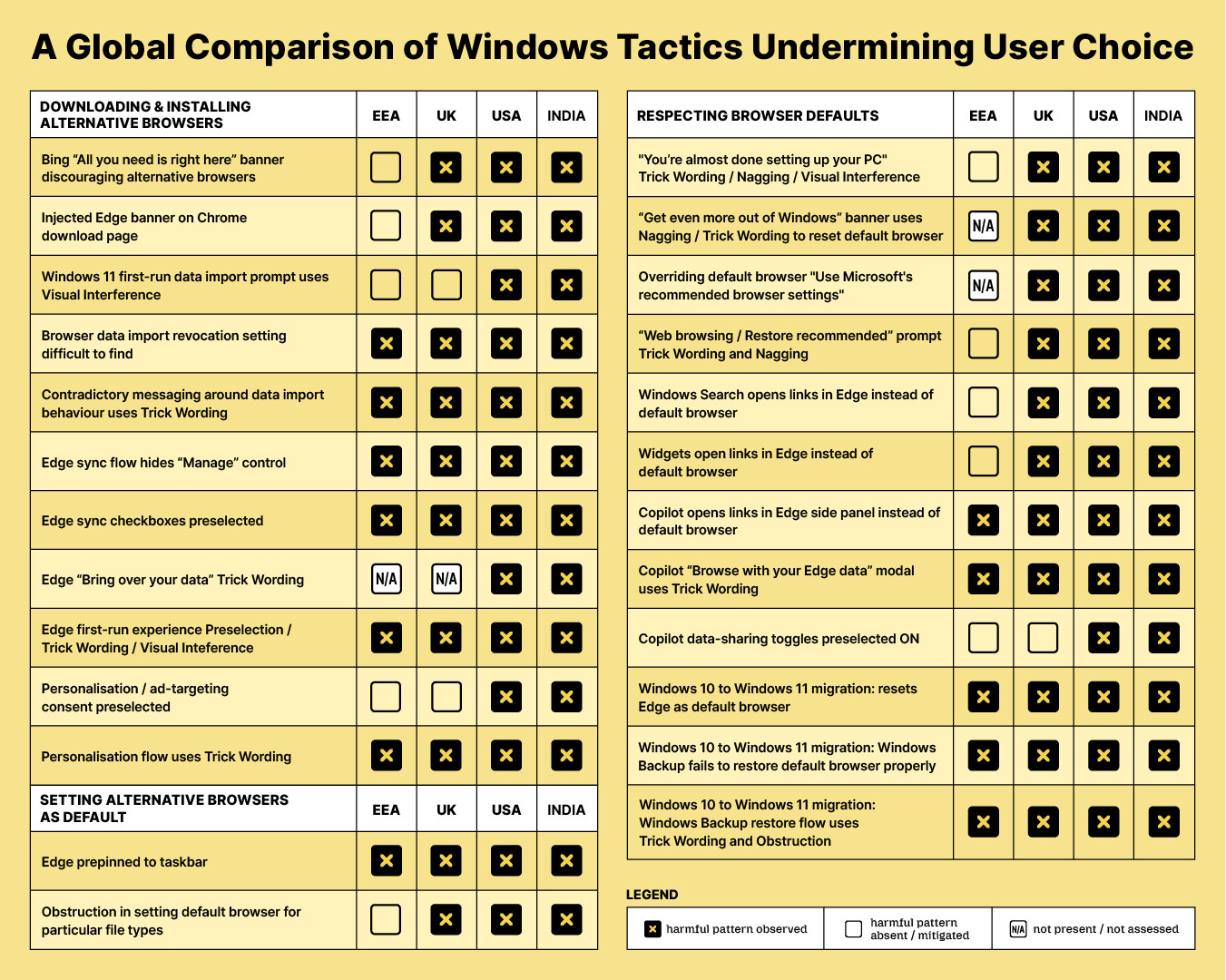
- The report notes that the situation is better in the European Economic Area, due to regulations there, and notes that “regulatory measures work”, urging authorities elsewhere to take a similar stance.
Mozilla, the maker of Firefox, has released another report claiming that Microsoft is not maintaining a level playing field for web browsers on Windows and is unfairly pushing users towards Edge.
As Mozilla makes clear, it published the first ‘Over the Edge’ report – on ‘How Microsoft’s design tactics compromise free browser choice’ – two years ago, and the follow-up has just arrived (as discovered by Eteknix).
Actually, I should point out that it was not written by Mozilla, but by two independent researchers commissioned by the Firefox maker (Harry Brignull and Cennydd Bowles, the same couple who wrote the first article). Takes into account feedback from users in the US, UK, India, and Germany on the “key journeys in browser choice” in Windows 11 and 10.

In a nutshell, they conclude that: “Microsoft continues to implement harmful designs to undermine people’s browser choice.”
This specifically involves, according to the report: “Misleading wording, obstruction, visual interference, pre-selection, annoyance and forced actions, at almost every step of the user journey.”
Some of the worst notable excesses are the pop-up banner Edge users see when they go to the Chrome download page (trying to get them to stick with Microsoft’s browser, which it says has the same technology as Chrome but with “extra trust from Microsoft”), and complaints within Windows about using Edge as the default browser in one form or another.
The report also points out how Edge is defaulted to the Windows taskbar and how a migration from Windows 10 to Windows 11 reestablishes Edge as the default browser, overriding any previous choices. There are also many accusations surrounding misleading wording, as well as an observation that Microsoft is using Copilot (AI) to open links in Edge instead of its default browser.
On the topic of AI, the report notes: “Researchers suggest that a sequence of seemingly minor consent requests across Windows and Edge may be combined into a ‘pipeline’ that funnels browsing data (potentially including data originating from rival browsers) into Microsoft’s advertising and personalization systems.”
It is notable that Germany, included as a representative country within the European Economic Area (EEA), which has different regulatory requirements that Microsoft must comply with, escapes quite a few of these excesses (including the nonsense of downloading Chrome).
Despite that, the researchers argue that their overall conclusion that “Microsoft does not allow people to download and install an alternative browser, set it as default, or continue using it as default, without harmful interference” is, they say, true “in all regions analyzed.”
Analysis: a call to regulate
Yes, this is a report commissioned by a rival browser, but these findings are generally unsurprising, and Microsoft has long been known to overzealously promote Edge in Windows 11, trying various dubious shenanigans to get the browser into play, as the report notes. Of course, on the other hand, Google pulls similar tricks with Chrome.
Still, that’s no excuse, and no browser should actively try to discourage people from downloading another rival browser. What Mozilla also points out, of course, is that Microsoft is in a particular position of power here, given that it owns the world’s leading desktop operating system and is leveraging that platform in a number of ways to drive Edge adoption.
Whether that has worked for Microsoft or not (spoiler alert, it hasn’t) is irrelevant, as this behavior is obviously neither ethical nor fair, and while it may not have affected Chrome’s reign as the top browser, it may have hurt smaller rivals like Firefox.
While the EEA may have a considerably better balance of browser equality within Windows, the report notes that this is of course because regulations have forced Microsoft to act. This is arguably another negative as it shows that Microsoft only respects user choice in terms of browsers when they are forced to.
Mozilla ends with the following paragraph that sums it all up nicely: “We again urge Microsoft to abandon these harmful patterns around the world. And we urge regulators in the European Union, the United Kingdom, the United States, India, and beyond to consider this report as evidence that regulatory action works; there is still much more to do.”
So if Microsoft really wants to talk about “increased trust,” how about taking action on some of these pain points? Or is it simply a matter of having to be more trustworthy than Google?

Follow TechRadar on Google News and add us as a preferred source to receive news, reviews and opinions from our experts in your feeds.

The best laptops for all budgets


