
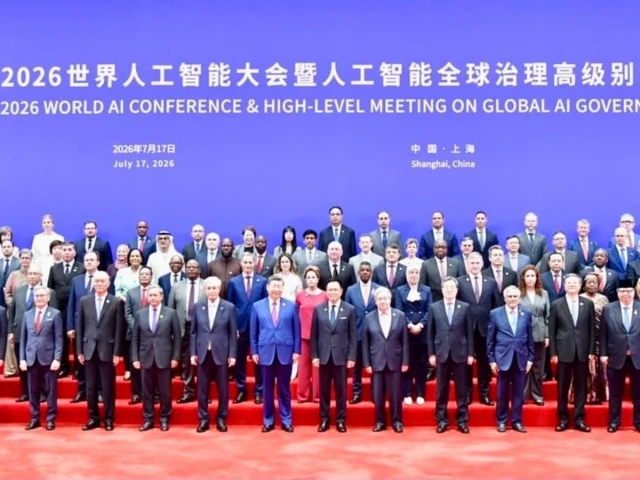
Deputy Prime Minister and Foreign Minister Ishaq Dar along with Pakistani delegation attends the opening ceremony of World Artificial Intelligence Conference (WAIC) 2026 in Shanghai. PHOTO: FO
Deputy Prime Minister and Foreign Minister Ishaq Dar along with the Pakistani delegation attended the opening ceremony of the World Artificial Intelligence Conference (WAIC) 2026 in Shanghai on Friday, a day after Pakistan became a founding member of the World Artificial Intelligence Cooperation Organization (WAICO).
Dar is in China on a two-day visit to attend WAIC 2026 and formalize Pakistan’s participation in the newly formed organization. Dar would represent Pakistan in engagements focused on artificial intelligence, emerging technologies and international cooperation.
Deputy Prime Minister and Foreign Minister Senator Mohammad Ishaq Dar @MIshaqDar50 along with the Pakistani delegation attended the opening ceremony of the World Artificial Intelligence Conference (WAIC) 2026 in Shanghai this morning, which was addressed by His Excellency President Xi… pic.twitter.com/2j8iROvuSI
– Ministry of Foreign Affairs – Pakistan (@ForeignOfficePk) July 17, 2026
According to the Ministry of Foreign Affairs (FO), the opening ceremony was led by Chinese President Xi Jinping and followed the formal establishment of WAICO through the signing of its founding agreement by member states, including Pakistan.
The FO said Pakistan joined the organization as a founding member after Dar signed the agreement on Thursday during his visit to Shanghai.
Reaffirming Pakistan’s position on the development of artificial intelligence, the FO said the country “supports inclusive and equitable global governance of AI, broader access to emerging technologies, capacity building for developing countries, and greater international cooperation to close the digital divide.”
He added that Pakistan believes that “the benefits of artificial intelligence are shared by all.”
FO said in an earlier statement that Dar met Chinese Foreign Minister Wang Yi in Shanghai on the sidelines of WAICO held on Thursday, where the two sides reaffirmed their commitment to strengthening the Pakistan-China strategic partnership and expanding cooperation in emerging technologies.
PR No. 1️⃣7️⃣4️⃣/2️⃣0️⃣2️⃣6️⃣
Vice Premier/Foreign Minister meets with Foreign Minister Wang Yi in Shanghai (July 16, 2026)
🔗⬇️ pic.twitter.com/KZBdXT7mCD
– Ministry of Foreign Affairs – Pakistan (@ForeignOfficePk) July 17, 2026
Dar was accompanied by Minister of State for Information Technology and Telecommunication Shaza Fatima Khawaja, Advisor to the Chief Minister on Artificial Intelligence and Special Initiatives Bilal Bin Saqib, Chairman Pakistan Virtual Assets Regulatory Authority (PVARA) Bilal Bin Saqib, Additional Secretary (Asia Pacific) Syed Asad Gillani, Ministry of Foreign Affairs and Pakistan’s Chargé d’Affaires in Beijing Aizaz Khan.
During the meeting, the two foreign ministers reviewed the broad picture of bilateral relations between Pakistan and China and expressed satisfaction over the continued strength and steady growth of ties.
The two sides “reaffirmed their shared commitment to further deepen the All-Weather Strategic Cooperative Partnership between Pakistan and China,” the FO said.
The leaders also stressed the importance of promoting high-quality development under the China-Pakistan Economic Corridor (CPEC) 2.0, and agreed to accelerate practical cooperation in a variety of sectors.
“They agreed to strengthen practical cooperation and enhance collaboration in trade, investment, science and technology, digital economy and artificial intelligence,” the statement said.
The meeting also focused on the latest regional and global developments, with both countries emphasizing the need for continued engagement on issues of mutual interest.
According to the FO, both sides “reaffirmed their determination to maintain close coordination and continue consultations on issues of mutual interest.”
The statement added that “both leaders also reiterated their commitment to continue cooperation in multilateral forums.”
The FO said the meeting further strengthened strategic cooperation between Pakistan and China and highlighted both countries’ shared vision for innovation-driven growth. “It also reflected the two countries’ shared commitment to innovation-driven development and cooperation in emerging technologies,” the statement added.
According to an earlier statement by the FO, the visit also aims to promote Pakistan’s commitment to inclusive and equitable governance of AI, capacity development and international cooperation, while promoting the priorities of developing countries.
In recent years, Pakistan has sought to position itself as an emerging player in the AI sector, with growing talent and startups driving innovation in the health, education and agriculture sectors.
The country approved its National Artificial Intelligence Policy last year, which outlines a roadmap focused on innovation, public awareness, secure systems and international collaboration. The plan includes an estimated investment of 278 billion rupees ($1 billion) by 2030 and initiatives such as the “AI Seekho 2026” program to train one million people.
Authorities have also launched a sovereign AI cloud and seed fund, along with efforts to establish a regulatory framework for the ethical and responsible use of AI.
The WAIC, scheduled for July 17-20 in Shanghai under the theme “AI Partnership for a Brighter Future,” is expected to bring together global technology leaders, policymakers and researchers.
Chinese President Xi Jinping will attend the opening ceremony and deliver a keynote speech, underscoring China’s focus on AI as an engine of economic growth and global governance.
Organizers say the four-day event will feature more than 140 forums and more than 1,400 participants, with more than 1,100 companies showcasing cutting-edge innovations, including hundreds of global debuts.
The conference has become one of the world’s leading platforms for discussions on AI development, governance and industry collaboration, while promoting innovation, talent exchange and startup growth.


