
He says a country once portrayed solely through the lens of terrorism is now recognized as a ‘middle power’
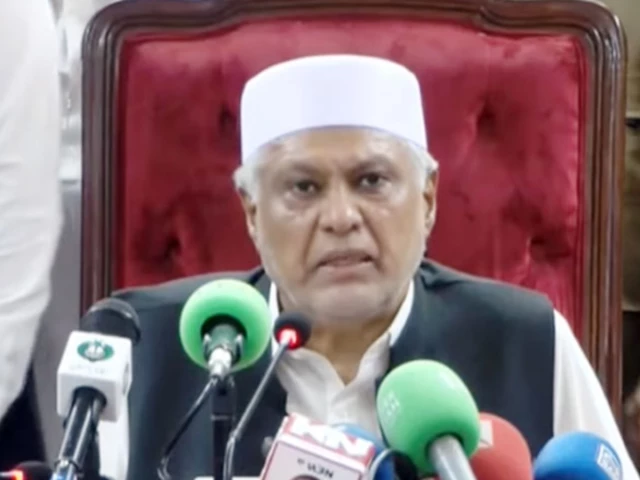
Deputy Prime Minister Ishaq Dar speaks to the media after the 983rd annual Ghusl Mubarak ceremony at Data Darbar. SCREEN CAPTURE
Deputy Prime Minister and Foreign Minister Ishaq Dar said on Thursday that Pakistan had emerged as a recognized “peacemaker” and “middle power” on the world stage, crediting the country’s recent role as a mediator in the US-Iran war for raising the country’s international standing.
Speaking to the media at Data Darbar, Foreign Minister Dar said Pakistan’s role in facilitating dialogue between rival countries had transformed perceptions of the country abroad.
“Today, Pakistan is being recognized around the world as a peacemaker,” he said. “A country that was once portrayed only through the lens of terrorism is now being recognized as a middle power and provider of online security.”
FM Dar said that people used to say that Pakistan was diplomatically isolated, while now Pakistan is making headlines around the world: “Countries that barely knew Pakistan are now talking about it.”
He credited Prime Minister Shehbaz Sharif, Chief of Army Staff and Chief of Defense Forces Field Marshal Asim Munir and the Ministry of External Affairs for what he described as intense diplomatic efforts.
“The captain of the team is Prime Minister Shehbaz,” FM Dar said. “Alongside him, Field Marshal Asim Munir and the Ministry of External Affairs worked tirelessly, day and night.”
Referring to Pakistan’s mediation efforts, Foreign Minister Dar said that Islamabad had helped bring together two countries that had not held direct talks in decades, “Pakistan’s role was to facilitate in an honest and impartial manner.”
He said the prime minister, military leaders and diplomats had carried out extensive behind-the-scenes diplomacy, but much of it had not been publicized because “a facilitator cannot become a party to the dispute.”
Foreign Minister Dar also reiterated Pakistan’s position on the conflict involving Iran, saying that Islamabad was one of the first countries to condemn attacks on a “brotherly Islamic country”, adding that Islamabad had simultaneously encouraged restraint and dialogue to avoid further bloodshed.
“People now respect the Pakistani passport,” he said. “Pakistan’s image in the world is very different today.”
Turning to internal affairs, Foreign Minister Dar said: “Allah allowed Pakistan to become a nuclear power, and later a missile power. What is left for us now is to become an economic power,” he said.
Read: Muharram 9 processions continue across the country under strict security measures
He credited former Prime Minister Nawaz Sharif for overseeing both the country’s nuclear tests in 1998 and the development of its missile program, while praising Prime Minister Shehbaz’s efforts to stabilize the economy.
FM Dar said Pakistan had ranked among the world’s top 24 economies in 2017 before falling in subsequent years, but argued that economic indicators were once again moving in a positive direction.
“The country’s image has improved, stability has returned and Pakistan is moving towards growth and development,” he said.
The deputy prime minister also congratulated devotees on the 983rd Ghusl Mubarak of Hazrat Data Ganj Bakhsh (RA) and praised the ongoing expansion of the Data Darbar complex.
He described the current project as the largest expansion of the shrine to date and credited Punjab Chief Minister Maryam Nawaz, the Auqaf department and their teams for the work.
Drawing a link between the expansion of religious sites and national prosperity, Foreign Minister Dar said investment in places of worship brought blessings and expressed confidence that Pakistan would continue to progress.
“When you come here, pray especially for Pakistan,” he said. “Pray that Allah will make Pakistan an economic power just as He has made it a nuclear and missile power.”


