
He says the agreement was structured in two phases and that three issues in the second phase “have been a source of real problems.”
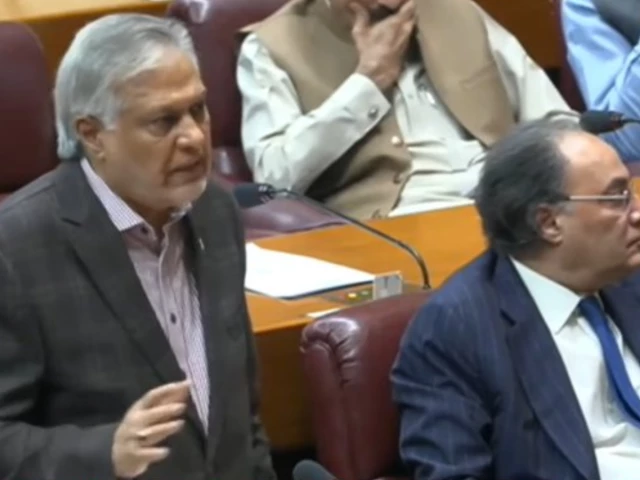
Deputy Prime Minister and Foreign Minister Ishaq Dar addresses the National Assembly. SCREEN CAPTURE
Foreign Minister Ishaq Dar presented the three-page US-Iran deal in the National Assembly on Wednesday, saying the second phase would involve technical discussions on nuclear issues, sanctions and frozen assets, and Lebanon.
Addressing the National Assembly (NA) session, Dar said he would put it on record along with the June 22 joint statement issued by the United States, Iran, Qatar and Pakistan, saying the document had been “considerably misunderstood” and misquoted.
“It is the right of both Houses to place this in the minutes of this assembly, so that if any colleague wishes to see this document, take a copy or quote it, there will be no misunderstanding,” he said.
He added that each page of the agreement carried initials and the third page carried full signatures, and that the Ministry of Foreign Affairs had also uploaded the statement to its website.
“Everyone agreed, and our Foreign Affairs office also put its copy on its website, so that colleagues who need to see what the result was, what the roadmap is, how to move forward, I will also put the copy, the one issued by the four countries from Switzerland on June 22, in the file of the Foreign Affairs office, so that any member of the National Assembly or the Senate can see it,” he said.
Giving the House a detailed account of how the agreement was reached, Dar said the breakthrough came after a 21-hour negotiation session on April 10 and 11. The session took place in six rounds, with breaks not for rest but for consultations, and continued until Fajr, Dar said. “I pay tribute to both sides,” he added, noting that they had agreed to sit at the same table on the condition that Pakistan, their mutually chosen mediator, was also present.
Read: Islamabad-Switzerland talks reinforce faith in dialogue, diplomacy: FO
The foreign minister said the US delegation included Vice President JD Vance, Steve Witkoff and Jared Kushner. Iran was represented by its senior president, Bagher Ghalibaf, and two other senior officials, including a secretary of the National Security Council.
“The Pakistani delegation was led by me along with Chief of Army Staff and Chief of Defense Forces Field Marshal Asim Munir and DG ISI,” he said.
However, after those talks stalled, and both sides had to consult their respective leaders, Dar said serious fears were raised in the weeks that followed that the process might not reach a conclusion.
He credited Prime Minister Shehbaz, Field Marshal Munir and the Ministry of External Affairs for persisting despite the arrests, saying: “They did not give up. Hope was not lost.”
Additionally, Dar noted that a regional forum composed of Saudi Arabia, Pakistan, Egypt and Turkiye was also “proactively engaged,” holding meetings in Riyadh on March 19, then in Antalya, in Islamabad on March 29 and, most recently, in Egypt.
As for the deal itself, Dar revealed that it was originally going to be physically signed in Geneva on June 19 at the Intercontinental hotel, and that deals are already underway. However, on the night of June 18, a sudden event changed the sequence. President Trump, who was in France for the G7 summit, decided to sign electronically on the sidelines of the forum. The document was then transmitted to Iran and President Pezeshkian signed it. Prime Minister Shehbaz then signed as mediator on behalf of Pakistan.
“The physical ceremony was later moved to Burgenstock in Switzerland, held at a property owned by the Qatar Investment Authority at the request of the United States and Qatar. Meetings held there on Sunday and Monday, involving all four parties, produced the June 22 joint statement,” Dar said.
He also mentioned that Pakistan ensured discretion throughout the process and said, “As a true and honest mediator, we were a trusted party, we treated this as a matter of trust, we did not lean one way or the other, we did not allow anything to become public.”
Regarding the Foreign Ministry, Dar said: “When they told me ‘give us a copy of the latest draft’, I said, ‘until both sides give permission, you cannot share Pakistan’s document.'”
Dar said the deal was structured in two phases. The first phase, aimed at resolution, had already produced visible consequences. He noted that for about three weeks, the government had absorbed the increase in fuel prices rather than passing it on, with special instructions issued to the Ministry of Finance. After three weeks, prices began to be passed on and four chief ministers were called to decide on a special subsidy for public transport in Pakistan and Azad Jammu and Kashmir.
He said the second phase would involve technical discussions on three topics: nuclear issues, sanctions and frozen assets, and Lebanon, which he said had “been a source of real problems.” He noted that Israel attacked Lebanon again just as the deal was almost finalized, delaying negotiations for two days before a new ceasefire between Lebanon and Israel allowed the process to resume.
On the economic impact, Dar said prices had already dropped, the US naval blockade had ended and Iran had removed all tariffs, additional charges, permits and permits.
Read more: Iran rules out commitment on missile capabilities
Regarding Pakistan’s broader diplomatic position, Dar told the house that at a recent diplomatic forum, the United States had officially stated that “Pakistan has become, by the role it has played in this dispute between the United States and Iran, something unimaginable, and Pakistan has become a net security provider for this region.”
He said that this was a country that only a few years ago had been called diplomatically isolated, and that today “Pakistan has become what used to be called a terrorist country, today it is remembered as a peacemaker.”
On China, Dar said: “I will be failing in my duty if I do not recognize China’s role.” On March 31, China’s Foreign Minister invited him for a one-day visit during which Pakistan and China jointly announced a five-point peace initiative calling for the Strait of Hormuz to be kept free of tolls or restrictions and restored to its pre-February 28 status. The announcement generated calls from foreign ministers in several capitals. “I received dozens of calls from foreign ministers in various capitals. Europe supported it,” Dar said.
Throughout the process, according to the foreign minister, Pakistan had maintained strict neutrality as a mediator, refusing to share documents even with close allies. “We didn’t even give it to Saudi Arabia, which was particularly involved,” he said. Dar also made reference to the Strategic Mutual Defense Agreement signed with Saudi Arabia in September 2025, saying that Pakistan had kept Iran informed about the sovereign pact at all times.
The Foreign Minister also noted that Iran had conveyed to Pakistan that “when difficult times came, we saw what a friend is and Pakistan fulfilled the obligations of friendship.” He concluded his remarks by saying that the credit belonged to the leadership of Prime Minister Shehbaz, Field Marshal Munir and the Ministry of External Affairs, but the ultimate success belonged to God.


