
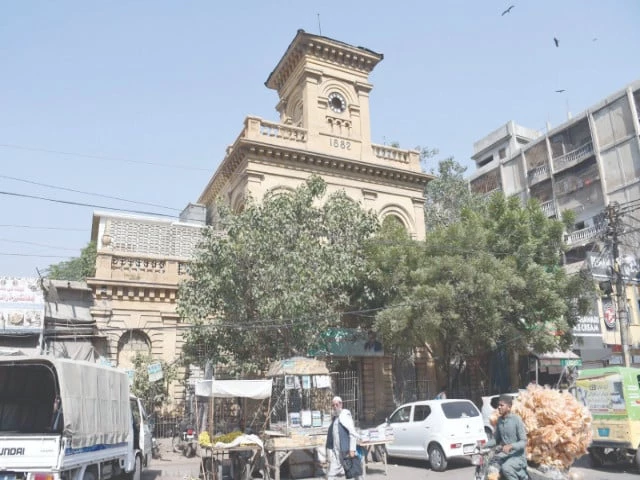
Eduljee Dinshaw Charitable Dispensary, Karachi. Photo: Anadolu Agency (archive)
KARACHI:
The metropolitan city of Karachi often makes headlines as chaotic and overwhelmed by modern sprawl.
But scattered among the skyscrapers, traffic-choked roads and dense informal settlements are reminders of a different city: a port once famous for its order, elegance and architecture.
Among the most striking relics are Karachi’s historic clock towers—orange and pink structures from the late 19th and early 20th centuries—that once guided the city’s rhythms.
Today, many are crumbling, forgotten or overtaken by encroachments, leaving historians and preservationists concerned that a rare chapter of the city’s past may soon disappear.
In the heart of downtown Saddar, among Chinese dental clinics and grocery stores, stands the 19th-century clock tower of the Eduljee Dinshaw Charitable Dispensary, now a facility of the Karachi Metropolitan Corporation (KMC).
The Victorian-era structure, built in 1882, is still used as a dispensary, but its once white wooden windows are now blackened from exhaust. The clock mounted above its entrance has no hands and has been frozen for decades. On a recent morning, pigeons perched wearily on its worn stone as health workers inside conducted free dengue tests.
In the back, the emergency stairs are collapsing and the paint has long been peeled off. The rusty spiral steps to the top of the tower recall a time when caretakers wound the clock every day.
A few kilometers away, the Lea Market clock tower, once a favorite public gathering place, is in even worse condition.
A makeshift vegetable market stretches the length of the building, while dozens of rickshaws treat the entrance as a permanent, illegal terminal.
“This was the favorite gathering place of all the locals, both young and old, until the 1980s,” said Mukhtar Baloch, a 70-year-old retired teacher.
“I still remember the days when this place was a center for political and social debates and public gatherings. But over time, it has lost its glory, like many of our other heritage sites.”
The heartbeat of the forgotten city
Karachi-based heritage researcher Shaheen Nauman said that as of 2019, around 11 clock towers were documented across the city, most built between 1882 and 1931.
Recent surveys uncovered four more in the southern districts, bringing the known total to 15, including Merewether Tower (1884), Holy Trinity Cathedral (1885), Empress Market (1889), Poonabai Mamaiya (1889), Sydenham Passenger Pavilion (1913), Lakshmi Building (1924) and Lea Market (1927).
Of them, only three are still operating, Nauman said, and the rest are awaiting official attention.
“These towers were built between the end of the 19th century and the beginning of the 20th century, when clocks were a luxury that very few could afford,” he explained.
Urgent preservation needed
There are glimmers of hope. At Empress Market, a centerpiece of colonial-era Karachi, the clock tower has been brought back to life thanks to the passion of local artist and technician Bilal Asif.
Once buried under hundreds of illegal vendors’ kiosks, the market regained its historic façade after a widespread anti-encroachment campaign in 2018. But its iconic clock remained broken until Asif intervened.
“It was a great challenge to bring back life to a clock that had stopped decades ago,” he told Anadolu.
“But I accepted the challenge and did it again. It took weeks of hard work, but I’m glad I managed to successfully restore it.”
Today, this is the only hybrid-powered clock tower in Karachi. Among the other clock towers still functioning, the one at KMC head office requires weekly winding, while the clocks at Merewether Tower are solar-powered.
Despite occasional restoration efforts, experts fear the broader picture is bleak.
Architect and heritage advocate Marvi Mazhar called for a structured intervention. “These watches must be declared heritage assets. Monthly checks must be carried out and notes must be recorded, so that there can be accountability and consultations, if necessary,” he said.
Nauman agreed that if one tower can be revived, others can too. “These forgotten clock towers were once the heartbeat of the city. They symbolize time itself and its deep meaning in human life,” he said. “When the clock on the Merewether Tower or the KMC building rings, its sound transports us back a hundred years, to a time when it was the only guide to setting the pace of daily life.”


