
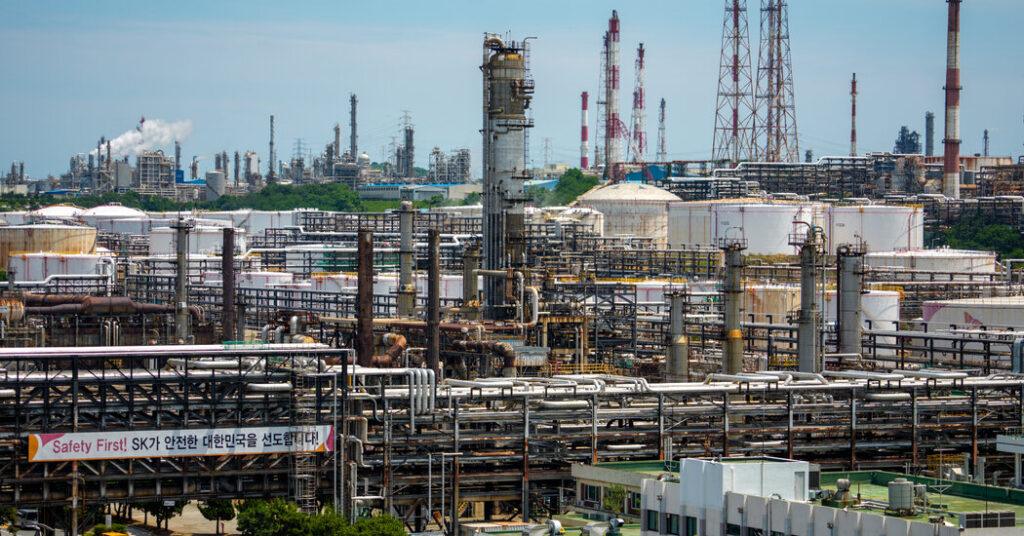
The faint smell of gas hangs over a laboratory at South Korea’s largest refinery, where chemical analysts are working overtime trying to find ways to shut down the growing Persian Gulf crude oil facility.
South Korea has long been one of the world’s top exporters of jet fuel, but the conflict in the Middle East is forcing its oil refiners to rethink how they do business.
The vast labyrinth in the southern port city of Ulsan depends on Middle Eastern oil, which accounts for about 60 percent of South Korea’s crude imports. Its flow was cut off when the US-Israel war against Iran led to the blockade of the Strait of Hormuz, causing what refinery officials called the most severe supply shock in its history.
South Korea attempted to offset reduced supply by increasing crude oil imports from the United States, Canada, Venezuela and Brazil. But oil from these sources is different from that coming from the Persian Gulf and must be analyzed to make sure it does not damage the refinery and is also profitable.
“We are continually testing unknown types of crude oil,” said Donghyun Kim, a technician whose team recently logged overtime at the Ulsan refinery. “Since the war, my team members have been struggling a bit.”
Switching a refinery from one type of crude oil to another is not as simple as pressing a button. Most refineries are built to handle crude oil blends from specific locations. Oil from different parts of the world has different densities and chemical characteristics, such as sulfur levels. An incorrect mixture can damage the refinery and repairs at a multi-million dollar facility like Ulsan can be costly.
The Ulsan Complex is the world’s second-largest refinery, according to data analytics company Industrial Info Resources. It is more than twice the size of New York’s Central Park and can process 840,000 barrels of crude oil a day.
A problem at this refinery has the potential to affect energy supplies on all continents. SK Energy, the petrochemical giant behind the Ulsan refinery, said it would continue to try to diversify its crude oil sources due to concerns about instability in the Middle East.
Oil refineries take crude oil and turn it into usable, everyday products, such as gasoline for cars, lubricating oils for manufacturing, and a material called naphtha that is used in the production of plastics, paints, and synthetic fabrics.
Before the war with Iran, South Korea provided more than 80 percent of the jet fuel imported to the U.S. West Coast, as well as much of the supply in Australia, Japan and New Zealand. Since the war began, tanker traffic through the Strait of Hormuz has been blocked and the price of jet fuel has almost doubled.
While the International Air Transport Association, a global airline industry body, does not see widespread shortages of jet fuel, rising fuel costs have forced airlines to raise ticket prices and cut flights. Despite the preliminary deal between the United States and Iran, airline fuel bills may not decline for months as the global jet fuel supply chain, of which Ulsan is a key part, recovers from the impact of war.
Before the conflict, the weekly arrival in South Korea of several supertankers from the Persian Gulf was a matter of routine. But earlier this month, on a windswept day, the docking of the Universal Winner was a moment of relief for the country.
The tanker, carrying 2 million barrels of crude oil from Kuwait, took more than 100 days to reach Ulsan after the blockade of the Strait of Hormuz left it stranded in the Persian Gulf. It was able to transit the waterway after high-level talks between Iran and South Korea.
When the ship arrived in Ulsan on June 10, cranes on its deck hoisted tubes that were fixed in the cargo holds to begin the two-day unloading process. The oil was pumped through miles of underwater and underground canals to an extensive storage tank farm at the Ulsan Complex.
From the tanks, crude oil can be fed to the refinery, which directs it to distillation columns about 300 feet high, beginning the process of extracting gasoline, jet fuel and asphalt, among other products. Refinery air is often filled with the smell of sulfur, an impurity that must be removed from crude oil to produce jet fuel and gasoline.
Refineries cannot simply choose to make a lot more jet fuel from a given amount of crude oil. Jet fuel yield is about 10 percent of South Korea’s total output, depending on the types of equipment and oil used, said Tae Hun Chang, an energy economist at the Korea Institute of Energy Economics.
Dwindling crude supplies from the Middle East have led to a drop in South Korea’s jet fuel exports. The country exported 6.8 million barrels in April, compared with 8.3 million in the same month last year, according to official data from the Korea Petroleum Association, an industry body.
According to SK Energy, this was due to limited crude oil supply. The South Korean government has imposed limits on gasoline exports since the war began, but has not done so on jet fuel, Chang said. The country’s jet fuel exports recovered somewhat in May, but were still below prewar levels, according to data firm Kpler.
At the refinery dock earlier this month, crews were finishing loading the STI Magic tanker with about 287,000 barrels of jet fuel before embarking on a 16-day journey to Sydney. Before the war with Iran, seven to ten empty tankers arrived at the Ulsan complex every week to collect fuel. Now, that number has been reduced to three, said Yeongho Kim, a storage operator.
It is still unclear when normal traffic through the Strait of Hormuz will resume, and the uncertainty increases pressure on workers at the Ulsan Complex.
“We are operating in completely uncharted territory,” said Hwansoo Choi, a spokesperson for SK Energy.


