
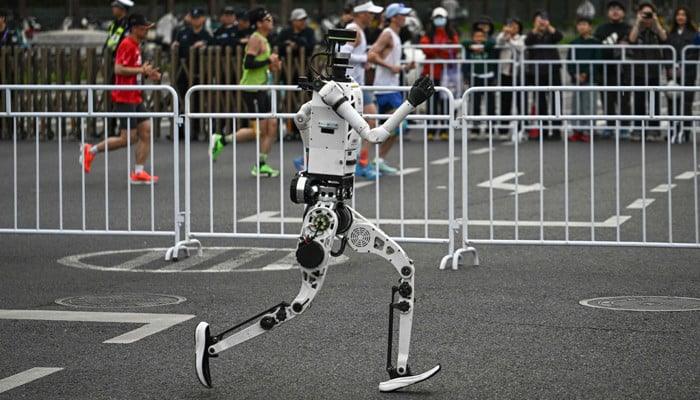
A humanoid robot that competes against flesh-and-blood runners broke the world record in a half marathon in Beijing on Sunday, showing the rapid technological advancement achieved by Chinese manufacturers.
Spectators lined the roads of Yizhuang, in the south of the capital, to watch the machines and their human rivals race, each group in a separate lane to avoid accidents or collisions.
Some of the robots were very agile and moved like famous runners like Usain Bolt, while others had more basic capabilities.
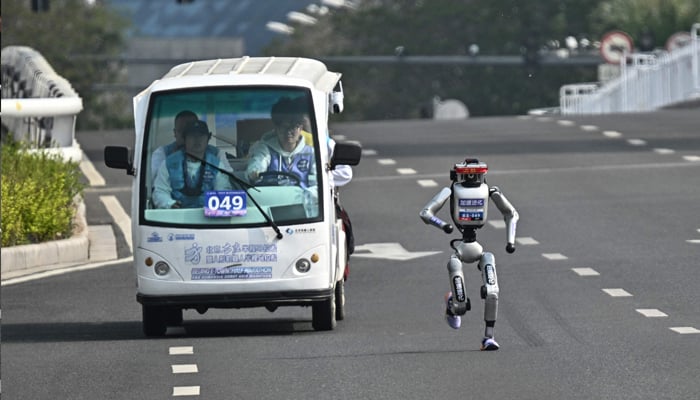
The winning humanoid, equipped with an autonomous navigation system and running for Chinese smartphone maker Honor, completed the roughly 21-kilometer (13-mile) course in 50 minutes and 26 seconds, at an average speed of about 25 kilometers per hour, according to state broadcaster CCTV.
He was much faster than the top human in Sunday’s race, and also beat the current men’s world record of 57:20 held by Ugandan runner Jacob Kiplimo.
The result represented dramatic progress from last year, when running robots crashed repeatedly and the best ones took more than two hours and 40 minutes to finish.
The number of humanoid entries jumped from about 20 last year to more than 100, according to organizers, a sign of the sector’s growing popularity.
‘Very good’
Han Chenyu, a 25-year-old student who watched the race from behind a safety barrier, barely had time to pull out her phone and snap a photo of the lead robot as it whizzed by.
she said AFP She was excited about these technological advances and thought the event was “very cool.”
But, he added, “as someone who works for a living, I get a little worried sometimes. I feel like technology is advancing so quickly that it could start to affect people’s jobs,” particularly now that artificial intelligence is becoming more and more sophisticated.
Humanoid robots have become commonplace in China in recent years, both in the media and in public spaces.
Xie Lei, 41, who watched Sunday’s race with his family, said robots could “become part of our daily lives” within several years, potentially used for “things like housework, company of the elderly or basic care” or “dangerous jobs, even firefighting.”
The humanoid half marathon aims to encourage innovation and popularize the technologies used in the creation and operation of such machines.
In a sign of the industry’s strength, investment in robotics and so-called embedded AI rose to 73.5 billion yuan ($10.8 billion) in China in 2025, according to a study by a government agency.
“For thousands of years, humans have been on top of planet Earth. But now, look at robots. Just in terms of autonomous navigation, at least in this specific sporting event, they are already starting to surpass us,” Xie said.
“On the one hand, it makes you feel a little sad for humanity. But at the same time, technology, especially in recent years, has given us a lot of imagination.”


