

- A simple test can see how well you can recognize lossy formats using your own music options.
- Past a certain point, most people can’t easily tell the difference.
- High quality lossless remains the most future-proof format
With music, how good is good enough? When you listen to digital music, what you hear depends on the original master, the file format and, above all, whether it is lossy (which reduces sound quality to reduce file size) or lossless, which is pristine and perfect. If you’re serious about sound, lossless will always beat lossless.
Good?
Maybe not.

On the r/audiophile subreddit, a user named vlad1m1r has shared a tool that tests how well different quality levels and formats can be differentiated. Can you tell the difference between a lossless FLAC or WAV and a 320kbps MP3, even if it’s music you listen to all the time and know inside out?
According to Apple Music executive Oliver Schusser, most people can’t. Speaking to Billboard, he said that “honestly, if we did an anonymous blind test on just an iPhone with headphones… I can tell you that most fans wouldn’t be able to tell the difference.”
Are you right? Turns out there’s an easy way to find out. Vlad1m1r’s Flactest runs in your browser and allows you to drag a FLAC, WAV or AIFF file into the app, at which point it will re-encode it at different MP3 bitrates and play them back to you without revealing which is which.
And at the risk of sounding clickbaity, the results may surprise you. They certainly surprised vlad1m1r, who had a hard time differentiating between uncompressed FLAC and high-bitrate MP3.
The Redditors have been having fun with this and I thought I’d join in. I have a very nice setup that supports high resolution audio. Are my headphones, speakers and ears good enough to detect differences that are often very subtle?
The problem with testing
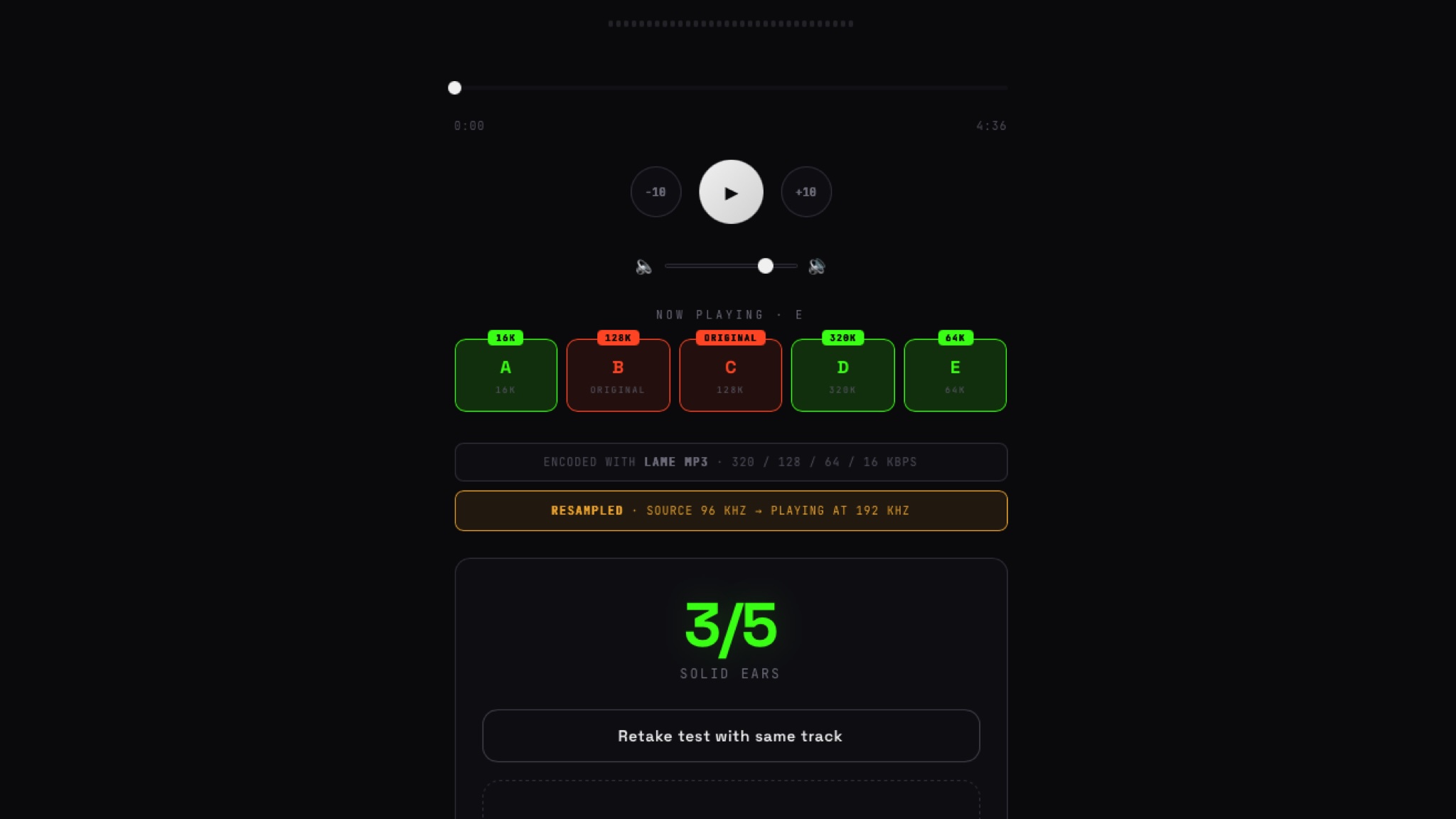
One of the problems with listening tests is that you can’t always be sure you’re listening to the same version when comparing different formats and bit rates. Some releases, especially from legacy artists, have been released multiple times and in some cases remastered, and that is likely to change the sound more than a small difference in encoding speed.
Of course, source quality isn’t the only factor that will affect what you hear. The speakers you’re using, their placement, and the acoustic qualities of your room make a difference, as do the type of headphones you’re listening to, the DAC you have, and the volume level at which you’re playing music. All of that will also shape the sound.
Flactest solves a lot of that for testing purposes because all of those things remain constant. You provide a single original and then re-encode it into multiple MP3 resolutions via the same LAME codec, plus play your original intact. What that means is that you get consistency: you’re listening to the same song from the same source on the same hardware and software while switching between the five mysterious formats it offers.
It’s worth noting that there’s another factor at play here, and it will apply to everyone who’s no longer a teenager: age. From early adulthood we start to lose the top end of our hearing, and that means that a 50-something like me won’t hear the same highs that I could easily discern at 15. So if the encoding changes are making a difference in the higher frequencies, which is where many digital artifacts tend to live in compressed MP3s, you may not be able to hear much of a difference.
Pure FLAC attack
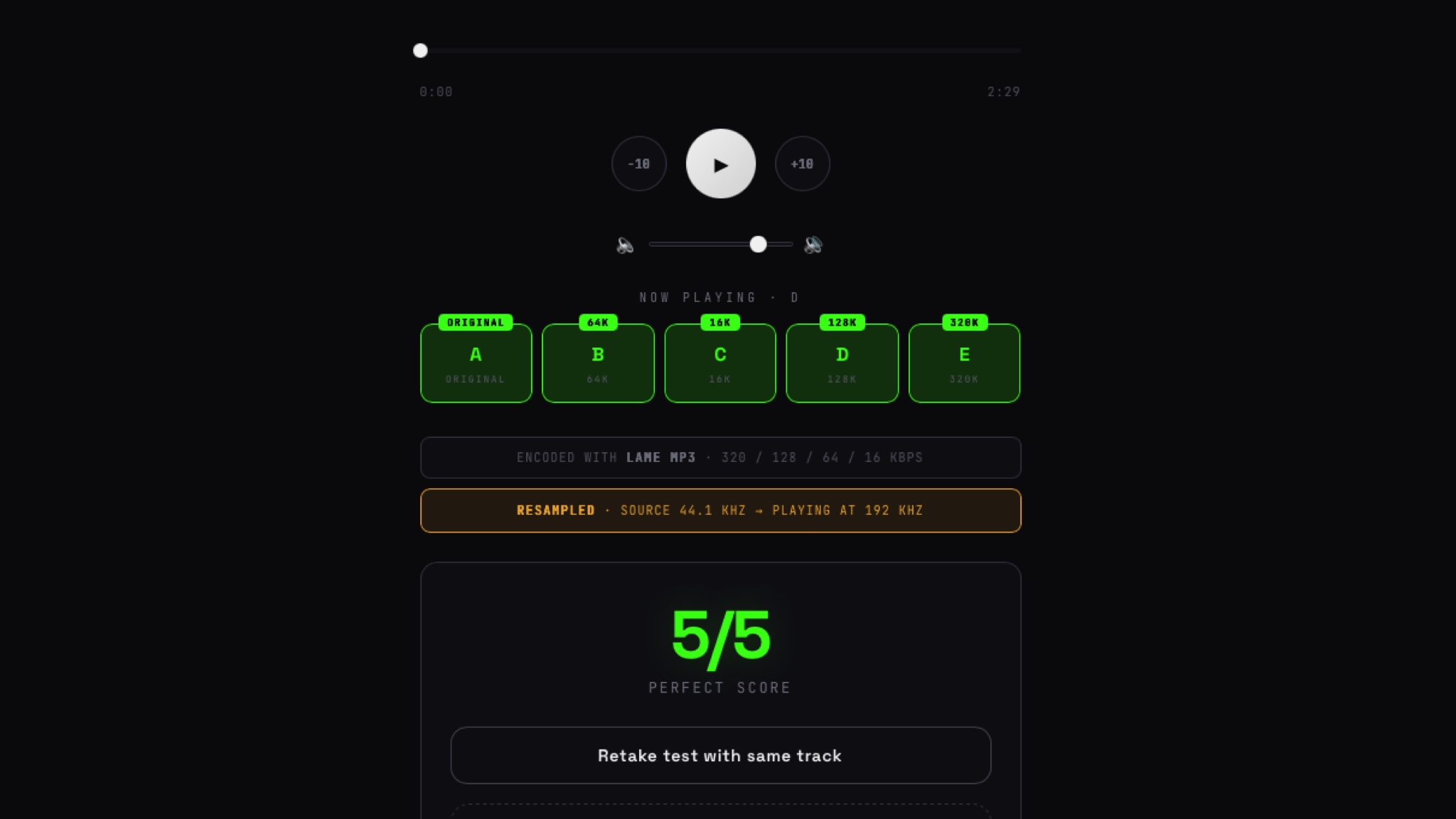
I listened to several songs two ways: on my big Adam studio monitors via an SSL 2 audio interface and on BeyerDynamic DT990 Pro open-back headphones via an iFi desktop DAC.
My source files were 44.1 kHz WAV and 16-bit/44.1 and 24-bit/96 kHz FLAC, with songs I’ve listened to for years (Radiohead, U2, Talk Talk, etc.), as well as music I’ve created myself on my Mac.
The low bitrate MP3s were easy to spot because they sound atrocious, like someone with a really bad hi-fi system was playing them in the next room. At 16kbps or 64kbps, MP3 compression is really obvious, and there’s a noticeable increase in quality when you go to 320kbps on busier tracks where there’s a lot going on. Indicators are gassy, distorted acoustic guitars and instruments, especially cymbals and hi-hats that become noticeably “splattering” as the bitrate is reduced.
But after 128 kbps it became complicated for me. Time and time again I couldn’t tell the difference between the 320kbps MP3s and the lossless originals.
Perhaps the trick to discerning the differences is to listen to the same music over and over again. When I tested using my own music (songs I’m currently mixing) I got perfect scores. That makes sense, because I’ve become obsessed with the little details of those tracks, like the sound of a drum machine’s hi-hat and the thump of a bass, and I’ve been listening to those things over and over again as I try to perfect them. But that’s a different kind of listening than when I listen for pleasure.
At least for me, the answer is clear: I can’t distinguish between the highest quality MP3 and the same song in FLAC format on my headphones or speakers. But that doesn’t mean I won’t do it in the future.
No loss
It is well known that, with a few exceptions, most of us cannot hear the difference between a very high bitrate file and a lossless one on everyday audio equipment. Once you hit 192kbps or higher, everything depends much more on the quality of your components: your hi-fi, your amplifier, your speakers, your headphones.
However, if you run the tests and find that you can’t distinguish between lossless and slightly lossy, that doesn’t mean you should limit yourself to encoding or purchasing everything as 320kbps MP3 or its AAC equivalent. High bitrate lossy compression is still lossy, and once the music information is removed, it cannot be recovered.
Upsampling can make a better estimate with impressive results, but it is still just a guess and not throwaway data. So, for long-term storage, it’s worth saving your digital music in the highest quality lossless format available, even if owning a high-end system isn’t in your immediate future, because if you get better equipment later, you may regret not having better quality files.
I know from reviewing high-end headphones and experiencing proper audiophile systems that cost a lot more than my car that with the right equipment you’ll hear details that lesser equipment gets buried in the mix.
And that’s why I think it’s wise to future-proof your digital library. You just don’t know what you’ll hear in the years to come. I thought I was pretty clever ripping CDs to 160kbps MP3s back in the iPod days, because I didn’t have good enough hardware to need anything better, a choice I now regret because I long ago threw away the original CDs. Today I’m on eBay buying many of them again.
Are you thinking of buying a new television?
Try our TV size and model finder! You tell you how far you sit from your TV, we’ll tell you what size to buy based on viewing angle advice from picture quality experts, and we’ll recommend our three best TVs in that size at different prices.

Follow TechRadar on Google News and add us as a preferred source to receive news, reviews and opinions from our experts in your feeds.


