
Calls to categorize those contributing to Kashmir cause, say accession comments weaken Pakistan’s stance
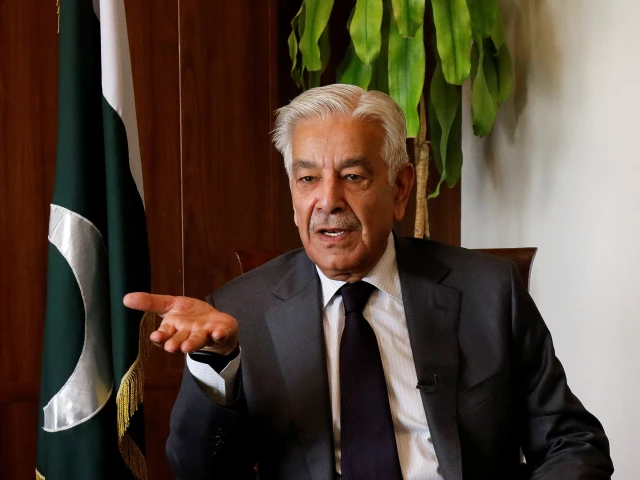
Defense Minister Khawaja Asif on Wednesday stood by his recent controversial comments on Azad Jammu and Kashmir (AJK), calling for a clear distinction between those who had made sacrifices for the cause of Kashmir and those who had not.
In a television interview, Asif said that Rawalakot, which has seen protests led by the Joint Awami Action Committee (JAAC), was “not Kashmir” and that he did not consider its residents to be Kashmiris. He later clarified the comments about
The controversy spread to the National Assembly on the same day, where PPP president Bilawal Bhutto-Zardari, JUI-F chief Maulana Fazlur Rehman and PPP MNA Raja Pervaiz Ashraf criticized Asif for his comments.
Read: Asif warns against ‘anti-Pak agenda’ in AJK
Responding to criticism on a private television program Aaj Shahzeb Khanzada Kay SathThe Minister resolutely said: “Bilawal has the right to say anything, I have no reservations about it, this is the beauty of democracy. When politicians criticize each other in the assembly or even in the media, I think it is a sign of the success of the system.
“I accept criticism and accept my point of view (right or wrong, but right from my point of view). I stand by it.”
He criticized the performance of the JAAC in AJK and accused its members of mistreating the bodies.
“The action committee members not only caused death of people but also desecrated their bodies. After that, one of the committee members said that as long as the bodies are returned from Balochistan, we will not return them from Kashmir,” he said.
The minister also criticized the committee’s demand to remove references to AJK’s accession to Pakistan from the official provisions.
“If such voices start emerging from our side of Kashmir, it undermines our position on a plebiscite. Such statements benefit India.”
Reiterating his position on the language issue, Asif said he stood by his earlier comments and maintained that the language spoken in parts of AJK differed from the Kashmiri spoken in the Valley.
“The language issue is completely different. The language spoken in some parts of Punjab is also spoken in certain areas of Azad Kashmir. However, Kashmiri is a completely different language from that spoken in the Valley and many parts of Azad Kashmir.”
“Those who migrated from there speak that language, but Kashmiri is not spoken in the areas adjacent to Punjab. Instead, the language of the Potohar region of Pakistan is spoken.”
Read also: Bilawal and Fazl criticize Khawaja Asif for AJK comments during heated NA session
The Defense Minister said there should be a clear categorization between those who had made sacrifices, those who continued to do so and those who had migrated and lived elsewhere.
“I believe that categorization is my right and also the right of those people who are still making sacrifices in Indian illegally occupied Jammu and Kashmir.”
Referring to the issue of reserved seats for migrants, Asif accused unnamed political forces of supporting protest elements for political gains.
He said some parties believed that a larger number of seats in Punjab could increase their political influence, describing the issue as “all politics”.
When asked about Fazl, who was approached by the JAAC to mediate with the government, the minister said he respected the veteran politician’s role.
“I respect Maulana’s policy. Whether his efforts can help find a solution is for the government to decide. Personally, I have no objection to Maulana’s mediation.”
Asif also expressed support for resolving issues through negotiations.
“I believe in dialogue, but at the same time I also believe in expressing my points of view. Whether you agree with someone or not, I respect their opinion.”
Responding to a question about Fazl’s call for protesters to end their sit-in, the minister said he had no objection to contacts between the JUI-F chief, the government and AJK political groups.
“If there are talks with maulana, whether by our party or by political elements within Kashmir, who am I to oppose?”
Background
Recent riots and deadly clashes broke out in areas including Rawalakot where the JAAC had been staging a sit-in in front of the Rawalakot Combined Military Hospital. AJK Police allege that armed JAAC members opened fire on law enforcement forces deployed in a planned attack, leaving four personnel dead and around 20 injured. JAAC, however, disputes this version, stating that security forces used tear gas and fired projectiles towards the hospital.
According to the AJK police, three people linked to the JAAC and four law enforcement officers died during the protests. JAAC, however, said in a statement on
The clash occurred when the AJK government and the JAAC witnessed a clash as the AJK election date was announced as July 27.
Read more: Certain elements seek to create instability in AJK despite repeated offers of dialogue: Rana Sanaullah
AJK’s 53-member legislative assembly includes 12 seats reserved for Kashmiri refugees, people who fled Indian-controlled Kashmir in 1947 and 1965 and are now scattered across Pakistan. Six seats represent refugees from the Jammu division (~434,000 people) and six from the Kashmir Valley (~30,000 people), an already imbalanced arrangement that many consider unfair.
The region witnessed one of its most turbulent periods in October last year, when protests led by the JAAC broke out over demands for constitutional and governance reforms. At least nine people, including three police officers, died during the riots.
The JAAC, which organized the protests and strike, had put forward a wide-ranging charter of demands, including an end to the privileges enjoyed by the ruling elite, the abolition of 12 assembly seats reserved for refugees, and the elimination of the quota system.
Two days after the violence, the government and the JAAC reached an agreement covering 12 basic and 13 additional points. Under the agreement, both sides agreed to constitute a high-level committee to examine the issue of refugee seats in the AJK Legislative Assembly.


