
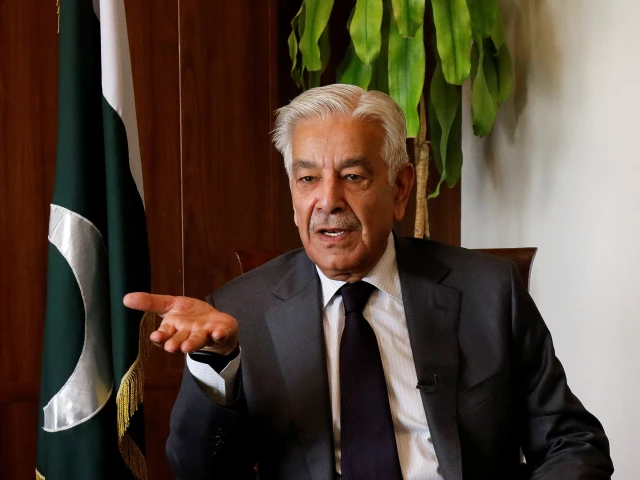
The Defense Minister says Pakistan’s stature has improved after the victory over India in Maarka-e-Haq last May.
Defense Minister Khawaja Asif on Friday expressed hope for a deal between the United States and Iran, saying Pakistan would be among the main beneficiaries of such a peace deal, with the “biggest benefit” being a secure border with Tehran.
His comments came amid a recent flare-up in the Gulf, where U.S. and Iranian forces clashed and the United Arab Emirates came under renewed attacks, threatening a month-long ceasefire and raising concerns about the prospects for a diplomatic resolution. The escalation came as Washington awaited Tehran’s response to a proposal aimed at ending the conflict, which began with joint US-Israeli airstrikes across Iran on February 28.
Hopes for a deal resurfaced in recent days after the United States conveyed a proposal through Pakistani mediation, and Washington expected an Iranian response on Friday. US Secretary of State Marco Rubio said this could lead to a serious negotiation process.
Read: Rubio says the United States should receive a response from Iran today
Speaking on a private television show Naya PakistanAsif said that due to the success in last year’s conflict against India, the nation seemed more confident than a year ago.
“About a year ago, there was an uncertain situation, even on the security front and in various other aspects. We were facing multiple problems at that time, and those problems still exist, I don’t deny it,” he said.
“As far as security is concerned, we now have much more confidence thanks to our armed forces,” he added.
Speaking about Pakistan’s mediation role in the Iran-US war, he said Pakistan had a historical, geographical and religious relationship with Iran, adding that the two countries shared multiple ties that had been handled with balance.
He further said that diplomatically, Pakistan had managed to convince the United States to accept a ceasefire aimed at restoring peace in the region. “We will also be one of the main beneficiaries of this peace,” he added.
While expressing hope that a deal would be reached between the two warring parties, he said that if sanctions were lifted after a deal with Iran, Pakistan would be able to source various commodities (currently coming from international markets) directly from Iran through land routes, including gas and oil.
“The biggest benefit would be that our border would become secure, from where terrorism has occasionally infiltrated our territory,” he said, adding that the border with Afghanistan remains insecure and talks in this regard are also underway with China.
He attributed Pakistan’s recent rise in stature to what he described as the country’s “historic victory” over India a year ago through Operation Bunyanum Marsoos and Marka-e-Haq.
Read also: ‘No one can harm Pakistan; We are prepared to respond to any aggression’: DG ISPR
“Through this, we have gained international recognition as a nation that can bring an enemy six times its size to its knees,” he said, adding that the dividends of that result were still benefiting Pakistan today as several world powers and neighboring countries had developed trust in Pakistan as an “honest negotiator.”
Terming the victory at Marka-e-Haq as a decisive success, he said it had significantly boosted national confidence as Pakistan had crossed a psychological barrier by proving that it could take on and defeat India, and the world recognized those efforts. “Even President Trump has maybe mentioned 70 to 80 times how many Indian planes were shot down,” he added.
He said that historically the world had not treated Pakistan and India equally, but after the victory, not only were both countries treated equally, but in some cases Pakistan was viewed more favorably. “We have become an option, both diplomatically and militarily. Pakistan is now accepted as a power to be reckoned with,” he said.
Replying to a question, he said India had also realized that the problems could be resolved through diplomatic engagement with Pakistan. However, he added that the Indian Prime Minister, given his Hindutva mindset and ideological backing, would never accept this as it would undermine his political narrative.
“Voices are emerging within India that recognize that in this conflict India was defeated, Pakistan had the advantage and that in the future these issues should be resolved peacefully,” he said.
He also alleged that India was engaged in a proxy war against Pakistan through Afghanistan, and described the Afghan actors as representatives of what he called India’s Hindutva-driven approach, which he said had “nothing to do with religion.”
“Afghans are being used by extremist Hindutva thought to create unrest along our western border,” he said.
He said India’s ultimate strategy was to surround Pakistan on all sides, but added that Pakistan’s relations with Iran were strong and secured its 1,100-kilometre border.
He further said that if a negotiated settlement was reached with Afghanistan and cross-border terrorism was stopped, Pakistan would be in a stronger position to deal with India with all flanks secured.


