
Sargodha AQI 344, Faisalabad 296, Multan 287, Gujranwala 274, Kasur 257, Sheikhupura 245
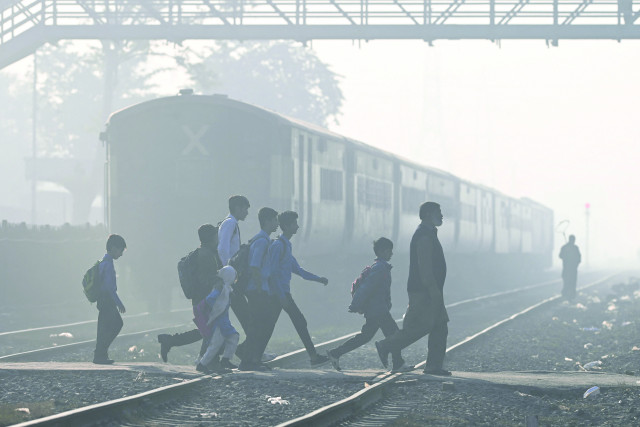
Schoolchildren walk along a railway track shrouded in dense smog in Lahore. Photo: AFP
Air pollution levels in Punjab have once again reached alarming levels, with Lahore on Wednesday topping the list of the world’s most polluted cities. According to global air monitoring agency IQAir, the city’s overall air quality index (AQI) was recorded at 403 in the morning, a level considered “dangerous” for human health. In comparison, India’s capital New Delhi recorded an AQI of 235.
Data from the Punjab Environment Department revealed that air quality in several parts of Lahore deteriorated to dangerous levels early in the morning. The highest readings were seen at Kahna Nau, GT Road and Egerton Road, where AQI levels peaked at 500, the maximum possible limit in the “extremely dangerous” category.
Other localities also reported serious pollution: Shahdara at 391, DHA Phase 6 at 371, Burki Road at 361, Multan Road at 344 and Safari Park at 339. Punjab University area recorded 303, while Wahga border had relatively cleaner air with a reading of 176.
In other parts of Punjab, the situation was equally grim. Sargodha reported an AQI of 344, Faisalabad 296, Multan 287, Gujranwala 274, Kasur 257, Sheikhupura 245, Dera Ghazi Khan 217, Sialkot 162, Bahawalpur 154 and Rawalpindi 130.
According to the Environmental Protection Agency (EPA), Lahore’s average AQI on Wednesday is expected to remain between 245 and 275. The agency predicted a sharp rise in pollution between 6 am and 9 am, due to heavy traffic and a drop in temperature, and the AQI is likely to rise to 315-340 during those hours. Conditions are expected to improve slightly around midday, with an AQI possibly falling to 180 between 12pm and 5pm, before worsening again in the evening, potentially reaching 345 by 11pm.
Experts predict that Lahore’s temperature over the next 24 hours will range between 20°C and 31°C, with wind speeds varying from 1 to 10 kilometers per hour. Increased vehicle emissions, open burning of waste and dust have led to an increase in suspended particulate matter (PM10), which contributes significantly to worsening air quality.
Global air quality data sets indicate that October and November have consistently been the most polluted months in Lahore for the past four years. In October 2022, the city’s average AQI was 182, with 19 days classified as “unhealthy.” While October 2023 saw some improvement with an average of 128, November that year again shot up to 205. The averages for 2024 were recorded at 163 in October and 184 in November, while in 2025, the two-month average settled at around 171. Notably, during these four years, Lahore did not witness a single day with “good” air quality.
The city’s average annual AQI has remained persistently high (184 in 2022, 121 in 2023, 126 in 2024 and 117 in 2025), indicating that pollution levels, although fluctuating, continue to pose serious risks to public health.
Ali Ejaz, deputy director of the Environmental Protection Agency in Lahore, attributed the seasonal increase in pollution to stubble burning, vehicle emissions and changing weather conditions. He said that while the government has introduced several measures to curb smog, lasting improvement requires both strict enforcement and public cooperation. He urged citizens to wear masks, avoid burning waste and ensure proper maintenance of vehicles to minimize emissions.


